What the CIS Poll Means for Property and Luxury on the Costa del Sol
The official pre-electoral survey, released as the campaign opened, gives the PSOE 33.3 per cent and leaves the PP and Vox short of a majority. Most other recent polls do not. The election was called after Congress rejected two housing decrees. An impartial look at what each plausible outcome would mean for property and luxury on the Costa del Sol.
By Wellington Almeida · Updated 13 NOV 2026
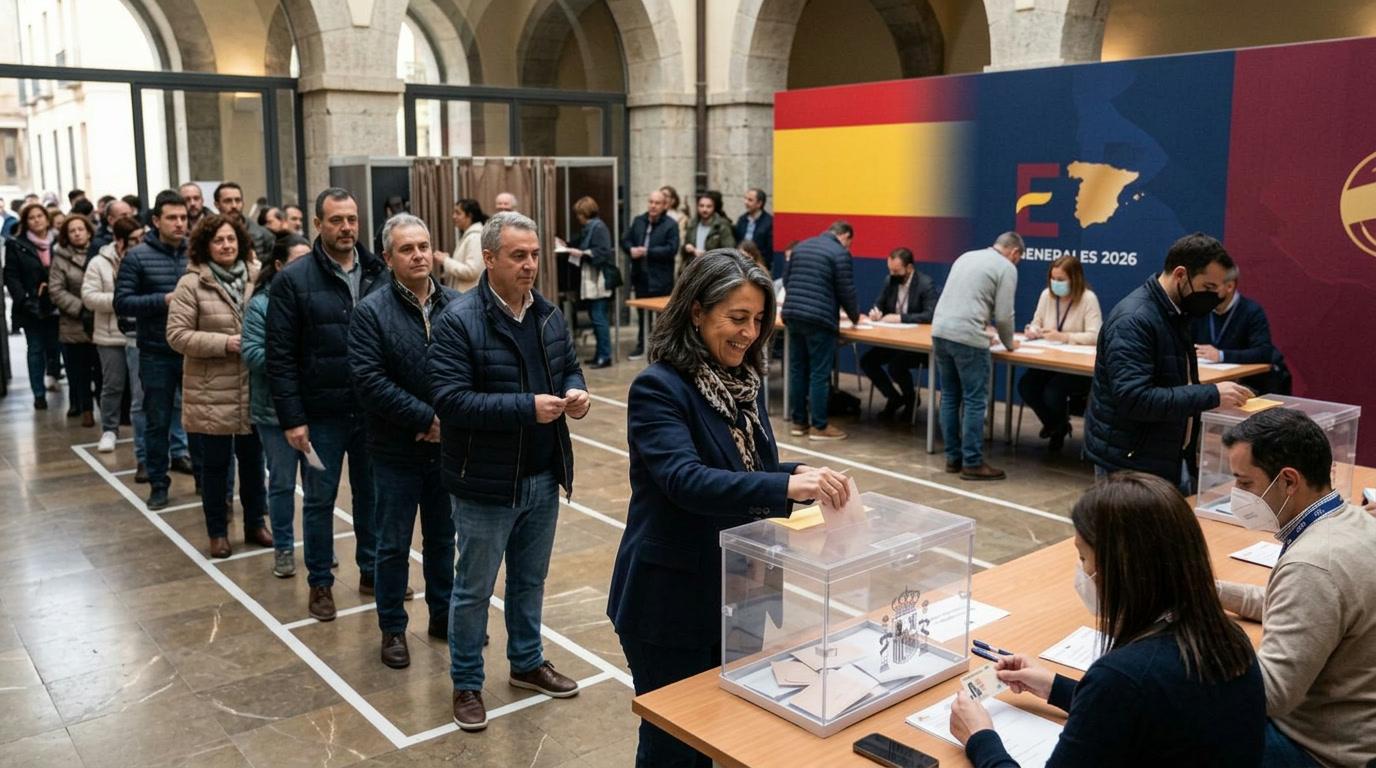
Generales 2026
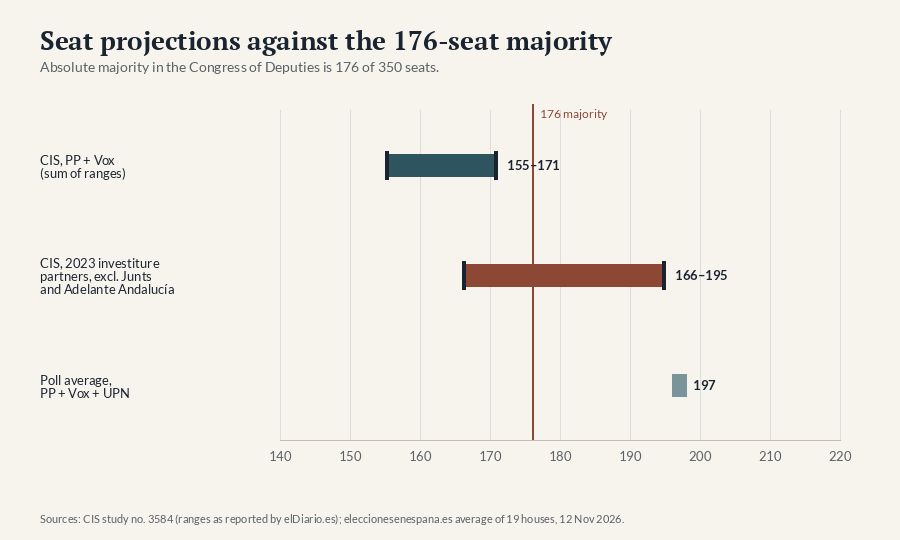
On Thursday 12 November, as the campaign for Spain's general election opened, the Centro de Investigaciones Sociológicas released its pre-electoral study. The official survey, study number 3584, gives the Partido Socialista Obrero Español 33.3 per cent of the valid vote and a range of 134 to 143 seats in the Congress of Deputies. The Partido Popular is placed on 25.5 per cent and 98 to 106 seats, Vox on 18.4 per cent and 57 to 65. Added at the top of those two ranges, the PP and Vox reach 171 seats, five short of the 176 needed for an absolute majority. At the bottom, they reach 155.
A poll is not a result. This one also sits apart from almost every other recent survey of the same election. The vote is on 29 November. The Cortes were dissolved in early October after Congress rejected two housing decree-laws, with the PP, Vox and Junts voting against. Housing is the reason the election was called before the end of the term, and why the figures matter on a coast where foreign buyers take a far larger share of sales than they do in Spain as a whole.
What the official survey says, and what the others say
The CIS interviewed 45,074 people by telephone between 7 and 30 October, in 4,190 municipalities across the 50 provinces and the two autonomous cities. For the sample as a whole, it puts the sampling error at plus or minus 0.5 percentage points, at a 95.5 per cent confidence level. Fieldwork began two days after the election was called and ended two days after the rail accident at Urda, in Toledo.
Behind the three national parties, the CIS gives Frente Amplio 4.7 per cent and 7 to 11 seats, the joint ERC-Podemos list in Catalonia 3.1 per cent and 10 to 14, and Adelante Andalucía 1.5 per cent and 3 to 4. Junts is on 1.2 per cent and 2 to 4 seats; EH Bildu, Compromís, the BNG and the PNV fill out the remainder. These are estimates of the valid vote. The raw share of respondents who named a party, calculated over the census, was lower: 28.7 per cent for the PSOE, 17.2 per cent for the PP and 15.0 per cent for Vox.
The CIS says the seat ranges are the 5th and 95th percentiles of its simulations, covering the central 90 per cent of the scenarios it ran, and that they are not a sampling error. It also warns that those ranges should not be added as if they were a joint forecast. The additions widely reported this week, including in the elDiario.es account of the study, are a journalistic convenience. Even on that reading, the official survey does not give Alberto Núñez Feijóo a majority with Vox. On the same basis, the parties that supported Pedro Sánchez's investiture in 2023, leaving out Junts and Adelante Andalucía, would span 166 to 195 seats.
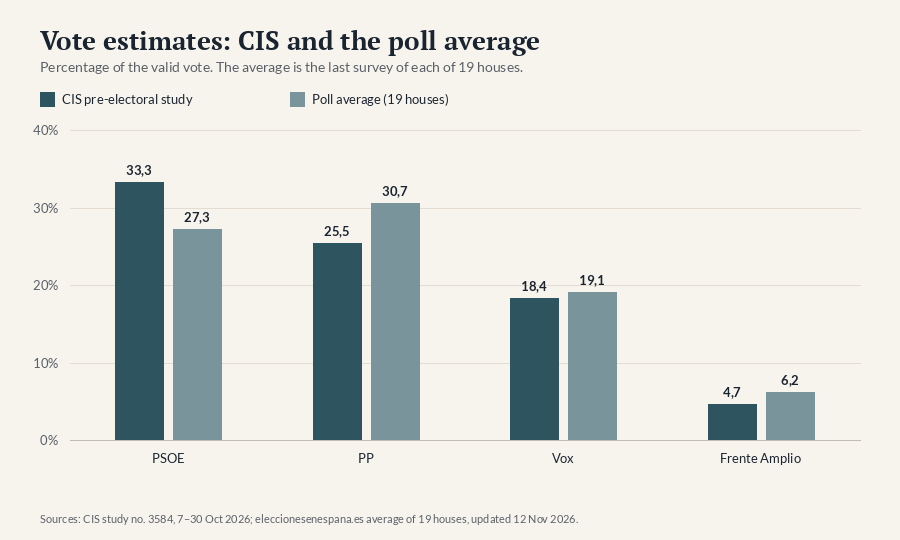
Most private pollsters have been describing a different parliament. A simple average compiled by eleccionesenespana.es, taking the latest survey from each of 19 houses with fieldwork in the 21 days to 8 November, and last updated on 12 November, puts the PP first on 30.7 per cent and about 129 seats, the PSOE on 27.3 per cent and about 110, and Vox on 19.1 per cent and about 66. That average includes the CIS itself, so the official study is already pulling the PSOE up and the PP down. Even so, the same compilation gives the parties that voted against the 2023 investiture, the PP, Vox and UPN, about 197 seats, well above 176. GAD3, for ABC, with fieldwork on 3 to 5 November, gave the PP 31.9 per cent and 136 seats and the PSOE 25.9 per cent. 40dB, for El País and Cadena SER, produced a tighter race, with the PP on 31.9 per cent and the PSOE on 29.9. SW Demoscopia, which works for La Séptima, has been the main private exception, placing the PSOE first in several recent waves. None of these figures is a result.
In Málaga province, which elects 11 deputies, the CIS range would give the PP four seats, the PSOE three or four, Vox two or three, and Adelante Andalucía one. RTVE, working from the same study, noted that Málaga is one of only two provinces, with A Coruña, in which the official survey puts the PP clearly first.
Why the figures matter on this coast
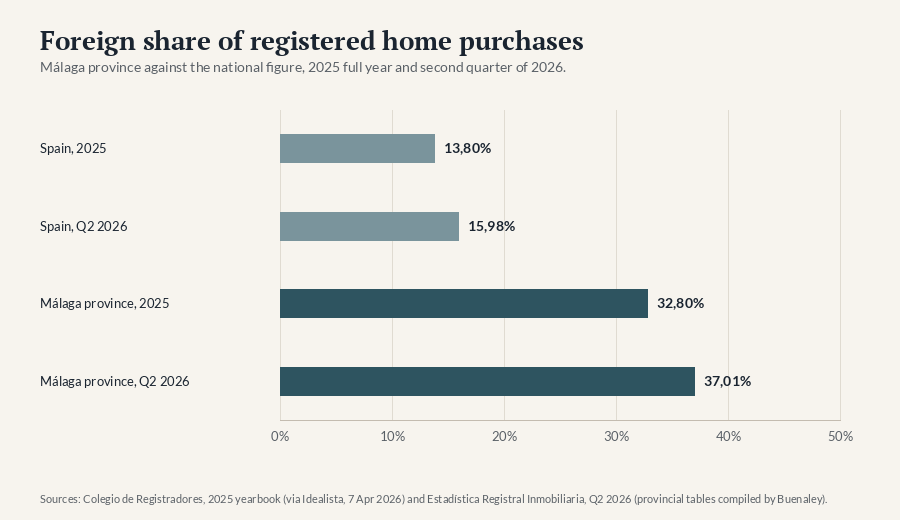
The Costa del Sol is not a typical Spanish housing market, and a change in the rules that govern foreign demand would not land evenly across the country. In 2025, according to the yearbook of the Colegio de Registradores, reported by Idealista on 7 April 2026, foreign buyers accounted for 32.8 per cent of registered home purchases in Málaga province, 11,827 transactions. Only Alicante had a higher share. The national figure was 13.8 per cent. In the second quarter of 2026 the gap widened. The registrars' quarterly statistics, published on 5 August, put the national foreign share at 15.98 per cent, a series record, with a little more than 26,800 purchases. The provincial tables from the same statistics, compiled by the Buenaley data observatory, put Málaga at 37.01 per cent, or 3,474 purchases, 20.79 per cent more than in the same quarter of 2025.
A provincial average is not a street-by-street reading. Inland towns dilute the share; the corridor west of the city, through Mijas, Marbella, Benahavís and Estepona, carries most of it. Nationality is not the same as residence: a foreign passport can belong to someone who has lived in the province for years, or to a buyer who will spend three weeks a year in the house. Non-resident foreigners, when they do buy, pay more. The same second-quarter statistics put their average at €3,493 per square metre, against €1,971 for Spanish buyers.
Asking prices have followed that demand. Idealista's October figures, reported by El Español on 10 November, put the provincial average at €4,322 per square metre. Marbella was the dearest municipality, at €5,974, followed by Benahavís at €5,534 and Estepona at €5,070. Those levels, and the way the market has tilted towards Estepona and Mijas as well as the established prime belt, have already been set out in this publication's account of the coastal realignment and in its earlier report on how international buyers continue to shape the prime market.
The luxury trade around those sales is wider than the notaries' ledger. Agencies, architects, interior studios and hotels all depend on people who can still enter, buy, rent and spend. A tax or a rental rule written in Madrid can move a completion on this coast more quickly than it would in a province where foreign demand is a rounding error.
The policy file that will be opened after the 29th
The national Housing Law of 2023 allows regional governments to declare "tensioned" residential markets and to cap rents there. Andalucía has not declared any. The regional housing minister, Rocío Díaz, told the Andalusian parliament this autumn that the Junta did not accept making that declaration a condition of state housing funds, and that the region's preference is to add supply rather than to intervene in private rents. In a province where staff housing is already a constraint on hotels, the absence of a cap is a relief for landlords and a problem for tenants. The Junta is not on the ballot on the 29th.
The Golden Visa closed to new applicants on 3 April 2025. Buying a home of €500,000 or more no longer confers residency. Álvaro Botella, president of The Leading Property Agents of Spain, told Málaga Hoy at the time that visa-driven purchases accounted for about 5 to 7 per cent of transactions on the Costa del Sol, and that most foreign purchases were second homes or buyers who intended to settle. The abolition has not, on the evidence of 2025 and early 2026, removed foreign demand from the provincial figures.
A much larger shock did not become law. On 13 January 2025 the prime minister announced a tax of up to 100 per cent of the value of a home bought by a non-resident from outside the European Union. A Socialist bill followed in May. Residence, not nationality, was the test, so a British, American, Swiss or Gulf buyer living outside the EU would have been in scope. New homes subject to VAT were excluded; resales were not. Reuters reported in March 2026 that the bill had stalled for lack of votes. It had not been debated by the time the Cortes were dissolved in October, and pending bills lapsed. It is not in force. A future government would have to table a new text and carry it. The same lapsed package foresaw raising VAT on holiday apartments to 21 per cent. Andalucía already requires tourist dwellings to be inscribed in the regional tourism register and to comply with municipal planning rules. Tighter fiscal treatment would cut yields on a certain class of investment apartment and could shift some overnight demand into hotels.
The PP, in the programme described by Europa Press on 10 November, says it would repeal the Housing Law, aim to add a million homes in a legislature, pass a new land law, and resolve new-build licences within three months. For buyers under 40 it would cut VAT on a first new home from 10 per cent to 4 per cent, and seek a cut in transfer tax on resale homes. Vox also wants the Housing Law repealed and land liberalised, with a super-reduced or, if Brussels allowed it, a zero rate of VAT on a primary home, and a full rebate of transfer tax reserved to Spanish buyers. It would abolish the wealth tax and inheritance tax, and it proposes a differentiated tax on purchases by non-EU buyers, with the proceeds used to fund relief for Spanish purchasers. In that respect, and only in that respect, its offer sits closer to the Socialist surcharge than to the PP's published programme, which does not contain an equivalent levy.
The PSOE has not withdrawn the ideas in last year's housing package: 21 per cent VAT on tourist apartments, a state tax on non-resident non-EU buyers, higher tax on Socimis that do not offer enough affordable lets, and a steeper local tax on empty homes. Frente Amplio, on 28 October, proposed a tax on the accumulation of housing, from the first property for companies and from the fourth for individuals. Those are proposals, not statutes. Andalucía already rebates the regional wealth tax for most taxpayers. The national Temporary Solidarity Tax on Large Fortunes, designed to reach the largest estates in regions that had lowered or removed their own tax, remains in force in 2026. A government of the right could be expected to try to repeal it; a government of the left, to keep it.
Pros and cons, by plausible outcome
Three outcomes are plausible, and they are not equally so in every poll. The official survey points to a renewed left-led government, possibly without Junts. The weight of the private polls points to a PP result that would still need Vox to reach 176. A hung parliament, or a repeat election, is the residual risk if the night matches neither script.
If a PSOE-led government is returned
Pros
- Continuity in the present national framework would at least be familiar to lawyers and agents already working with the Housing Law, the Golden Visa's closure and the tourist-rental register.
- A revived tax on non-resident non-EU buyers, or higher VAT on holiday lets, could, if it were passed and if it reduced purely speculative demand, ease some pressure on mid-market stock that local workers now struggle to rent. That is the stated purpose of the measures. Hotels could also gain custom if some apartments left the short-let market.
- Andalucía's refusal to declare tensioned zones would still stand unless the Junta changed its mind, so the sharpest national rental controls would not automatically apply on this coast.
Cons
- The 100 per cent tax, if reintroduced in a similar form, would fall heavily on non-resident buyers from the United Kingdom, the United States, Switzerland and the Gulf, a much larger part of this market than of Spain as a whole. New-build sales subject to VAT were excluded from the lapsed bill; resales were not. Even if the tax never returns, the possibility that it could be tabled again will lead some buyers to postpone a completion.
- Twenty-one per cent VAT on tourist apartments would cut yields. A tax on accumulated housing, as proposed by Frente Amplio, would touch corporate landlords and, from a fourth property, private owners with a small portfolio.
- The Solidarity Tax would likely remain, a continuing cost at the upper end of the villa market.
If the PP and Vox obtain a majority
Pros
- Repeal of the Housing Law would remove the national rent-cap architecture and, in the PP's argument, some of the uncertainty that has kept dwellings off the long-term rental market. A faster land law and a three-month licence clock would matter to developers, if the administration actually hit the deadline.
- Lower VAT on first new homes for younger buyers, and a lower transfer tax on resales, would support a segment of domestic demand that has been crowded out on this coast.
- Repeal of the Solidarity Tax and, if Vox's programme were carried, of wealth and inheritance tax would reduce the holding cost of the largest estates. The 100 per cent surcharge on non-resident non-EU buyers would, on present PP texts, remain a lapsed bill.
Cons
- A majority of this kind would almost certainly be a coalition, not a PP government alone. Vox has proposed a differentiated tax on non-EU purchasers and would reserve its most generous transfer-tax rebate to Spanish buyers. The fine print of a coalition agreement would matter more than either manifesto.
- Repeal of rental controls, if it is not matched by a real increase in supply, could push long-term rents higher in towns that already struggle to house hotel and restaurant staff.
- Tighter treatment of tourist lettings is not only a left-wing idea; inspection of illegal listings has also been promised on the right. Licensed hotels might welcome it. Owners of legal short-lets would not.
If the parliament is hung, or the election is repeated
Pros
- No new tax and no repeal would pass quickly. For a buyer or a developer who can live with the present law, delay is a form of stability. Andalucía would continue, in the meantime, to set its own course on tensioned zones and the regional wealth-tax rebate.
Cons
- Unfinished business, above all the lapsed 100 per cent tax and the tourist-rental VAT rise, would remain available as bargaining chips in any investiture negotiation. Completions are postponed more easily than they are accelerated. A repeat election would extend that interval by months, and in a market where asking prices in Marbella already sit close to €6,000 per square metre, a winter of delayed decisions would be felt in agencies, notaries and the trades that finish houses.
- Buyers who need residency as well as a deed already face a more complicated path than they did before April 2025. A long political pause does not simplify the permit, the NIE, or the school search, work that firms such as EQUA Estates handle alongside the purchase itself, and that this publication has previously described for families moving to Marbella.
Until the night of the 29th
The CIS has produced the largest pre-electoral study of this campaign, and it describes a parliament in which the PP and Vox do not reach 176 seats. The rest of the polling field, with a couple of exceptions, describes the opposite. Both cannot be true on the night. Neither should be treated as a forecast of what a new government would actually pass. Majorities have to be assembled, bills have to be written, and regional governments, including the Junta de Andalucía, will still hold part of the housing file.
For the Costa del Sol the practical questions are narrower. Will non-resident buyers from outside the EU face a new tax? Will tourist apartments be charged as a business? Will the national rent-cap machinery be repealed, left in place, or extended into a region that has so far declined to use it? Will the holding cost of a large estate rise or fall? Those questions will be answered in legislation, not in a survey. Until then, the honest position for anyone buying, selling or advising on this coast is to plan for more than one outcome, and to read a poll as a poll.
The professional firms that work in that interval, in conveyancing, tax, architecture and property management, are listed in this publication's directory. Houses that want to be considered for it can apply to the Black Book.
From the journal
Related articles
Getting Work in the Costa del Sol's Luxury Corridor
Málaga's hospitality sector employed a record 120,848 people in August 2026, and hotels still cannot fill every post. A reported guide to pay, permits and where to apply, from Málaga to Sotogrande.
12 NOV 2026

Fashion & Automotive Branding: How Luxury Brands Are Redefining the Value of Real Estate on the Costa del Sol
From Dolce & Gabbana-designed residences in Marbella to Lamborghini-inspired villas in Benahavís, the intersection of fashion, automotive design and luxury property is creating a new category of high-value real estate in southern Spain.
10 NOV 2026
International Buyers Continue to Shape the Luxury Property Market on the Costa del Sol
International buyers continue to shape the Costa del Sol's premium property market. From Marbella's exclusive villas to Estepona's growing residential developments, discover the locations, buyer profiles and market trends attracting overseas property investors.
03 NOV 2026
Live from the coast
Related wire dispatches
Marbella Remains Málaga's Dearest Market As Coastal Asking Prices Diverge
Idealista's October figures, reported by El Español on 5 November, put Marbella at €5,974 per square metre and Estepona at €5,070, while Cómpeta recorded the province's steepest annual rise, of 31.7 per cent.
Costa del Sol Hoteliers Press Next Government on Power, Water, Housing and Transport
Aehcos, the Costa del Sol hoteliers' association, has launched 'Toca mirar por Málaga', a campaign asking Spain's next government to invest in six areas: electricity capacity, access to housing, transport, water, territorial balance and the coast, including completion of the Senda Litoral.
Malaga Home Sales Fall for a Third Straight Quarter as Foreign Buyers Take Nearly 39%
Home sales in Málaga province fell 3.5% in the 12 months to September, the third consecutive quarterly decline in Colegio de Registradores data. Foreign buyers accounted for 38.83% of purchases, up from 34.3% in the first quarter, making Málaga Spain's second most international market after Alicante.