International Buyers Continue to Shape the Luxury Property Market on the Costa del Sol
International buyers continue to shape the Costa del Sol's premium property market. From Marbella's exclusive villas to Estepona's growing residential developments, discover the locations, buyer profiles and market trends attracting overseas property investors.
By Mistral & Marea · Updated 03 NOV 2026
Costa del Sol's premium property
The Costa del Sol has developed into one of Europe's most recognisable destinations for international property investment. Its appeal extends well beyond the traditional image of a Mediterranean holiday destination. For an increasingly diverse group of overseas buyers, the southern Spanish coastline represents a place to establish a permanent residence, acquire a second home, diversify an investment portfolio or secure a lifestyle that combines favourable weather, established infrastructure and access to an international community.
From the established luxury neighbourhoods of Marbella to the expanding residential developments of Estepona, the exclusive hillside properties of Benahavís and the increasingly attractive residential areas of Mijas and Benalmádena, international demand continues to influence the character and direction of the regional property market.
British, French, Italian and American buyers are among the nationalities showing interest in premium Spanish homes. Their motivations are not identical, and neither are their expectations. Some prioritise privacy, architectural design and large outdoor spaces, while others are more interested in proximity to international schools, healthcare facilities, airports, restaurants and year-round services. There are also buyers who approach the market primarily from an investment perspective, assessing rental potential, long-term capital appreciation and the relative attractiveness of Spanish property compared with other European destinations.
What connects these different groups is the perception that the Costa del Sol offers something increasingly difficult to find in many major European cities: a combination of residential comfort, international connectivity, outdoor living and a substantial selection of properties across different price categories.
For estate agencies, developers, property consultants and investors, understanding these changing motivations is becoming essential. The international luxury market is no longer driven exclusively by holiday-home purchases. It is increasingly influenced by relocation decisions, family requirements, wealth diversification and a growing preference for properties that can accommodate both permanent and seasonal lifestyles.
The result is a property market in which international buyers are not simply purchasing homes. They are helping shape the residential development, commercial activity and long-term positioning of the Costa del Sol.
The Costa del Sol's international appeal goes beyond tourism
For decades, the Costa del Sol has attracted visitors from across Europe, particularly from the United Kingdom and Northern Europe. Many initially discovered the region through holidays, golf trips, coastal resorts or extended winter stays. Over time, a proportion of these visitors developed a stronger connection with the area, eventually considering property ownership.
That transition from visitor to homeowner remains an important part of the regional property market.
However, the profile of the international buyer has evolved. The market now includes entrepreneurs, executives, remote professionals, retirees, families with children and internationally mobile individuals who may divide their time between several countries.
The ability to work remotely has also changed the traditional relationship between employment and residential location. A buyer who previously needed to remain close to an office in London, Paris, Milan or another major European city may now have greater flexibility when choosing where to live. For some, relocating to southern Spain becomes a practical option rather than simply an aspirational lifestyle decision.
The Costa del Sol benefits from several advantages that support this transition.
Málaga Airport provides connections to numerous European destinations and important international markets. The region has an established hospitality industry, private healthcare providers, international schools, sports facilities and a wide selection of restaurants and leisure venues. Málaga city itself has developed into a significant centre for technology, culture, education and business.
These elements matter because international buyers considering permanent relocation tend to evaluate a destination differently from someone purchasing a holiday apartment.
A beautiful coastline might attract initial interest, but access to healthcare, reliable transport, education, professional services and everyday amenities can determine whether a buyer ultimately commits to living there.
The Costa del Sol has spent decades developing the infrastructure required to accommodate an international residential population. That established ecosystem gives the region an advantage over destinations that may offer attractive scenery but lack comparable year-round services.
For the premium property sector, this creates an opportunity to appeal to buyers seeking more than a seasonal retreat.
Marbella remains the reference point for luxury property

When discussing high-end residential property on the Costa del Sol, Marbella remains the name that carries the greatest international recognition. Its reputation has been built over several decades through a combination of exclusive residential communities, luxury hospitality, international events, golf courses, marinas and a well-established social scene.
For overseas buyers, Marbella offers a familiar proposition. It is a destination with an existing international property market, a substantial network of professional services and a lifestyle that has attracted wealthy individuals from different parts of the world.
The Golden Mile continues to represent one of the most recognisable addresses in the region. Its proximity to the coastline, luxury hotels, restaurants and established residential communities makes it particularly attractive to buyers seeking a prestigious location. Sierra Blanca, Nueva Andalucía, La Zagaleta and the surrounding residential areas offer different interpretations of luxury living, from contemporary architectural villas to traditional Mediterranean estates and gated developments with extensive security and privacy.
Puerto Banús also remains an important part of Marbella's international identity. Although its reputation is closely associated with luxury shopping, yachts and nightlife, the surrounding residential market attracts buyers who want convenient access to restaurants, beaches, sporting facilities and entertainment.
However, Marbella's appeal should not be reduced to its most recognisable addresses.
International buyers are increasingly considering the wider municipality, including areas where larger properties, more privacy and different architectural styles may be available. Some prefer established neighbourhoods with mature gardens and traditional villas, while others are attracted to newly constructed homes with modern layouts, energy-efficient systems and integrated technology.
The premium market is also becoming more demanding. Buyers accustomed to luxury residential markets in London, Paris, New York or Milan often arrive with clearly defined expectations. They may want generous indoor and outdoor spaces, professional property management, advanced security, wellness facilities, home automation and the ability to accommodate guests without compromising privacy.
For estate agencies, this means that selling a Marbella property requires more than presenting attractive photographs and quoting the number of bedrooms. International purchasers often expect detailed information about construction quality, ownership costs, community regulations, maintenance requirements and the surrounding area.
The quality of the purchasing experience can be just as important as the property itself.
Estepona is developing a stronger position in the premium residential market
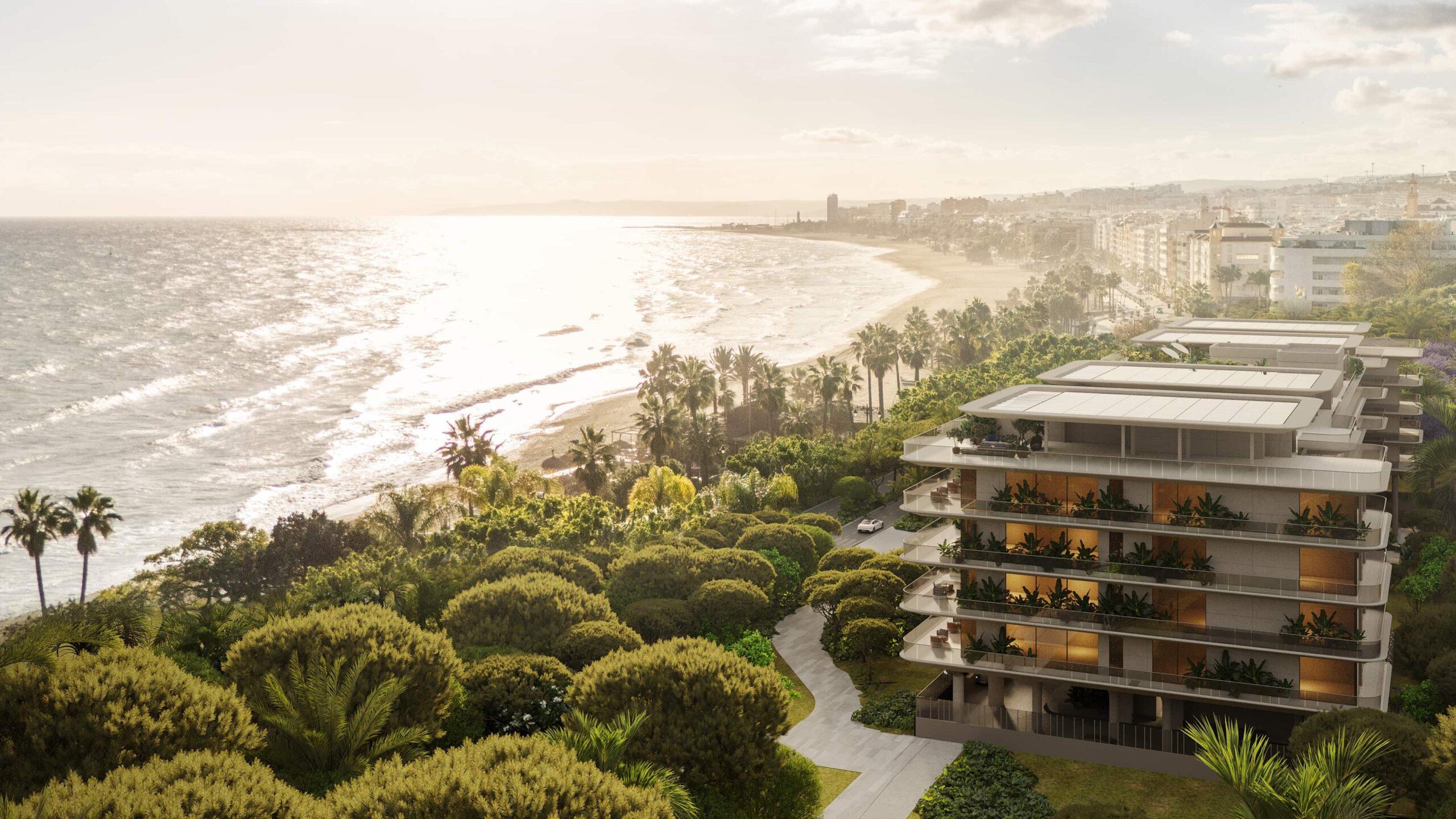
Estepona has undergone a significant transformation over recent years, strengthening its position as one of the most interesting residential destinations on the western Costa del Sol.
Traditionally regarded as a quieter alternative to Marbella, the municipality has invested heavily in its urban environment, public spaces, coastal infrastructure and cultural offering. Its historic centre, pedestrianised streets, flower-filled squares and renovated public areas have helped establish a distinctive identity that appeals to both residents and visitors.
This evolution has coincided with growing interest from international property buyers.
One of Estepona's strongest advantages is its ability to offer several different residential experiences within the same municipality. Buyers can choose between apartments close to the town centre, beachfront developments, golf-oriented communities, contemporary villas and larger properties in more private residential areas.
The New Golden Mile, stretching towards Marbella, has become particularly relevant for premium residential investment. Its position between established luxury destinations, combined with access to beaches, golf courses and hospitality facilities, makes it attractive to international purchasers who want the benefits of the Marbella area without necessarily purchasing within Marbella itself.
Areas such as El Paraíso, Cancelada, Atalaya and the surrounding residential communities offer a variety of property types and price points. Further inland, buyers can find properties with larger plots, elevated positions and open views across the Mediterranean.
The diversity of the local market is important. Not every international buyer wants a multimillion-euro mansion. Some are searching for a modern three-bedroom apartment with a terrace, swimming pool and convenient access to daily services. Others want a detached villa with sufficient space for extended family visits, remote working and year-round living.
Estepona is particularly well positioned to accommodate this range of requirements.
Its appeal is also connected to the development of Málaga province as a place to live rather than simply visit. International residents increasingly consider access to education, healthcare, supermarkets, restaurants, sports facilities and transport when selecting a property. Estepona's growing residential population and expanding commercial infrastructure contribute to that proposition.
For property agencies, the opportunity lies in communicating the differences between individual neighbourhoods rather than presenting Estepona as a single, uniform market.
A buyer looking for beachfront living will have different priorities from someone interested in a golf community or a secluded villa. Understanding these distinctions can make the difference between a generic property enquiry and a serious purchasing conversation.
Benahavís attracts buyers looking for privacy, space and exclusivity

Benahavís occupies a particularly interesting position within the Costa del Sol's luxury property landscape.
Although it does not have the coastal profile of Marbella or Estepona, its residential communities have established an international reputation among buyers seeking privacy, substantial properties and an environment removed from the busiest tourist areas.
The municipality is home to some of the region's most exclusive residential developments, including La Zagaleta, El Madroñal and Monte Mayor. These communities attract buyers interested in large villas, extensive plots, controlled access and panoramic views.
For certain international purchasers, these characteristics are more important than being within walking distance of a beach or restaurant.
Privacy has become an increasingly significant consideration in the luxury residential sector. High-net-worth individuals may prioritise secure entrances, discreet surroundings, private gardens and the ability to enjoy a property without constant exposure to neighbouring developments or public spaces.
Benahavís offers an environment particularly suited to these requirements.
Its elevated residential locations also provide a different relationship with the landscape. Rather than looking directly onto the coastline, many properties enjoy views across mountains, valleys, golf courses and the Mediterranean in the distance.
The architectural character of the area is equally varied. Traditional Andalusian estates coexist with contemporary villas featuring expansive glass façades, minimalist interiors, infinity pools and sophisticated outdoor entertainment areas.
The location also offers convenient access to Marbella, San Pedro de Alcántara and the wider coastal road network. This balance between relative seclusion and access to established commercial centres is an important part of its appeal.
However, Benahavís presents specific considerations for buyers. A property located several kilometres inland or on a hillside may involve greater dependence on private transport. Maintenance costs can also differ considerably depending on plot size, landscaping, swimming pools, security arrangements and community facilities.
For international buyers unfamiliar with the area, understanding these practical details is essential.
An attractive villa advertised with spectacular views may appear ideal during a short viewing trip, but the buyer should also consider everyday accessibility, driving times, local services and the long-term cost of maintaining the property.
Estate agencies that provide transparent, detailed information about these factors can build greater confidence among overseas purchasers.
Mijas and Benalmádena broaden the international buyer market

While Marbella, Estepona and Benahavís frequently dominate discussions about luxury real estate, Mijas and Benalmádena deserve equal attention when examining the broader international property market.
Both municipalities offer residential environments that appeal to overseas buyers, although their characteristics and market positioning differ.
Mijas is particularly diverse. Its territory includes the traditional whitewashed village of Mijas Pueblo, the residential communities of Mijas Costa and the increasingly popular coastal area of La Cala de Mijas.
For international buyers, this diversity creates several possibilities.
Mijas Pueblo appeals to those who appreciate traditional Andalusian architecture, elevated views and a quieter village atmosphere. Mijas Costa offers a broader selection of residential developments, golf communities, villas and apartments. La Cala de Mijas has developed into a particularly attractive location for buyers looking for a combination of coastal living, restaurants, shops and access to recreational facilities.
Its location between Fuengirola and Marbella also makes it practical for residents who want to remain connected to the wider Costa del Sol.
Benalmádena has a different proposition. Its proximity to Málaga Airport and the city of Málaga makes it particularly convenient for international residents who travel frequently or need access to metropolitan services.
The municipality includes several distinct environments, from the traditional streets of Benalmádena Pueblo to the coastal residential areas and the marina.
Puerto Marina is one of its most recognisable landmarks, providing a strong leisure and tourism identity. Meanwhile, residential areas such as Torrequebrada attract buyers interested in established communities, golf facilities and proximity to the sea.
Benalmádena's accessibility is an important competitive advantage. For a British family travelling regularly between Spain and the United Kingdom, or an American buyer maintaining professional commitments abroad, reducing travel friction can influence the purchasing decision.
These municipalities also demonstrate why the Costa del Sol should not be marketed exclusively through Marbella.
International purchasers have different budgets, family requirements and lifestyle expectations. An agency capable of presenting suitable alternatives across several municipalities can provide a more useful service than one focused entirely on a single prestigious postcode.
British buyers remain an important part of the market
The British connection with the Costa del Sol is deeply established.
For generations, British visitors have travelled to southern Spain for holidays, golf, winter escapes and extended stays. Many have developed personal connections with the region, making property ownership a natural next step.
British buyers are not a homogeneous group. Their motivations range from retirement and second-home purchases to permanent relocation, family investment and the acquisition of properties intended for occasional use.
For retirees, the appeal often includes climate, outdoor activities, access to healthcare, established expatriate communities and the possibility of maintaining an active social life.
Families may have different priorities. International education, proximity to sports clubs, safe residential environments and access to everyday services can become more important than being directly on the beachfront.
Younger professionals and entrepreneurs may also consider the Costa del Sol as a base for remote work, particularly if they can maintain business relationships with the United Kingdom while enjoying a different residential environment.
There are, however, practical considerations that British buyers must address.
Following Brexit, British nationals face different immigration and residency arrangements from European Union citizens. Buyers considering permanent relocation should understand the relevant visa and residency requirements rather than assuming that purchasing property automatically provides a right to live in Spain indefinitely.
Tax residency is another important consideration. Spending time in Spain can have tax implications depending on individual circumstances, income sources and the applicable tax rules.
Currency movements can also influence purchasing decisions. A buyer transferring substantial funds from pounds sterling into euros may find that exchange-rate changes affect the effective cost of a property.
For this reason, the purchasing process often involves more than an estate agent and a solicitor. Currency specialists, tax advisers, mortgage brokers and immigration professionals may all play a role.
Agencies that recognise these concerns and maintain relationships with qualified professionals can provide a more comprehensive experience.
French and Italian buyers bring different expectations
France and Italy have long-standing cultural and commercial connections with Spain, and buyers from both countries form part of the international residential market.
For French purchasers, the Costa del Sol can offer an appealing alternative to expensive residential markets in parts of France, particularly for those interested in coastal living, favourable weather and access to international transport.
Some French buyers are attracted by the region's established hospitality sector and Mediterranean lifestyle. Others are looking for second homes that can accommodate extended family visits or provide a base for spending several months each year in Spain.
The French-speaking international community is also relevant. Although English is widely used across the Costa del Sol's property and hospitality industries, being able to communicate in French can help agencies build stronger relationships with clients who prefer to conduct complex financial or legal discussions in their native language.
Italian buyers share some of these motivations, particularly the attraction of Mediterranean living and the possibility of acquiring a property in a well-connected international destination.
For Italian purchasers, architectural quality, outdoor spaces, food culture, proximity to the coast and access to restaurants can be significant considerations.
There may also be interest in properties that provide a balance between residential use and occasional holiday accommodation, although any rental strategy must be assessed against the applicable regulations and the property's specific permissions.
One important point is that buyers from France and Italy should not automatically be grouped together simply because they share an EU background.
Their purchasing criteria can vary substantially according to family circumstances, financial position, professional commitments and intended use of the property.
For estate agencies, this reinforces the importance of understanding the individual client rather than relying on nationality-based assumptions.
American buyers are adding another dimension to the luxury market

The growing international visibility of the Costa del Sol has also created opportunities to attract buyers from the United States.
American purchasers may approach the Spanish property market with expectations shaped by high-value residential markets such as Miami, Los Angeles, New York and other major metropolitan areas.
Some are attracted by the Mediterranean lifestyle, while others see Spain as an opportunity to acquire a European residence that provides access to multiple countries and international destinations.
The Costa del Sol has several characteristics that can appeal to this group.
Large contemporary villas, private outdoor areas, swimming pools, panoramic views and high-quality hospitality facilities offer a familiar concept of luxury living, although the architectural and residential environment differs from many American markets.
For some American buyers, the appeal also lies in the possibility of spending extended periods in Europe without committing to the cost of purchasing property in major European capitals.
Málaga's international airport, the region's established private healthcare sector and the availability of international education are additional considerations for families and professionals.
However, American purchasers may require more detailed guidance through the Spanish purchasing process.
The legal structure of property ownership, taxes, inheritance arrangements, financing and residency requirements can differ considerably from what buyers are accustomed to in the United States.
Currency conversion also introduces another consideration. A property priced in euros can become more or less expensive in dollar terms depending on exchange-rate movements.
Buyers may need advice from professionals familiar with cross-border tax matters, particularly when maintaining financial interests in the United States while acquiring Spanish real estate.
For agencies targeting this segment, the quality of information and the ability to coordinate an international purchasing process can be decisive.
A premium property presentation is important, but it needs to be supported by accurate documentation, clear communication and an understanding of the concerns associated with overseas ownership.
What international luxury buyers expect from a property in 2026
The definition of luxury residential property has changed considerably.
Location and size remain important, but modern buyers increasingly assess the overall experience of living in a property.
A large villa with an attractive exterior may generate initial interest, yet its long-term appeal will depend on how well it accommodates the owner's daily requirements.
Several features are becoming particularly relevant.
1. Privacy and security
Privacy is one of the most valuable characteristics in the premium property market.
International buyers may want gated access, secure parking, surveillance systems, discreet entrances and residential surroundings that offer separation from public areas.
This is especially relevant for high-profile individuals, entrepreneurs and families who spend considerable time travelling.
2. Outdoor living
The Mediterranean climate makes outdoor space a central part of residential life.
Large terraces, landscaped gardens, swimming pools, outdoor kitchens and shaded dining areas can significantly influence purchasing decisions.
For many overseas buyers, the ability to enjoy outdoor living throughout much of the year is one of the main reasons for considering the Costa del Sol.
3. Contemporary architecture and interior design
Buyers increasingly expect properties to combine visual appeal with practical functionality.
Open-plan layouts, natural light, high-quality materials, spacious kitchens and integrated indoor-outdoor living areas are common features in modern luxury developments.
Architectural consistency and construction quality are also important, particularly for buyers comparing Spanish properties with premium developments in other international markets.
4. Home technology
Smart-home systems are becoming an increasingly familiar feature of high-end residential properties.
Automated lighting, climate control, security systems, remote access and energy management can make properties easier to operate, particularly for owners who spend only part of the year in Spain.
Remote monitoring is particularly useful for second-home owners who need reassurance that their property remains secure and properly maintained while they are abroad.
5. Energy efficiency and sustainability
Energy performance is becoming more relevant as buyers consider long-term ownership costs and environmental impact.
Solar installations, efficient heating and cooling systems, insulation, intelligent irrigation and water-management solutions can contribute to a more sustainable property.
In southern Spain, water efficiency is especially important. Landscaping that requires excessive irrigation may create additional maintenance costs and environmental concerns.
Buyers are increasingly likely to ask questions about energy ratings, utility consumption and the practical performance of installed systems.
6. Wellness and recreational facilities
Private gyms, saunas, wellness rooms, swimming pools and landscaped relaxation areas have become attractive additions to luxury residential properties.
Some buyers also place considerable importance on proximity to golf courses, tennis facilities, walking trails, beach clubs and high-quality fitness centres.
This reflects a wider change in the way people evaluate residential locations. The property itself is important, but so is the lifestyle available within a reasonable distance.
7. Space for remote working
A dedicated office or flexible workspace has become a valuable feature.
International buyers may continue managing businesses, consulting clients or working for companies based in other countries.
A quiet office with reliable high-speed internet can therefore be just as important as a swimming pool or entertainment room.
For families, additional flexible rooms can also accommodate visiting relatives, children or domestic staff.
The difference between purchasing a holiday home and relocating permanently
One of the most important developments in the international property market is the distinction between buyers looking for occasional accommodation and those intending to establish a permanent residence.
Although both groups may be interested in similar properties, their decision-making processes can be very different.
A holiday-home purchaser might prioritise proximity to beaches, restaurants, golf courses and entertainment. The property may remain unoccupied for several months each year, making security, maintenance and property management particularly important.
A permanent resident, on the other hand, is more likely to examine the surrounding neighbourhood, access to supermarkets, healthcare, schools, public transport and everyday services.
This distinction can have a substantial impact on which municipalities and residential communities attract different types of international buyers.
For example, someone purchasing a second home for summer holidays might prefer a beachfront apartment in Marbella or Benalmádena. A family relocating from London could be more interested in a spacious villa in Estepona or Mijas, with sufficient room for children, home offices and visiting relatives.
A buyer seeking privacy and a substantial property may find Benahavís more suitable.
These differences demonstrate why property agencies should avoid treating all international enquiries as equivalent.
Understanding the intended use of a property should be one of the first steps in the sales process. It allows agents to narrow down suitable locations, establish realistic budgets and present properties that genuinely correspond to the client's expectations.
It also reduces the time spent arranging viewings for properties that may look attractive online but are unsuitable for the buyer's actual requirements.
Financing, taxation and the practical side of buying property in Spain
The Costa del Sol's international property market also operates within a financial and regulatory environment that overseas buyers must understand.
Purchasing a Spanish property involves more than agreeing on a price and signing a contract. International purchasers need to consider the legal status of the property, applicable taxes, registration procedures, financing arrangements and the costs associated with ownership.
Cash purchases remain relevant in the luxury sector, particularly among buyers who are financially established and prefer to avoid mortgage arrangements. However, not every international purchaser pays entirely in cash.
Some buyers explore Spanish mortgage products, while others consider financing through their home country or existing investment structures.
The availability and conditions of mortgage finance can depend on residency status, income, existing liabilities, nationality and the lender's assessment of the applicant.
Buyers should also account for the additional expenses associated with a property transaction.
These may include property transfer tax on qualifying resale purchases, VAT and stamp duty on qualifying new-build transactions, notary fees, land registration, legal advice and mortgage-related expenses where applicable.
The exact amounts depend on the type of property and the applicable regional and national rules.
For foreign purchasers, currency movements can add another layer of complexity. A British buyer transferring pounds sterling, for example, may face a different effective purchase price depending on the exchange rate at the time funds are converted.
The same applies to American buyers purchasing in euros with dollars.
Another important consideration is the distinction between owning property and obtaining residency rights.
Purchasing a home in Spain does not automatically grant a foreign national permission to reside in the country indefinitely. Non-EU buyers must assess the immigration routes available to them, while EU citizens benefit from different residence arrangements.
Tax residency also requires careful consideration. An individual who spends significant time in Spain may have tax obligations that extend beyond the property itself.
For this reason, independent legal and tax advice should form part of the purchasing process.
Estate agencies can help coordinate the transaction and introduce buyers to qualified professionals, but they should not replace independent legal or financial advice.
For international clients, having access to reliable information from the beginning can make the difference between a straightforward transaction and a stressful experience.
The importance of professional estate agencies in an increasingly international market
As the Costa del Sol attracts buyers from a wider range of countries, the role of estate agencies is becoming increasingly important.
International purchasers frequently begin their search online, often months before visiting Spain. They may compare properties across several municipalities, review different agencies and communicate with multiple agents before deciding which properties deserve a viewing.
This creates a competitive environment in which presentation, responsiveness and the quality of information can influence purchasing decisions.
A professional agency needs to do more than maintain a portfolio of available properties.
It must understand the characteristics of the local market, identify suitable properties for different types of clients and communicate effectively with people who may have little previous experience of buying real estate in Spain.
Language capabilities are one part of this equation.
English remains particularly important, but French, Italian and other languages can provide a competitive advantage when dealing with international clients.
Equally important is the ability to explain local differences.
A buyer unfamiliar with the Costa del Sol may not understand the practical distinction between Marbella, Nueva Andalucía, San Pedro de Alcántara, Estepona, Benahavís and Mijas.
An experienced agent should be able to explain not only the location of a property but also its surroundings, accessibility, lifestyle characteristics and potential disadvantages.
This is particularly relevant in the luxury market, where a buyer may be committing a substantial amount of capital.
The purchasing experience should be supported by accurate property descriptions, high-quality photography, professional video presentations, clear floor plans and detailed information about ownership costs.
Virtual viewings can also be useful, particularly when clients are based overseas and cannot immediately travel to Spain.
However, digital presentation should complement rather than replace professional advice and physical inspections.
For agencies, the objective should be to establish trust before a prospective buyer arrives in the region.
Digital marketing is changing how luxury properties reach international buyers

The international property market has become increasingly digital.
A prospective buyer in London, Paris, Milan or New York can discover a luxury villa in Estepona, compare its specifications with similar properties in Marbella and arrange a virtual viewing without leaving home.
This has changed the relationship between estate agencies and their potential clients.
Traditional property portals remain important, but they are no longer the only route through which international buyers discover opportunities.
Search engines, social media, specialist property publications, video platforms, digital newsletters and targeted online campaigns all contribute to property discovery.
For agencies operating in the premium sector, an effective digital presence can become a significant competitive advantage.
Search engine visibility
Search engine optimisation is particularly relevant for agencies targeting international buyers.
A prospective purchaser might search for phrases such as:
Luxury villas for sale in Marbella.
Modern properties for sale in Estepona.
Exclusive homes in Benahavís.
Sea-view villas on the Costa del Sol.
Luxury apartments near Puerto Banús.
Investment properties in Mijas Costa.
These searches demonstrate different levels of purchasing intent.
Someone searching for general information about the Costa del Sol may simply be researching the destination. Someone searching for a four-bedroom villa in a specific neighbourhood may already be considering a purchase.
Agencies that publish useful, location-specific content can improve their visibility among people actively researching the market.
However, successful SEO requires more than repeating keywords throughout property descriptions.
Content should answer real questions about locations, property types, ownership costs, neighbourhood characteristics and the purchasing process.
Detailed area guides, local market reports and informative property articles can help establish an agency as a knowledgeable source of information.
Social media and property presentation
Social media has also become an important channel for luxury real estate marketing.
Instagram, Facebook, YouTube and other platforms allow agencies to present properties through photography, video tours, lifestyle content and local destination features.
Short-form video can be particularly effective for showcasing architectural details, panoramic views, outdoor areas and the surrounding environment.
However, there is a difference between attracting attention and generating qualified enquiries.
A video that receives thousands of views may produce little commercial value if the audience is not interested in purchasing property.
Agencies should therefore evaluate marketing performance using more meaningful indicators, including qualified enquiries, viewing requests, buyer conversations and completed transactions.
The objective is not simply to make properties popular online. It is to reach individuals who have the financial capacity and genuine intention to purchase.
Websites and lead generation
A professional website remains one of the most valuable digital assets an estate agency can maintain.
For international buyers, the website is often the first opportunity to evaluate an agency's credibility.
Property search functionality, accurate descriptions, high-quality imagery, mobile optimisation, clear contact information and straightforward enquiry processes all contribute to the experience.
Multilingual websites can also help agencies communicate with buyers from different markets.
A French or Italian purchaser should not have to navigate an entire website in English if the agency intends to target those audiences.
The same applies to the quality of the content. Poor translations, incomplete property information and outdated listings can undermine confidence.
A website should also provide useful information beyond individual property advertisements. Location guides, buying advice, local lifestyle articles and market updates can help attract prospective purchasers who are still evaluating the Costa del Sol.
For agencies competing for high-value international clients, digital marketing should be viewed as part of the sales operation rather than an optional promotional expense.
What this means for property developers and investors
The continued presence of international buyers creates opportunities for property developers, although it also raises the importance of understanding demand before launching new projects.
Luxury residential developments require substantial investment, and the expectations of international purchasers can influence everything from architectural design to the selection of facilities and the positioning of a development.
A project aimed at buyers seeking permanent residences may require a different approach from one designed primarily for holiday-home purchasers.
Developers targeting families may place greater emphasis on practical layouts, storage, private gardens, proximity to schools and convenient access to everyday services.
Projects aimed at high-net-worth individuals may prioritise privacy, architectural distinction, security, wellness facilities and personalised services.
The surrounding location is equally important.
A development can offer impressive architecture and extensive facilities, but its commercial success will also depend on its relationship with the wider area.
Access to restaurants, healthcare, beaches, golf courses, transport and established residential communities can influence how attractive a project appears to international buyers.
Investors should also distinguish between the long-term potential of a location and short-term market excitement.
Not every new development represents a sound investment, and not every premium property will deliver strong rental income or capital appreciation.
Construction quality, planning permissions, developer reputation, community costs, market competition and future supply all deserve attention.
The luxury segment can be particularly sensitive to differences in product quality. Buyers paying premium prices generally expect a level of construction, finishing and service that justifies the asking price.
For investors, independent valuation and professional legal due diligence remain essential.
Challenges facing the Costa del Sol property market
Despite its international appeal, the Costa del Sol is not immune to the challenges affecting residential markets across Spain and Europe.
One of the most significant issues is affordability.
Strong international demand can contribute to higher property prices, particularly in highly desirable locations where available land is limited.
This can create a growing separation between the purchasing power of international buyers and the budgets of local residents.
The issue is particularly relevant in established coastal municipalities where housing demand includes both permanent residents and international purchasers.
Housing affordability has therefore become an important part of the wider discussion about the future development of the region.
Another challenge concerns the availability of suitable properties.
International buyers looking for large villas in established neighbourhoods may discover that the selection is limited, particularly when they have specific architectural or location requirements.
New developments can help expand the available supply, but construction must be balanced with infrastructure, environmental considerations and the long-term needs of local communities.
Water management is another important issue.
The Costa del Sol has experienced periods of water scarcity, making efficient consumption and responsible urban development increasingly relevant.
Luxury developments featuring extensive landscaped gardens, private swimming pools and large outdoor areas need to consider water efficiency as part of their long-term operating model.
Transport infrastructure also deserves attention.
Although Málaga Airport and the coastal road network provide important connections, congestion can become a problem during busy periods, particularly in heavily populated coastal areas.
For international residents, convenient access to employment centres, healthcare, education and transport remains an important consideration.
Finally, the regulatory environment surrounding property rentals deserves careful attention.
Buyers intending to generate income through holiday rentals should verify the applicable national, regional and municipal requirements, as well as community rules and any licensing obligations.
The assumption that every residential property can automatically be operated as a holiday rental can lead to serious financial and legal complications.
These challenges do not eliminate the Costa del Sol's appeal, but they demonstrate why informed purchasing decisions are becoming increasingly important.
The outlook for international property demand
The Costa del Sol enters the final months of 2026 with a property market that continues to benefit from international recognition and an established residential ecosystem.
Marbella remains the region's most internationally recognised luxury destination, while Estepona continues to strengthen its position as a residential alternative with an increasingly sophisticated offering.
Benahavís retains its appeal among buyers seeking privacy and substantial properties. Mijas and Benalmádena provide additional opportunities for international purchasers looking for coastal living, accessibility and established residential communities.
The diversity of these municipalities is one of the region's strongest advantages.
Rather than relying on a single type of buyer, the Costa del Sol can appeal to different international markets with different budgets, requirements and purchasing motivations.
British buyers remain an important audience, while French, Italian and American purchasers contribute to a broader international profile.
However, the direction of demand will depend on several external factors.
European economic conditions, interest rates, currency movements, geopolitical developments and the availability of suitable properties can all influence purchasing decisions.
Changes to immigration arrangements, taxation and property regulations may also affect the attractiveness of Spain for certain categories of overseas buyers.
It would therefore be premature to assume that international demand will increase indefinitely or that every municipality will experience the same market performance.
The distinction between individual locations and property categories will remain important.
A well-positioned contemporary villa in an established luxury community may attract a very different level of interest from an overpriced apartment in a less desirable location.
Buyers are becoming more informed, and access to international property information makes it easier to compare prices, specifications and locations.
This places greater pressure on sellers and agencies to justify asking prices through the quality of the property, its location and the overall purchasing proposition.
For serious investors, the emphasis should remain on fundamentals rather than assumptions about future price growth.
Why local knowledge will matter more than ever
As the Costa del Sol becomes increasingly international, the value of genuine local knowledge should not be underestimated.
Overseas buyers may arrive with a general understanding of Marbella, Estepona or Málaga, but they often need assistance identifying the neighbourhoods that best match their expectations.
Two properties located within the same municipality can offer completely different lifestyles.
A beachfront apartment, a golf-side townhouse and a detached villa in the hills may all be advertised as Costa del Sol properties, but their practical advantages, maintenance requirements and potential uses can differ substantially.
An experienced estate agent should be able to explain these distinctions clearly.
This includes providing honest information about the surrounding environment, accessibility, construction standards, community fees, ownership costs and any relevant restrictions.
For international buyers, a reliable local contact can also help coordinate property viewings, legal advice, financial services and other aspects of the purchasing process.
The agencies most likely to establish lasting relationships with overseas clients will be those that understand the entire journey, from the initial online enquiry to the completion of the transaction and beyond.
There is also an opportunity for agencies to maintain relationships with buyers after the purchase.
Property management, maintenance, renovation coordination, interior design, relocation assistance and rental management can all become additional services.
For clients who live abroad for part of the year, having a trusted local representative can be particularly valuable.
This creates opportunities for agencies to develop recurring business rather than relying exclusively on individual property transactions.
Conclusion: An international market with several distinct opportunities
The Costa del Sol's position as an international property destination has been built over decades, but the market continues to evolve.
The region is no longer simply a place where European holidaymakers purchase apartments for summer use. It has developed into a residential destination capable of attracting families, entrepreneurs, professionals, retirees and high-net-worth individuals from several continents.
Marbella continues to provide the strongest international luxury identity, while Estepona is establishing itself as an increasingly sophisticated residential destination. Benahavís remains attractive to buyers seeking exclusivity and privacy, and Mijas and Benalmádena offer different combinations of coastal living, accessibility and residential infrastructure.
British, French, Italian and American purchasers are among the international groups contributing to this market, although their individual motivations and requirements vary considerably.
For developers, the opportunity lies in creating properties that respond to the expectations of modern international buyers while taking account of the long-term needs of the surrounding communities.
For investors, careful selection of location, property quality, legal status and ownership costs will remain essential.
For estate agencies, the challenge is to combine local expertise with international marketing capabilities, professional communication and a genuine understanding of the purchasing process.
The agencies that succeed will not necessarily be those with the largest property portfolios. They will be those capable of identifying the right opportunities, reaching qualified buyers and providing reliable guidance throughout the transaction.
Ultimately, the Costa del Sol's competitive advantage is not based on sunshine and sea views alone. It is the combination of its international connectivity, established residential communities, Mediterranean lifestyle, hospitality infrastructure and diverse property offering.
As overseas buyers continue to evaluate where they want to live, invest and spend their time, the region has an opportunity to strengthen its position among Europe's leading premium residential destinations.
The next stage of growth, however, will depend on maintaining the qualities that made the Costa del Sol attractive in the first place: a high standard of living, well-planned development, accessible services and a residential environment that offers genuine value beyond the property itself.
From the journal
Related articles
Costa del Sol Property Market Realignment: Why Estepona and Mijas Continue to Attract Buyers Despite a Changing Market
Why moderating sales volumes do not mean falling prices: an operational breakdown of market realignment, cash buyers, and prime values in Estepona and Mijas.
29 OCT 2026

The Real Difference Between a Broker and an Advisor in Marbella Real Estate
An operational guide to Marbella real estate: understanding the critical differences between brokers and advisors in inventory filtering, fees, and legal risk.
19 OCT 2026

What the CIS Poll Means for Property and Luxury on the Costa del Sol
The official pre-electoral survey, released as the campaign opened, gives the PSOE 33.3 per cent and leaves the PP and Vox short of a majority. Most other recent polls do not. The election was called after Congress rejected two housing decrees. An impartial look at what each plausible outcome would mean for property and luxury on the Costa del Sol.
13 NOV 2026
Live from the coast
Related wire dispatches
Marbella Remains Málaga's Dearest Market As Coastal Asking Prices Diverge
Idealista's October figures, reported by El Español on 5 November, put Marbella at €5,974 per square metre and Estepona at €5,070, while Cómpeta recorded the province's steepest annual rise, of 31.7 per cent.
Malaga Home Sales Fall for a Third Straight Quarter as Foreign Buyers Take Nearly 39%
Home sales in Málaga province fell 3.5% in the 12 months to September, the third consecutive quarterly decline in Colegio de Registradores data. Foreign buyers accounted for 38.83% of purchases, up from 34.3% in the first quarter, making Málaga Spain's second most international market after Alicante.
Marbella Offers Council Land for More Than 500 Price-Capped Rental Homes
Marbella will make municipal land available for more than 500 homes for rent at capped prices and has set aside €6 million in its draft 2027 budget to co-finance protected housing with the Junta de Andalucía. The council aims to mobilise up to €50 million in funding from several administrations.