Getting Work in the Costa del Sol's Luxury Corridor
Málaga's hospitality sector employed a record 120,848 people in August 2026, and hotels still cannot fill every post. A reported guide to pay, permits and where to apply, from Málaga to Sotogrande.
By Anna Kuznetsova · Updated 12 NOV 2026

Early morning in a resort service courtyard on the Costa del Sol.
In August 2026, 120,848 people in Málaga province were affiliated to Social Security in hospitality. The Asociación de Hosteleros de Málaga (Mahos), citing figures from the Ministry of Inclusion, Social Security and Migration, called it a record. By October the total had eased to 112,446, still 4.9 per cent higher than a year earlier. The province is now the fourth-largest hospitality employer in Spain, behind Madrid, Barcelona and the Balearic Islands, and accounts for about a third of Andalusia's hospitality jobs.
The record has not closed the gap. Hotels still report unfilled posts, a shortage of trained candidates, and rents that, in the assessment of the Asociación de Empresarios Hoteleros de la Costa del Sol (AEHCOS), can take 40 to 45 per cent of a worker's pay. Demand along the corridor from Málaga to Sotogrande is real. So are the constraints: housing, seasonality, language, and, for anyone from outside the European Union, a permit system that treats a waiter's vacancy differently from a ship's cook.
A labour market that peaks in August and tightens in the autumn
The headline affiliation figures cover the whole of hospitality, not only five-star resorts. Hotel employment, a narrower measure, tells a similar story. According to the Andalusian regional government, working from Instituto Nacional de Estadística (INE) data and reported in October by Diario Sur, hotels in Málaga province employed 22,718 people in July to September, 10.7 per cent more than a year earlier, with occupancy of 77.13 per cent, the highest of any Andalusian province. From January to September, those hotels recorded 18,243,766 overnight stays, 38.5 per cent of the Andalusian total, with average occupancy of 67 per cent and 19,295 people on the books, a 13 per cent rise in hotel jobs.
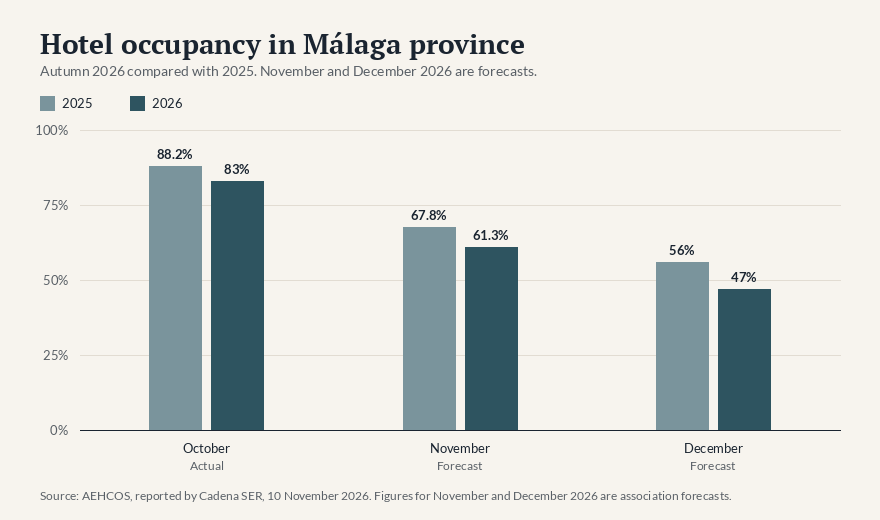
The season still turns. AEHCOS told Cadena SER on 10 November that provincial hotel occupancy in October was 83 per cent, 4.5 points below October 2025. More than eight in ten of those guests were international. The association's forecasts for the rest of the year are 61.3 per cent in November and 47 per cent in December, both well below the same months in 2025. Hiring follows that curve. Many contracts are permanent-discontinuous (fijo discontinuo), a form that appears in current listings on AEHCOS Talent, and applications for the summer peak often begin in late winter.
The tighter constraint is not only the calendar. In April 2026, Javier Hernández, executive vice-president of AEHCOS, told Cadena SER that hotels were struggling to recruit anyone who did not already live in the same municipality or a neighbouring one. Unions, he said, had told the association that three in four workers arriving from other provinces could not find a home, and that rent at 40 to 45 per cent of pay "often does not compensate" for the move. Some hotels have begun to offer staff rooms or to look for rented flats, but Hernández said most properties are not set up to house employees. The pressure is sharpest in Málaga city, Torremolinos, Benalmádena and Marbella.
Housing is now part of the same problem as unfilled posts and pay. Anyone arriving to take a job will need a realistic plan for where to live. Firms that advise on renting and relocation, including EQUA Estates, work that stretch of the market. The questions that sit beside a job offer are set out in our earlier guide to buying in Marbella with a family.
Five-star hotels and restaurants: openings, shortages and the wage floor
The luxury end of the market is adding inventory, but not all of it is hiring tomorrow. Lanserhof, the medical and wellness group, is building its first southern European resort in the grounds of Finca Cortesin, near Casares: 71 rooms and suites, 2,900 square metres of medical space and 1,840 square metres of spa, wellness and fitness. The company says it will open in 2027 and that it began onboarding staff in the first quarter of 2026. Its careers page is already live, lists openings in medicine, hospitality and management, and states a clear language rule: new staff should be fluent in English and Spanish.
Wyndham Grand La Cala Golf Residences, operated by IDILIQ Hotels & Resorts, opened in October 2026 beside the fairways of La Cala Resort in Mijas: 30 two- and three-bedroom residences, with daily housekeeping and a concierge, and a gym and co-working space promised for 2027. It is a modest staffing need.
The St. Regis is a longer wait. On 20 October 2026, Platinum Estates and Sierra Blanca Estates announced an agreement with Marriott International for a 169-room St. Regis resort and 151 branded residences on the seafront at Las Dunas, in eastern Marbella. The developers said infrastructure works would start in 2026, that they expect to open in 2031, and that construction would involve more than 2,000 direct and 4,500 indirect jobs, with more than 450 posts once the resort is running. Those are the developers' figures, not a hiring schedule. Hotel jobs at The St. Regis Marbella are years away.
Until then, the working hotels are hiring in the ordinary way, and often struggling to do it. In March 2025, at the Emplea Turismo fair in Torremolinos, AEHCOS president José Luque said the Costa del Sol needed about 5,000 workers a year; that day's event was trying to fill some 1,800 vacancies. Javier Frutos, president of Mahos, told the same fair that the missing piece was trained staff, "the more solid base that comes from school." Carmen Sánchez, then the Junta's employment delegate in the province, said Andalusia's ten hospitality schools turn out 300 to 400 trained people a year, "perhaps not enough" given the number of new hotels. Local training partnerships, and schools such as Les Roches Marbella, have tried to close that gap.
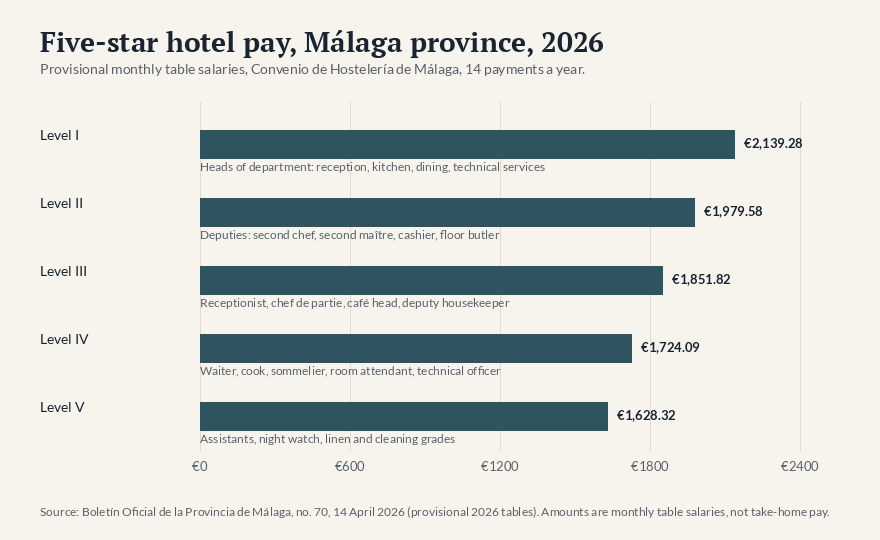
Pay, at least at the legal minimum for the job, is not a mystery. The Convenio Colectivo de Hostelería de Málaga (agreement code 29000945011981) is in force until 31 December 2027. Provisional salary tables for 2026 were published in the Boletín Oficial de la Provincia de Málaga, number 70, on 14 April 2026. They are about 2 per cent above the definitive 2025 tables and may be revised, up to a 3 per cent cap, if December inflation exceeds 2 per cent.
In a five-star hotel or apartment, the provisional 2026 monthly table salaries, paid over 14 instalments, run from €1,628.32 at Level V (assistants, night watch, linen and cleaning grades) to €2,139.28 at Level I (department heads, including head of reception, head chef, first maître and executive housekeeper with languages). Level IV, which covers waiters, cooks, sommeliers, room attendants and technical officers, is €1,724.09 a month. The annual table figures, before supplements, therefore run from about €22,796 to about €29,950. The working year in the agreement is 1,800 effective hours, with 30 calendar days of holiday and a vacation bonus of €1,589.06 in the hotel and guesthouse sections. The 2026 tables also set a uniform allowance of €59.44 a month where the employer pays cash instead of providing clothes, a meal allowance of €59.44, and a family-assistance supplement of €29.71, the last of these only where Social Security family benefits are already being paid. Night hours between 22:00 and 06:00 carry a 25 per cent supplement. Overtime is paid at a 75 per cent uplift, or taken as time off in lieu at 1 hour 45 minutes per extra hour. A distance allowance, in the form of public-transport fares, applies when the workplace sits outside the urban area of the employee's home town.
These amounts are the legal floor. A resort may pay above the table, and tips can change a monthly envelope.
A sommelier sits at Level IV on the table. The qualification that often accompanies that job can be taken locally: Iberian Wine Academy, an official Wine & Spirit Education Trust centre at Calle Eslava 13 in Málaga, runs the Level 2 and Level 3 wine awards. The Marbella Club's careers site was advertising a sommelier post in mid-November, alongside a technical-services team leader, salon roles and an internship in reservations. Several of the club's other live vacancies were for its Sierra Nevada properties, not the coast. It is worth reading the location line twice.
Prime real estate and branded residences
The same stretch of coast is also a dense market for agents, sales galleries, property managers and the lawyers who handle conveyancing for international buyers. Branded residences blur the line with hospitality: the St. Regis residences will eventually need a sales and aftercare team, and the 30 units at Wyndham Grand La Cala are already being run with housekeeping and a concierge. Day-to-day hiring is still concentrated in agencies, developers and the professional firms around them.
There is no single public wage table for this work, and commission arrangements vary too widely to summarise honestly here. The hiring filter is usually language, a demonstrable book of clients or local inventory, and a clean record with the tax and anti-money-laundering duties that come with handling deposits. Many offices recruit through their own sites and through LinkedIn rather than through hospitality boards. A job in this field often arrives with a housing question attached, either for the employee or for the client, which is why a firm such as EQUA Estates describes itself as a property and relocation advisory rather than as a simple brokerage.
Yachts and marinas
Puerto Banús, the marina at Sotogrande and the smaller harbours between them support a second labour market: deck and engineering crew, interior staff, shore-based marina operations, and charter companies. STCW basic safety training (in Spanish, formación básica en seguridad marítima) and a valid ENG1 medical certificate are the usual starting papers for crew. Yacht Pro Spain, which has a nautical school in Marbella and Fuengirola, lists basic maritime safety training among its professional courses, alongside GMDSS radio, yacht skipper and yacht captain.
One peculiarity of Spanish immigration law helps at sea and not on land. The official Catálogo de Ocupaciones de Difícil Cobertura for the third quarter of 2026, published in the Boletín Oficial del Estado on 2 September (BOE-A-2026-18504), includes ship cooks, ship waiters, passenger-ship assistants and ship stewards (mayordomos de buque) among merchant-navy occupations listed for all coastal provinces. It does not list land-based hotel cooks, waiters, receptionists or room attendants. For a third-country national, that distinction can decide whether a general work permit is open without a full labour-market test.
Crew jobs are still often filled through specialist yacht agencies and captain-to-captain recommendation. A candidate already able to work in the Schengen area has a simpler path than one who is not.
Private households and estate management
Behind the gates of Benahavís, the Golden Mile and Sotogrande sits a quieter payroll: housekeepers, butlers, nannies, private chefs, chauffeurs, household managers and estate managers. These roles are rarely advertised on public boards. Kensington Personnel has a Marbella office and says it places, and trains, household staff from Sotogrande to Málaga, after meeting each candidate in person. The White Glove, also based in Marbella, describes itself as a retained-search firm for UHNW households and family offices, handling estate managers and other senior domestic appointments, and states that it does not advertise private household vacancies publicly.
Pay in this sector is negotiated, often on a live-in or rota basis, and is not governed by the hospitality convenio. Anyone taking a private post should still insist on a written contract and an official Social Security registration (alta). Informal cash arrangements leave the worker uninsured.
Golf, wellness and longevity
Golf is both a seasonal employer and a year-round one. La Cala Resort in Mijas, with three courses, now has the Wyndham Grand residences next door and, at the end of November, hosts the Andalucía Costa del Sol Open de España. Event weeks bring short contracts in operations and hospitality; the clubs themselves hire shop staff, teaching professionals, greenkeepers and food-and-beverage teams through the year. Further west, Finca Cortesin and the Sotogrande clubs form a similar cluster. There is no public wage book for club professionals comparable to the hotel convenio.
Wellness is the faster-growing adjacent market. Lanserhof's Casares project is the clearest near-term hire in medicine and spa management. Further ahead, the conversion of the former Incosol hotel into Oakmond Marbella, scheduled to open in 2029, will add another medical-hospitality payroll, a shift already examined in this publication's account of longevity tourism on the coast. Therapists, nurses and spa managers will be hired against clinical credentials as much as against hotel experience.
Retail, interiors and design
Puerto Banús and the Golden Mile still employ shop-floor and management staff for international houses, jewellers and smaller boutiques. Hours follow the retail calendar rather than the hotel one. Most hiring is through the brand's own careers page or a local interview.
Interior design and furnishing sit closer to the property market than to hotels. New villas and apartments are often handed over empty, and studios hire designers and project managers who can work in English and Spanish and who understand delivery lead times from European workshops. One of the more concrete service models on the coast is the fixed-price furniture package, such as those offered from Mijas to Casares by Furniture Packages Marbella, which bundles design, supply, delivery, assembly and styling for two-bedroom homes from published starting prices.
Permits, the NIE and Social Security
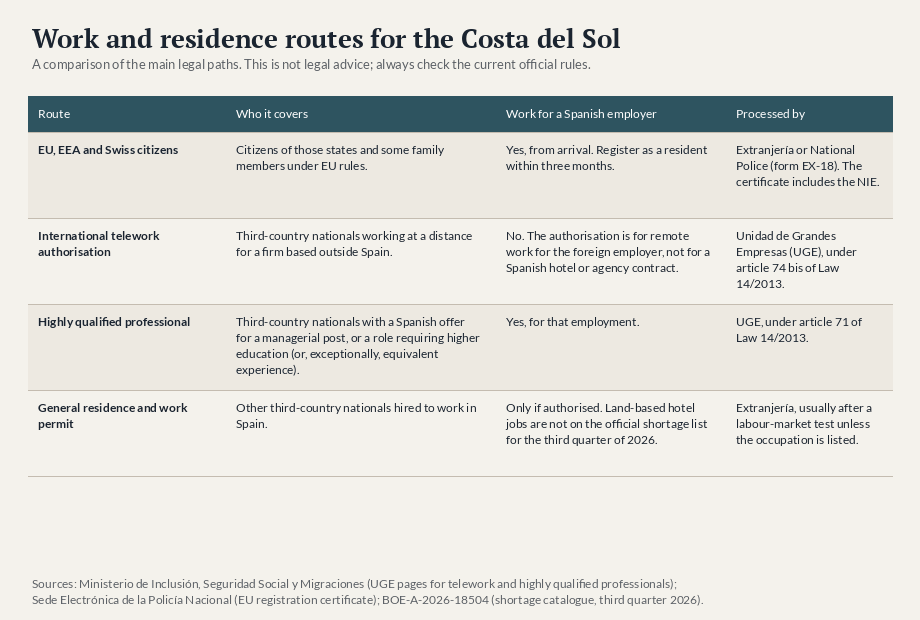
Citizens of the European Union, the European Economic Area and Switzerland may live and work in Spain without a prior permit. After three months they must register as residents, in person and by appointment, at the provincial Oficina de Extranjería or, where there is no such office, at the National Police, using form EX-18 and proof of payment of fee 790, code 012. A passport or national identity card is required, plus evidence of work (a contract or Social Security registration) or, if not employed, of sufficient resources and health insurance. The certificate is issued at the appointment and includes the Número de Identidad de Extranjero, or NIE, the identification number used for tax, banking and employment.
Third-country nationals need an authorisation before they can work. Two routes handled by the Unidad de Grandes Empresas y Colectivos Estratégicos (UGE) are often confused, and they are not interchangeable.
The international telework authorisation, created by article 74 bis of Law 14/2013 and marketed as a digital nomad visa, is for people who already work at a distance for a company based outside Spain. Applicants must usually show a relationship with that company of at least three months, and either a higher-education qualification or three years of relevant experience. Registration with Spanish Social Security is mandatory: an employed teleworker is enrolled by the foreign employer (or, where a bilateral agreement allows it, remains covered from the home country); a self-employed teleworker must register under the Special Regime for Self-Employed Workers (RETA). The authorisation does not, by itself, let the holder take a job at a Spanish hotel, restaurant or agency. The statutory detail is on the ministry's UGE page for international teleworkers.
The highly qualified professional authorisation, under article 71 of the same law, is the one that attaches to a Spanish job offer. It is available to a third-country national hired for a managerial post, or for work that requires a higher-education qualification, or, exceptionally, at least three years of equivalent professional experience. A head of department at a large resort, a senior asset manager or a medical director at a clinic is a more plausible fit than a seasonal waiter.
Everyone else falls under the general residence-and-work regime. Unless the occupation appears in the quarterly shortage catalogue, an employer must usually advertise the post through the public employment service and show that it could not be filled locally. As set out above, land-based hotel jobs are not on the list for the third quarter of 2026. It is a slower path, and many employers will not start it.
Once any of these routes is granted, two further numbers matter. The NIE is the identification number; if it was not issued as part of the residence procedure, it can be requested with form EX-15. Anyone staying more than six months on a residence authorisation should also obtain a Tarjeta de Identidad de Extranjero (TIE). Employment also requires a Social Security alta and a Número de Afiliación, handled by the employer for a contracted worker or through RETA for the self-employed. Working without that registration leaves both parties exposed, and can lead to a telework authorisation being withdrawn. The official pages of the UGE, the National Police and the provincial extranjería office are the ones to follow, because the forms change.
Where to apply
Start with the employer. Puente Romano keeps a careers site at careers.puenteromano.com. The Marbella Club uses careers.marbellaclub.com. Lanserhof's Marbella (Casares) page is on the group careers site. Marriott's jobs board is the right place to watch for St. Regis and Westin roles. Brand sites are usually the most current.
The hotel association's own platform, AEHCOS Talent, is the most specific public board for hotels in Málaga province. On 12 November 2026 it was carrying vacancies that included a technical officer, a receptionist, a gardener, a head chef and several kitchen and waiting posts at The Westin La Quinta Golf Resort & Spa in Benahavís. Some were permanent; at least one was listed as fijo discontinuo. Turijobs, InfoJobs and LinkedIn also carry hotel, agency and retail posts. The public employment service remains the formal channel when an employer needs to show that a post could not be filled locally.
Yacht crew should go through specialist agencies and verified captains, with STCW and ENG1 papers ready. Household and estate roles are more often filled by firms such as Kensington Personnel and, for senior retained searches, The White Glove. Real-estate and design studios hire through their own sites and through professional networks.
A short, specific curriculum vitae still does most of the work: the property or yacht, the dates, the role, the languages actually spoken, and the permit already held. A candidate who cannot legally start in the week the hotel needs them will usually lose the job to someone who can. The professional services around this labour market have their own directory. Firms that want to be considered for that roster can apply to the Black Book.
The corridor will keep adding rooms, berths and houses. Lanserhof is hiring now for 2027. The St. Regis will not need a front desk until the next decade. In between, the work of staffing a coast that already employs more than 100,000 people in hospitality continues against a housing market that has made recruitment local. The people who last here tend to arrive with their papers in order, a language they can work in, and a clear view of what the convenio actually pays, before the rent is deducted.
From the journal
Related articles

Relocating to Marbella With Your Family: What to Know About Buying Real Estate
A practical relocation guide for families buying in Marbella: neighbourhood selection, school commutes, legal due diligence, and ownership costs.
24 OCT 2026

What the CIS Poll Means for Property and Luxury on the Costa del Sol
The official pre-electoral survey, released as the campaign opened, gives the PSOE 33.3 per cent and leaves the PP and Vox short of a majority. Most other recent polls do not. The election was called after Congress rejected two housing decrees. An impartial look at what each plausible outcome would mean for property and luxury on the Costa del Sol.
13 NOV 2026

Fashion & Automotive Branding: How Luxury Brands Are Redefining the Value of Real Estate on the Costa del Sol
From Dolce & Gabbana-designed residences in Marbella to Lamborghini-inspired villas in Benahavís, the intersection of fashion, automotive design and luxury property is creating a new category of high-value real estate in southern Spain.
10 NOV 2026
Live from the coast
Related wire dispatches
Marbella Remains Málaga's Dearest Market As Coastal Asking Prices Diverge
Idealista's October figures, reported by El Español on 5 November, put Marbella at €5,974 per square metre and Estepona at €5,070, while Cómpeta recorded the province's steepest annual rise, of 31.7 per cent.
Costa del Sol Hoteliers Press Next Government on Power, Water, Housing and Transport
Aehcos, the Costa del Sol hoteliers' association, has launched 'Toca mirar por Málaga', a campaign asking Spain's next government to invest in six areas: electricity capacity, access to housing, transport, water, territorial balance and the coast, including completion of the Senda Litoral.
Malaga Home Sales Fall for a Third Straight Quarter as Foreign Buyers Take Nearly 39%
Home sales in Málaga province fell 3.5% in the 12 months to September, the third consecutive quarterly decline in Colegio de Registradores data. Foreign buyers accounted for 38.83% of purchases, up from 34.3% in the first quarter, making Málaga Spain's second most international market after Alicante.