Costa del Sol at 50: A New Brand and the Long Fight Against Seasonality
Turismo Costa del Sol unveiled its new identity in May and took it to Madrid and Barcelona this week, marking 50 years since the 1976 Patronato. INE data show why the push for year-round visitors matters: August still brings three times January's hotel nights, and most of this year's growth came in January, March and April.
By Anna Kuznetsova · Updated 20 NOV 2026
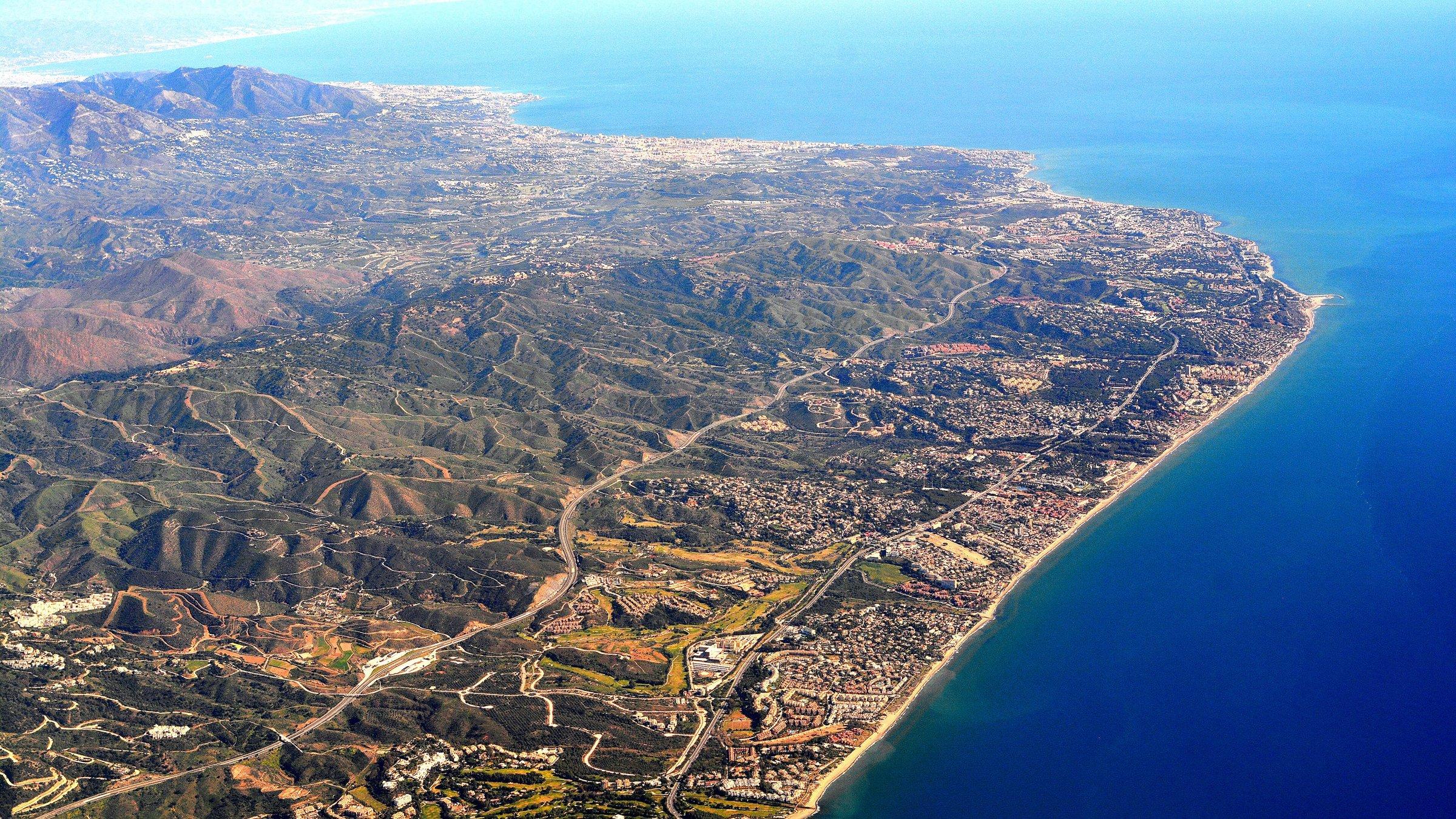
The Costa del Sol seen from above Marbella, looking east towards Fuengirola and Benalmádena, in February 2015. Photo: Mike McBey, via Wikimedia Commons, CC BY 2.0.
On Thursday in Barcelona, a group of journalists and content creators took a cocktail workshop built on Málaga produce and then a light-painting session, the long-exposure technique of drawing with light, with compositions inspired by Pablo Picasso. A day earlier the same programme ran in Madrid. The hosts were Turismo Costa del Sol, the promotion company of the Diputación de Málaga, and the purpose of both evenings was to show the national press the destination's new brand identity in the year the organisation marks half a century of promoting the province abroad.
The brand itself is not new this week. It was unveiled on Wednesday 27 May at a gala in the Edgar Neville auditorium in Málaga, in front of about 200 hoteliers, mayors, officials and business figures. What happened on 18 and 19 November was the second stage: a media roadshow in Madrid and Barcelona, accompanied by press material that frames the identity as a tool against seasonality. The Europa Press headline on Friday was blunt: the Costa del Sol wants tourists 365 days a year.
That ambition is older than the logo, and the official statistics show how far the coast has come and how far it still has to go. Hotels in the province recorded three times as many overnight stays in August as in January this year. The new colours are meant to tell travellers that the off-season has things to offer. Whether they do so depends less on design than on flights, trains, beds and the price of housing for the people who work in the industry.
What was launched, and what was not
The identity keeps the name and replaces the visual system. Each letter of the wordmark is filled with a different colour, and the palette is meant to stand for the segments the destination sells: sun and beach, culture, golf, gastronomy, nature, meetings and incentives, and active tourism, according to the release carried by Europa Press on the night of the gala. It was described as "a flexible and contemporary brand" that brings the various provincial sub-brands under one visual architecture and is built for digital channels. It will be rolled out progressively across the company's campaigns rather than switched over on a single date.
A promotional film accompanies the identity. Francisco Salado, president of the Diputación and of Turismo Costa del Sol, said at the May gala that the aim was to move from "a brand that attracts to one that excites. Costa del Sol, the art of living well", as Sur in English reported. "In these 50 years, the province has evolved from a mainly holiday destination to a diversified and internationally recognised tourist offer in multiple sectors," he said. "The new image aims, precisely, to reflect this evolution."
Several things were not disclosed. None of the coverage of the May gala or of this week's events names the agency or studio that designed the identity, and none gives a budget for the design, the film or the rollout. Those gaps matter for a public company funded by the provincial government, and they are the first questions any reader of the brand book will ask.
There is also a small discrepancy in attribution. The line "we are celebrating 50 years of taking the province of Málaga and its Costa del Sol to the world, and we do it looking to the future", with the follow-up that the image reflects "a diverse, innovative destination capable of offering a complete experience all year round", was spoken by Salado in May, according to Málaga Hoy, ABC and Sur. The November material, as reproduced by Europa Press and Forbes España, attributes the same words to Antonio Díaz, the company's managing director. The message is the same either way. The record shows Salado said it first.
Fifty years of what, exactly
The anniversary being celebrated is institutional. On 29 April 1976 the province set up the Patronato de Turismo de la Costa del Sol, described at the May gala as the first promotional body of its kind in Spain and a model later copied by other provinces. According to Sur's account of the gala, the founding minutes describe a public-private emergency committee formed "due to the need to provide an immediate response to the problems of the tourism sector". One of its first tasks was to bring under a single umbrella the promotion that Torremolinos, Marbella and other coastal towns had been doing separately.
Some coverage of the gala described it as fifty years since the creation of the Costa del Sol brand. That is not accurate. The name is considerably older. The historian Elías de Mateo Avilés, in a paper for the Real Academia de Bellas Artes de San Telmo, traces "La Costa del Sol" to a 1928 press campaign by Rodolfo Lussnigg, an Austrian-born hotelier in Almería, who wanted the label applied to the whole Spanish Mediterranean from Figueres to Seville. It attached itself to the Málaga coast from the 1950s, helped by the newspaper Sur, whose director began promoting it in 1954, the year the Hotel Costa del Sol opened in Torremolinos. Before the Patronato there was a promoters' cooperative, constituted at the Hotel Don Pepe in Marbella, which the same paper identifies as the forerunner of the provincial body.
The original Costa del Sol logo also predates the Patronato. The studio of the designer José María Cruz Novillo lists its Costa del Sol project as "promotion of a tourist area, 1974". What turns fifty this year is the public-private machinery for selling the region, not the name or the original mark.
The shape of the year
The case for a year-round brand rests on numbers that the province's hotels produce every month. According to the National Statistics Institute's hotel occupancy survey (INE, table 2074), hotels in Málaga province recorded 22.2 million overnight stays in 2025. August alone accounted for 2,860,300 of them. January accounted for 846,283. The four coolest months, January, February, November and December, produced 18.7 per cent of the year's hotel nights. July and August together produced 24.6 per cent.
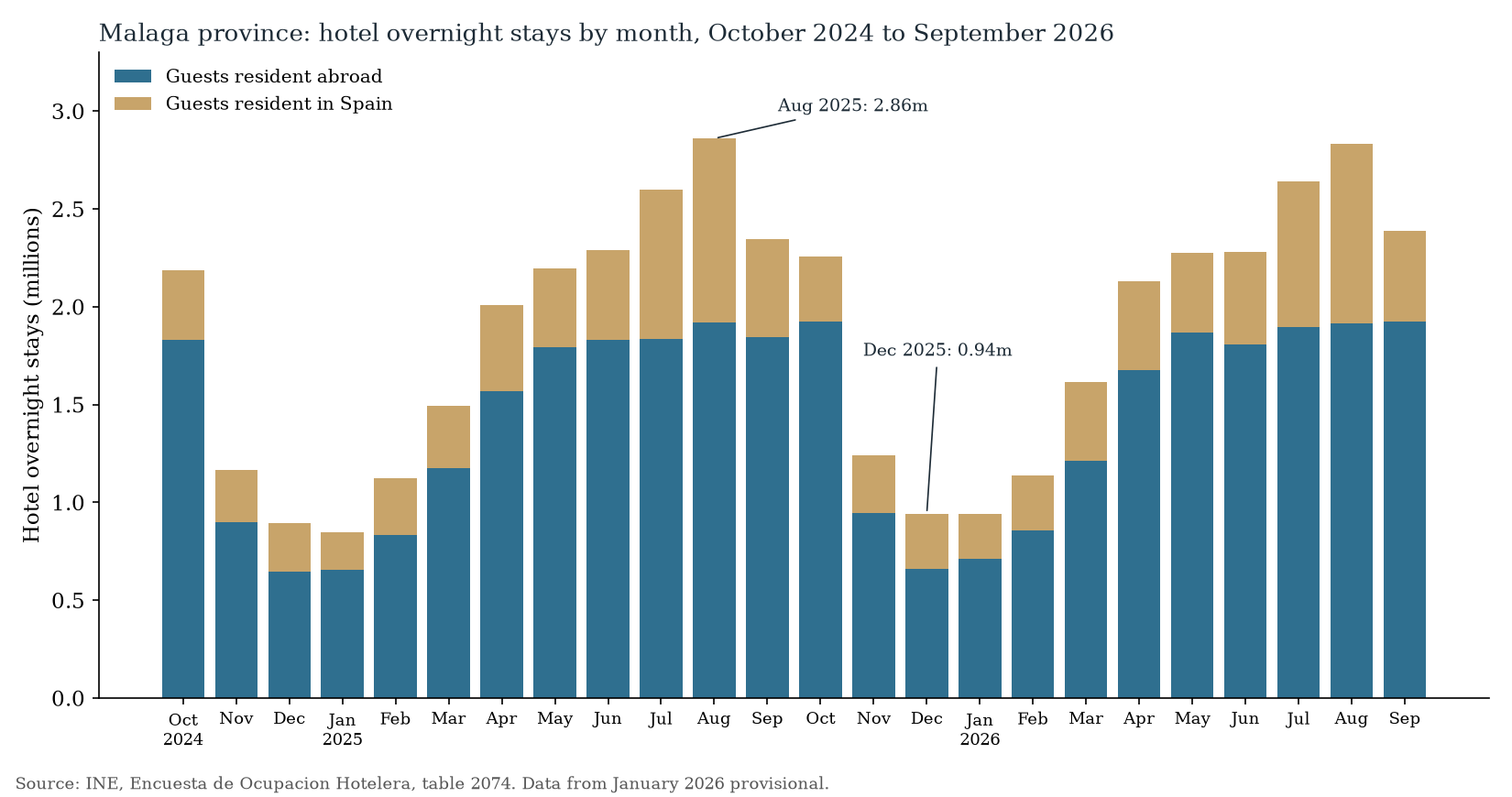
The detail behind those totals is more useful than the totals. Split by where guests live, the summer peak turns out to be largely a Spanish phenomenon. Overnight stays by guests resident abroad were almost flat from May to October 2025, between 1.80 million and 1.92 million a month; the foreign figure for October (1,922,493) was slightly higher than for August (1,919,127). Guests resident in Spain, by contrast, went from 188,480 nights in January 2025 to 941,172 in August, a fivefold increase. Spanish residents generated about 23.5 per cent of hotel nights across the year but almost a third in August.
Put another way, the international market already behaves like a seven-month season, from April to October, with a deep trough from November to February. The domestic market adds a sharp spike in July and August. A year-round strategy therefore has two different problems to solve: extending the international season into the winter months, and persuading Spanish travellers to come outside the school holidays. That second problem explains why this week's launch events were held in Madrid and Barcelona.
The averages hide a smaller point that industry figures regularly make. Turismo Costa del Sol's own 2025 balance put average hotel occupancy at 75.4 per cent for the year, with peaks of 90 per cent in summer and Holy Week, according to La Opinión de Málaga. The Diputación said at the same presentation that most hotels in the province now open all twelve months. The claim matters because it is the precondition for any winter campaign: a brand cannot sell rooms that are shut.
Where the growth is coming from
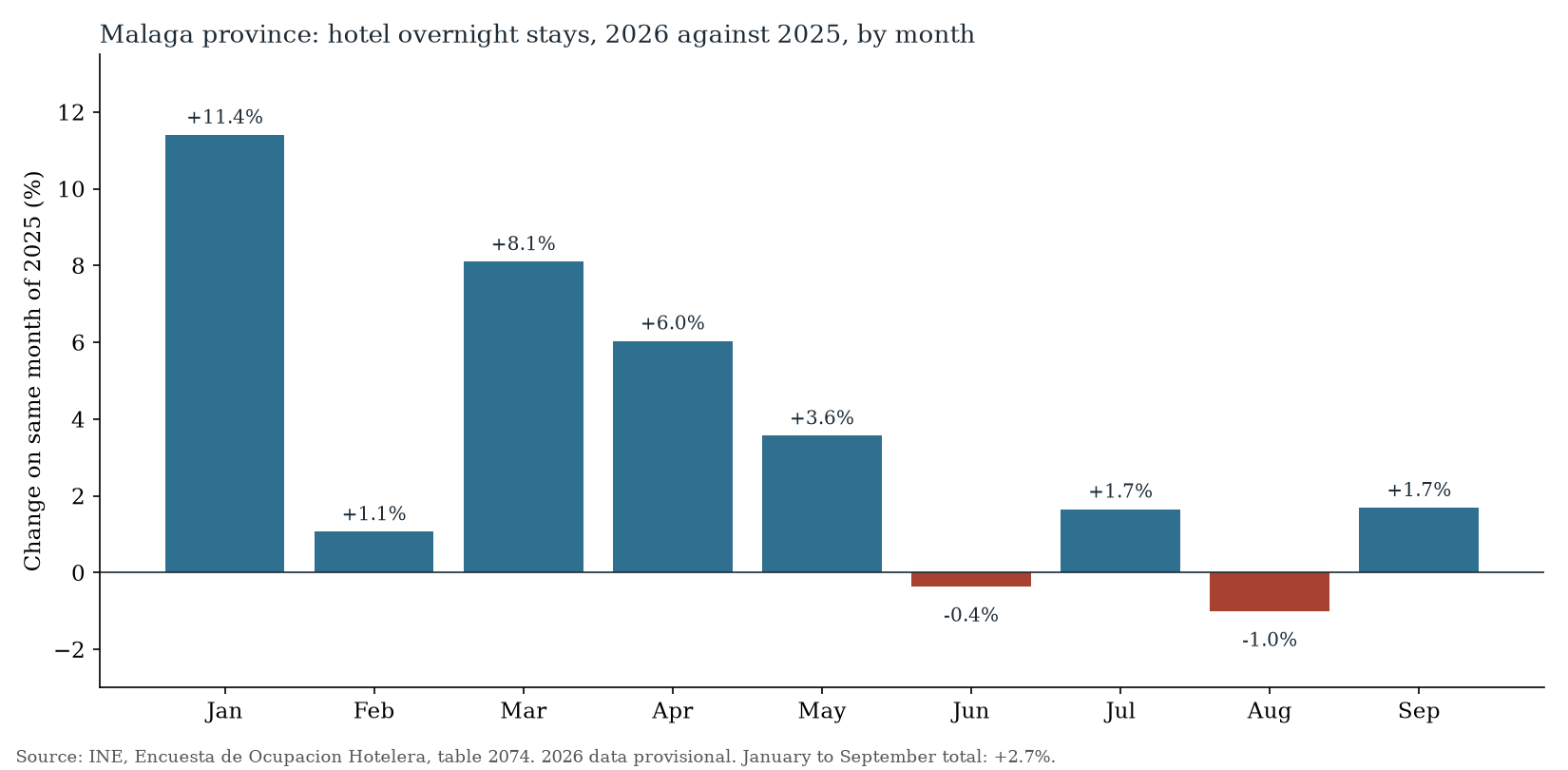
The more encouraging data for the strategy are in the 2026 figures. In the first nine months of the year, hotel overnight stays in the province rose 2.7 per cent on the same period of 2025, according to the INE series. The growth was concentrated at the start of the year. January was up 11.4 per cent, March 8.1 per cent and April 6.0 per cent. June fell 0.4 per cent and August 1.0 per cent. The summer did not shrink by much, but nearly all of the increase came from the cooler months and the shoulder season.
The labour market shows the same pattern. Turismo Costa del Sol's latest barometer, reported by Sur in English on Thursday, puts tourism employment in the province at an average of 170,463 people between January and September, 12 per cent more than a year earlier and almost 22 per cent of working residents. Between June and September, however, tourism employment fell 3.9 per cent, in line with flat summer visitor and overnight figures, and the sector's share of provincial employment slipped to 19.7 per cent in the third quarter. Of tourism workers, 75.7 per cent hold permanent contracts and 84.1 per cent work full time. We covered the figures in our dispatch on tourism employment.
Revenue has also outpaced volume. The province received 14.65 million tourists in 2025, 1.19 per cent more than in 2024, while the estimated economic impact of their spending rose 2.8 per cent to €21,811.7 million, according to the balance reported by Diario Sur. Hotel revenue per available room rose 7.2 per cent to about €108. Salado has argued for some time that the destination should count visitors less and spending more. In January he said hotels might "reorient" their product rather than chase 80 to 90 per cent occupancy all year, and charge more for a better offer.
The two sources on that balance do not agree on one figure. Diario Sur gives tourism employment in 2025 as 152,162 people, up 10.7 per cent. La Opinión de Málaga, reporting the same presentation, gives growth of 15 per cent and "more than 152,000" workers on the average of the first three quarters. Both figures are attributed to the Diputación's own balance, and we have not been able to reconcile them.
The markets that fill the winter
Málaga-Costa del Sol airport is the province's front door. The airport handled a record 26,760,549 passengers in 2025, up 7.4 per cent, of whom 22,248,605 travelled on international routes, according to Aena. December 2025 was its busiest December on record, with 1,681,268 passengers. In October this year it handled 2,696,944, another monthly record, and by the end of October the year's total had reached 24,826,892, 6.4 per cent ahead of 2025, as we reported in our October airport dispatch.
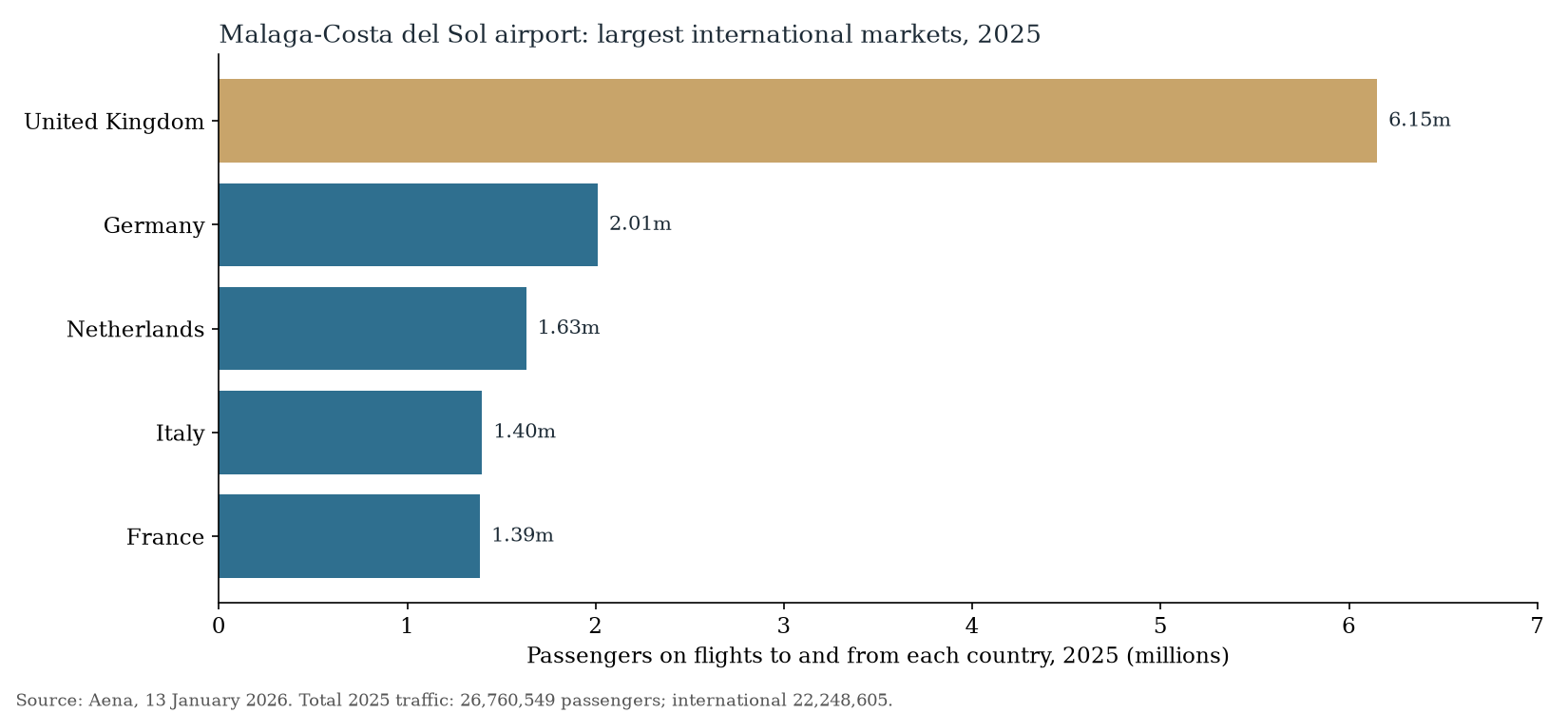
The United Kingdom dominates. Flights to and from British airports carried 6,149,697 passengers in 2025, three times the figure for Germany (2,012,019), followed by the Netherlands, Italy and France. The British market also holds up in winter: in December 2025 it was again the largest, with 328,014 passengers, according to Aena. That concentration is also a risk. At the World Travel Market in London on 3 November, Salado said airlines had scheduled 1,296,799 seats from the UK to Málaga between October 2026 and March 2027, about 5 per cent fewer than a year earlier, across 18 British cities and eight carriers, Sur in English reported. "This decline should prompt us to seek out tourists who stay longer at the destination. In other words, to prioritise quality over quantity," he said. Turismo Costa del Sol announced €1.5 million for promotion in the UK next year and expects about 3.3 million British tourists in 2026.
Other carriers are adding capacity. Ryanair's winter programme for Málaga, announced on 14 October, offers more than 3.4 million seats between late October and late March, 3 per cent more than last winter, on 82 routes including six new winter connections to Trieste, Venice, Turin, Katowice, Košice and Hamburg, according to the airline. Aena's October figures show the fastest-growing markets were Poland, Bulgaria, Latvia, Hungary and Lithuania. Turismo Costa del Sol's 2026 plan also includes promotion in the United States, Canada and Asia aimed at high-spending visitors, and the Diputación said in January it wanted the existing New York route extended to more months of the year.
Golf, meetings and cruise ships
Three products carry most of the weight in the off-season, and each is listed among the segments the new palette is supposed to represent.
Golf is the oldest. Málaga province has more than seventy courses, the largest number of any Spanish province, and its high season runs from October to May, the opposite of the beach calendar, EFE reported. Citing the second economic impact report on golf in Spain by IE University, EFE said about 700,000 travellers come to Andalucía each year to play, that they stay close to 12 nights against 7.5 for the average tourist, and that they spend an average of €352 a day. The direct impact of international golf tourism in Andalucía reached €1,757 million in 2024, by the same account. Those figures are regional rather than provincial, but the coast between Málaga and Casares holds about two thirds of Andalucía's courses.
Meetings and conferences are the second. Málaga city hosted 2,215 professional meetings and events in 2025, with 330,254 participants, generating direct spending of €284.6 million, 6.8 per cent more than a year earlier, according to a Málaga Convention Bureau study reported by La Opinión de Málaga. Including indirect and induced effects, the total was €641.8 million. Of participants, 72.1 per cent stayed in four- and five-star hotels, and international delegates stayed an average of 3.7 days. The figures exclude San Diego Comic-Con Málaga, which drew 96,356 visitors to the city's trade fair centre in September 2025. Meetings are far less tied to the beach calendar than leisure travel, which is why the expansion debate at FYCMA, set out in our article on the trade fair centre, is also a debate about seasonality.
Cruise traffic is the third, and it has moved towards luxury. The port of Málaga recorded 625,447 cruise passengers in 2025, up 32 per cent. For the last quarter of 2026 the port authority expects 137 calls, about 21 per cent more than in the same quarter of 2025, but roughly the same number of passengers, about 182,000 against 184,656, because a growing share of the ships are small luxury vessels, La Opinión de Málaga reported. Twenty-six of those calls are turnarounds, mostly by premium lines such as Windstar, Ponant, Star Clippers and Four Seasons Yachts. A University of Málaga study for the port put average spending at €100.2 per passenger per day. Turnaround calls, where passengers begin or end a voyage in Málaga, are the ones most likely to add hotel nights.
Gastronomy and culture complete the list. The city's museum offer, the winter festival calendar and the Christmas season described in our guide to the coast's Christmas markets are what a Madrid couple might book a December weekend around. Hotels, restaurants and members' clubs that want to be in front of that audience can apply to The Salons.
A difficult autumn for a launch
The media roadshow went ahead in an unusually bad month for the domestic market. Since the collision of two high-speed trains near Urda, in Toledo, on 28 October, in which 69 people died, the Madrid-Andalucía high-speed line has been closed. On Friday, El País reported that the transport ministry hopes repairs will take about two weeks once work begins, but that it has not committed to a reopening date. Renfe, Iryo and Ouigo are selling tickets only from 13 December. It was the line's second fatal accident this year, after the crash at Adamuz, in Córdoba, on 18 January, in which 46 people died.
The effect on hotels is already visible. Aehcos, the Costa del Sol hoteliers' association, expects occupancy of 61.3 per cent in November, against 67.8 per cent a year earlier, and 47.2 per cent in December, against 56.91 per cent, and attributes most of the fall to the absence of the train, Diario Sur reported on 10 November. The All Saints' long weekend reached 73.1 per cent, down from 80.9 per cent. Turismo Costa del Sol produced a preliminary estimate that a closure lasting until 13 December would mean 139,572 fewer tourists, €185.6 million of lost economic activity and 1,974 jobs at risk, while acknowledging that a report prepared in four hours was "purely an estimate". The Andalusian hotel federation, Fahat, put the loss for Málaga at 36,693 overnight stays across hotels and other accommodation in November and December.
The coincidence is awkward. The brand's message to Madrid and Barcelona is that the Costa del Sol is worth a visit in November and December, at the moment when the fastest route from Madrid is closed. It also shows where the strategy depends on infrastructure the province does not control. Aehcos launched a campaign this month, "Toca mirar por Málaga", asking the next central government to invest in electricity capacity, housing, transport, water and the coast before the general election on 29 November, as we reported in our dispatch on the hoteliers' campaign. "What the people of Malaga need is the same as what tourism needs," José Luque, the association's president, told Sur in English.
Beds, homes and the long-stay visitor
A year-round destination needs a year-round supply of beds, and on the Costa del Sol much of that supply is not in hotels. The province's regulated accommodation stock, including registered holiday lets, reached 701,994 beds at the end of 2025, 6.5 per cent more than a year earlier, according to the Diputación's balance. Salado blamed the 1.4 per cent fall in overnight stays in hotels, apartments, campsites and rural houses that year partly on the growth of holiday-let homes, which those figures do not count.
The INE's experimental statistic, built from listings on the main platforms, counted 45,176 tourist dwellings in Málaga province in May 2026, with 213,006 beds, the largest figure of any Spanish province, although about 3,000 fewer homes than in November 2025, La Opinión de Málaga reported. The Andalusian tourism register, which counts every home formally inscribed, gives 12,662 holiday-let homes in the city of Málaga alone. The city council imposed a three-year moratorium on new registrations in August 2025 in the 43 neighbourhoods where such lets already exceeded 8 per cent of homes, and has since proposed requiring a planning change before any form of tourist accommodation can open on residential land.
Not every long-stay visitor uses a hotel or a registered holiday let. Owners who spend part of the winter on the coast, and remote workers who stay for weeks rather than days, need fully equipped homes rather than hotel rooms. Owners who buy from abroad often face the practical job of furnishing a property they cannot visit regularly. Furniture Packages Marbella, run by Mirela B. Interiors, sells fixed-price furnished-home packages for owners between Mijas and Casares, including a version aimed at holiday rentals, with delivery, assembly and styling included and most of the process handled remotely. Our guide to what makes a short-term rental work covers the design choices guests notice.
The property market is where the tension between tourism and residents is most visible. Home sales in the province fell 3.5 per cent in the twelve months to September, the third consecutive quarterly decline, while foreign buyers accounted for 38.83 per cent of purchases, according to the Colegio de Registradores' third-quarter report as reported by El Mundo. The average price reached €3,400 per square metre at the end of September, 9.8 per cent higher than a year earlier, La Opinión de Málaga reported. The most frequent foreign buyers come from the United Kingdom, the Netherlands, Germany, France and Belgium, El Mundo reported, largely the same countries that lead the airport's international traffic. For international clients relocating to Marbella, EQUA Estates advises on buying and renting and coordinates residency, tax and schooling support. Lawyers, tax advisers and property managers who serve that clientele can apply to The Black Book.
Salado acknowledged the other side at the May gala. The great challenge, he said, was "to build an even more innovative and sustainable legacy" that deals with transport, water and housing, and "the current success of tourism must go hand in hand with the well-being and quality of life of its residents". He told Málaga Hoy that one of the institution's goals was for job seekers to see the Costa del Sol as a region of opportunity. Aehcos makes the same point from the employers' side: the industry, it says, needs affordable housing for its own staff.
What a brand can and cannot do
The design has had critics. Esteban Zamora Voorn, a Málaga graphic and motion designer, wrote in a LinkedIn post after the May launch that the identity was "a very poor piece of work", that its six colours lacked any formal logic and that it relied on familiar assets such as sun, beach and gastronomy rather than the less exploited attributes that might set the coast apart. He called it a missed opportunity for a sector that he put at about 15 per cent of the provincial economy. We found no public response from Turismo Costa del Sol.
The critique and the official line agree on one point: the identity reflects a destination that has already changed. The Costa del Sol of 1976 was a summer resort with a crisis committee. The Costa del Sol of 2026 has a record airport, hotels that stay open in January, 2,215 business meetings a year in its capital and seventy-odd golf courses whose busiest months are in winter. The INE data show that the cooler months are growing faster than the summer. The design records those changes; it did not produce them.
More useful tests of the strategy arrive over the next few weeks. INE publishes October hotel data on Monday 23 November. Aehcos will report how far November fell short of last year. Operators have scheduled the first trains on the reopened high-speed line for 13 December, subject to Adif's repairs. The first real measure of the new identity will be whether the winter of 2026-27 repeats the gains made last January and March, with 5 per cent fewer British seats scheduled and the rail link to Madrid still to reopen.
From the journal
Related articles
FYCMA: Málaga's Trade Fair and Congress Centre, and the Case for Building Bigger
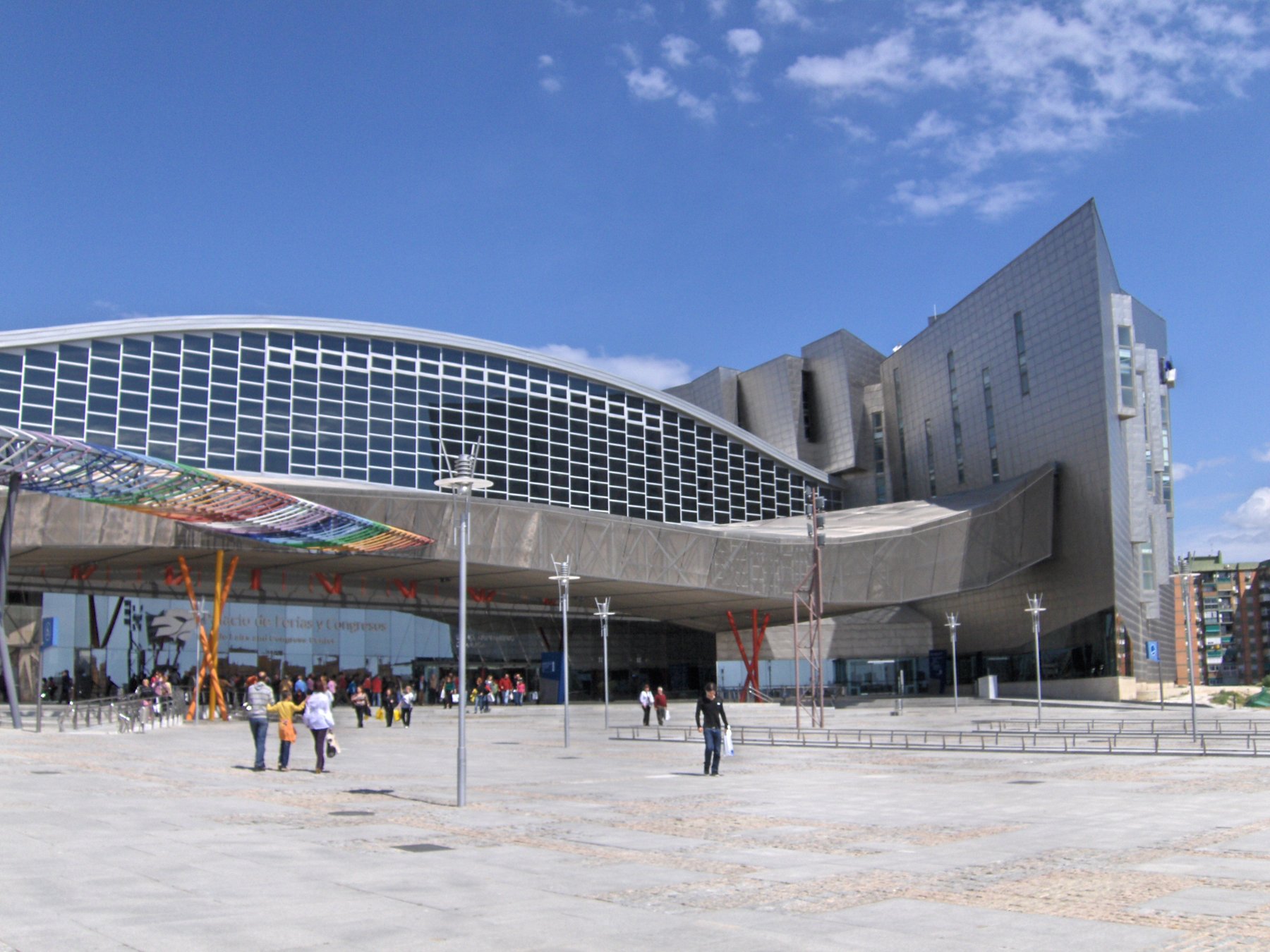
Málaga's municipal trade fair and congress centre reported 147 events and 283,936 attendees in 2025 and now plans a 12,000-square-metre hall. A look at the building, its self-reported figures, its place in the ICCA table and the limits an extension would and would not solve.
16 NOV 2026

Marbella Is Going After the World's Biggest Spenders: How DUCO Spain & Portugal 2026 Signals a New Era for Luxury Tourism
An operational breakdown of DUCO 2026 in Marbella: connecting 170 luxury travel advisers with regional hospitality to drive year-round, high-yield tourism.
27 OCT 2026
The Ten Christmas Markets Worth Visiting on the Costa del Sol This Season
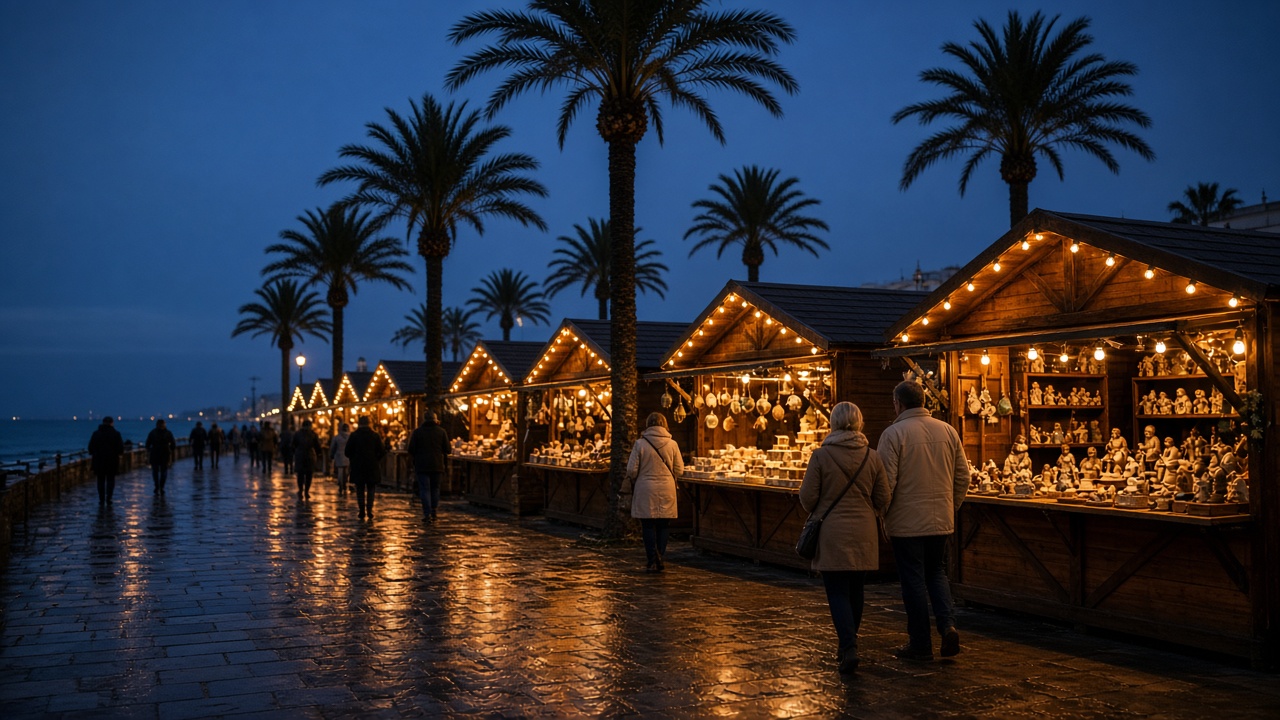
From the Paseo del Parque in Málaga to Puerto Banús and Mijas Pueblo, a guide to the ten Christmas markets to plan around this season, with which 2026 dates are confirmed and which still rest on last year's calendar.
14 NOV 2026
Live from the coast
Related wire dispatches
Costa del Sol Hoteliers Press Next Government on Power, Water, Housing and Transport
Aehcos, the Costa del Sol hoteliers' association, has launched 'Toca mirar por Málaga', a campaign asking Spain's next government to invest in six areas: electricity capacity, access to housing, transport, water, territorial balance and the coast, including completion of the Senda Litoral.
Tourism Employs 170,463 in Malaga Province, Up 12%, Though Summer Hiring Dipped
Tourism employed 170,463 people in Málaga province in the first nine months of 2026, 12% more than a year earlier and almost 22% of the working population, according to Turismo Costa del Sol's barometer. Employment fell 3.9% in the June to September quarter, as visitor numbers were flat.
Puente Romano Names Francesco Roccato General Manager, Returning Him to Marbella
Puente Romano Marbella has appointed Francesco Roccato as general manager. The Turin-born hotelier led the opening of Nobu Hotel Marbella between 2016 and 2018 and will oversee a multi-year investment programme covering the resort's suites, restaurants and sports facilities.