FYCMA: Málaga's Trade Fair and Congress Centre, and the Case for Building Bigger
Málaga's municipal trade fair and congress centre reported 147 events and 283,936 attendees in 2025 and now plans a 12,000-square-metre hall. A look at the building, its self-reported figures, its place in the ICCA table and the limits an extension would and would not solve.
By Anna Kuznetsova · Updated 16 NOV 2026
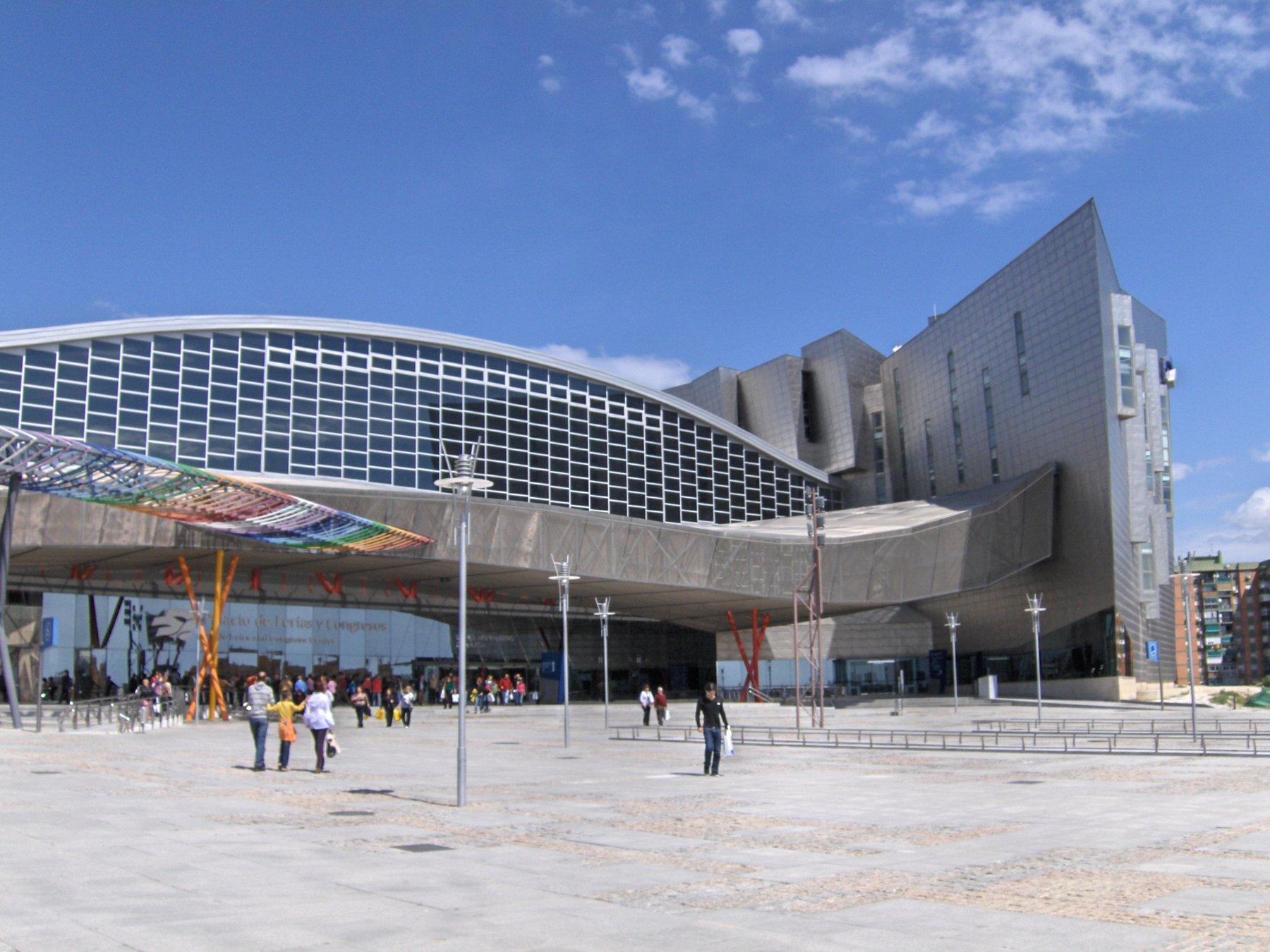
The Palacio de Ferias y Congresos de Málaga (FYCMA), designed by Ángel Asenjo, in March 2009. Photo: Tyk, via Wikimedia Commons, CC BY-SA 3.0.
On the morning of Thursday 12 November, the mayor of Málaga, Francisco de la Torre, opened the twenty-second edition of Simed, the Salón Inmobiliario del Mediterráneo, in a hall on the western edge of the city. By the organiser's count, 165 exhibitors had taken 11,500 square metres of stands, showing more than 4,300 homes for sale and land for another 5,100 across 43 Spanish municipalities. The organiser was the building itself. Simed is one of the fairs that FYCMA, the Palacio de Ferias y Congresos de Málaga, runs under its own name, and it is a fair guide to what the place has become: a municipal venue that rents out halls to others and also produces its own events.
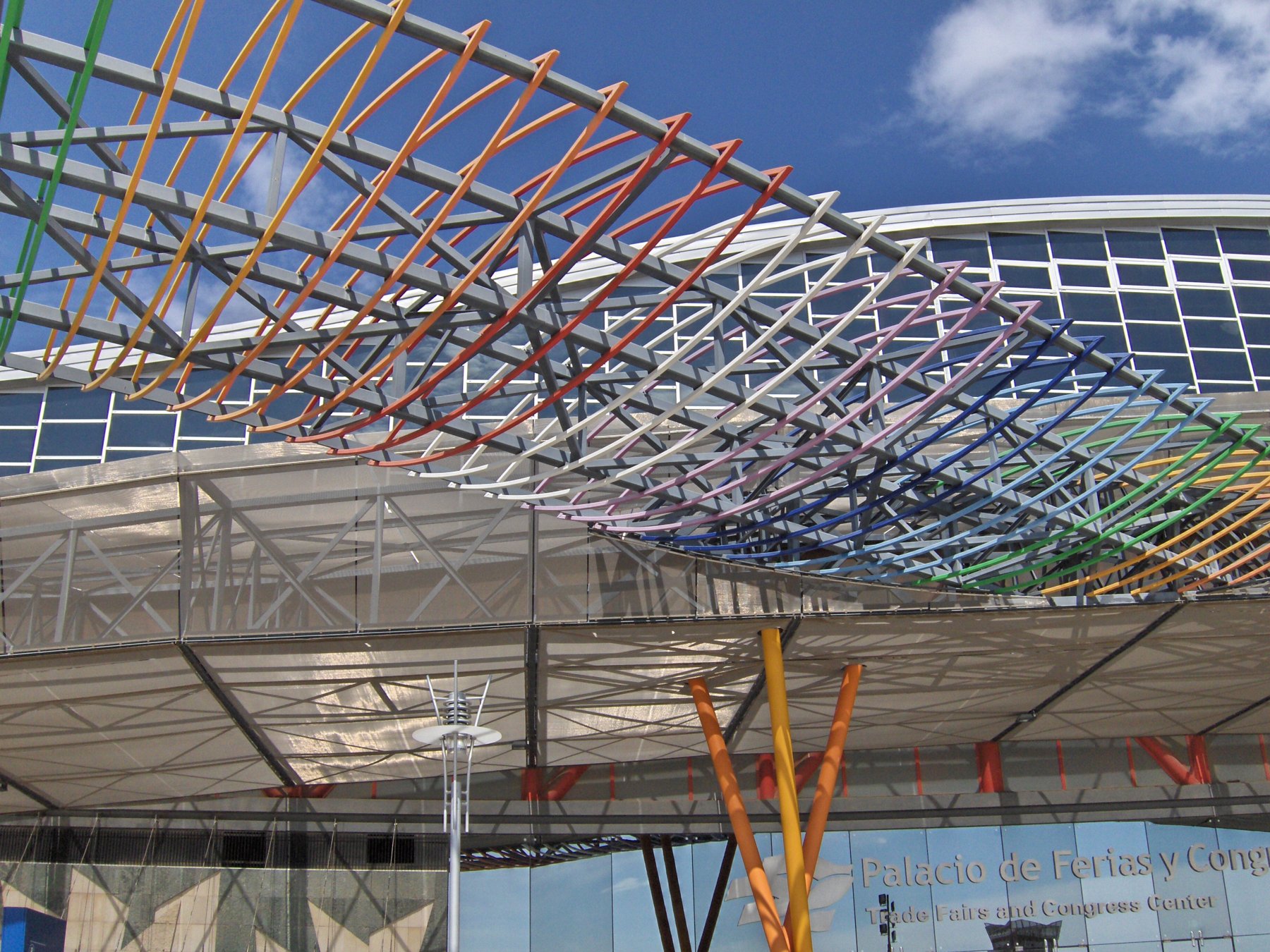
FYCMA does not look like a civic building. The silver roofline of its pavilions, the angular tower clad in metal panels and the coloured steel canopies over the forecourt give it a profile that is hard to mistake from the ring road. Its numbers are more modest than its silhouette suggests, and its owner, Málaga City Council, now argues that the building is too small for the events it attracts. What follows sets out what FYCMA is, what its own figures claim, where it falls short of Spain's larger fairgrounds, and what the planned extension would and would not change.
A building on the ring road
The Palacio opened on 22 March 2003. It stands at number 201 on Avenida de José Ortega y Gasset, in the Cruz de Humilladero district, beside the MA-20 western ring road and roughly halfway between the historic centre and the airport. FYCMA's own travel page puts Málaga-Costa del Sol Airport nine kilometres away. The most direct public-transport link is the C1 suburban train to Victoria Kent station; the airport's express bus, line A, does not pass the building, and visitors who take it have to change at Avenida de Velázquez onto city bus 22. There is a free car park with 1,200 spaces beside the pavilions.
The design is the work of the Málaga architect Ángel Asenjo and his studio. FYCMA describes the materials as concrete, steel, marble, glass and titanium, and its spaces brochure speaks of joining "the maritime tradition of Málaga" with contemporary architecture. The Spanish-language encyclopaedia entry on the building calls it a metal structure of undulating, irregular forms. Both descriptions hold up on site. The long, low curve of the halls is easy to read as a hull, and the tower and canopies break it up at the entrance.
Ownership is simple. The city council built the Palacio, and since 2010 it has been run by a municipal company, Palacio de Ferias y Congresos de Málaga S.A. Its incorporation was signed before a notary by the mayor at the end of December 2009, with share capital of €60,101.21 paid in full by the council. The board at the time was chaired by the mayor, with council members from the governing and opposition groups and representatives of the Chamber of Commerce, Unicaja and the Confederación de Empresarios de Málaga. Its statutes allow the company to become a mixed public-private enterprise, although that has not happened. Today the councillor responsible for FYCMA is Alicia Izquierdo, who also holds the council's portfolio for innovation, digitalisation and investment attraction. The pairing places the building inside the city's economic development strategy.
What is inside
FYCMA gives its total built area as 60,000 square metres, of which 19,500 are exhibition space. The core is two connected pavilions. Pavilion 1 covers 10,800 square metres under a 22-metre ceiling and, according to the venue's technical sheet, holds up to 9,000 people standing, 8,000 in theatre rows or 5,500 at a banquet. Pavilion 2 adds 6,000 square metres at the same height. Together they make the 17,000 square metres that most trade fairs book.
For congresses there are two auditoriums. Auditorium 1 has 901 fixed seats on 1,000 square metres and a stated capacity of 950; Auditorium 2 has 583 seats, each with a fold-down desk, and a capacity of 640. A conference room takes 400, an exhibition room up to 450, and the venue lists between sixteen and eighteen multipurpose rooms, depending on which of its own pages you read. At the centre is an open-air patio of 5,400 square metres that FYCMA says can hold 4,000 people. In total the building claims capacity for events of more than 20,000 participants.
The certificates are extensive for a venue of this size. FYCMA has held ISO 9001 and ISO 14001 since February 2010, the energy-management standard now known as ISO 50001 since January 2012, ISO 20121 for sustainable event management since January 2018, and the Spanish tourism quality "Q" since December 2008. In January 2025 it added the ICTE's "S" for tourism sustainability. It also holds the UNE 170001 universal accessibility standard, ISO 27001 for information security and ISO 45001 for workplace health and safety. These are management-system certifications, which audit procedures rather than results.
The figures, and how to read them
FYCMA publishes an annual balance each winter, and the recent run is set out below. In 2025 the venue reported 147 events and 283,936 attendees, a rise of 70 per cent on 2024, with estimated economic impact of more than €265 million, up 37 per cent. Revenue from activity passed €16.4 million, which FYCMA calls a record. In 2024 it reported 133 events, 166,792 attendees, revenue of €12.7 million and impact of €193 million. The 2023 balance gave 156 events, more than 268,000 attendees and impact above €220 million; 2022 gave 176 events, about 254,500 attendees and €183 million.
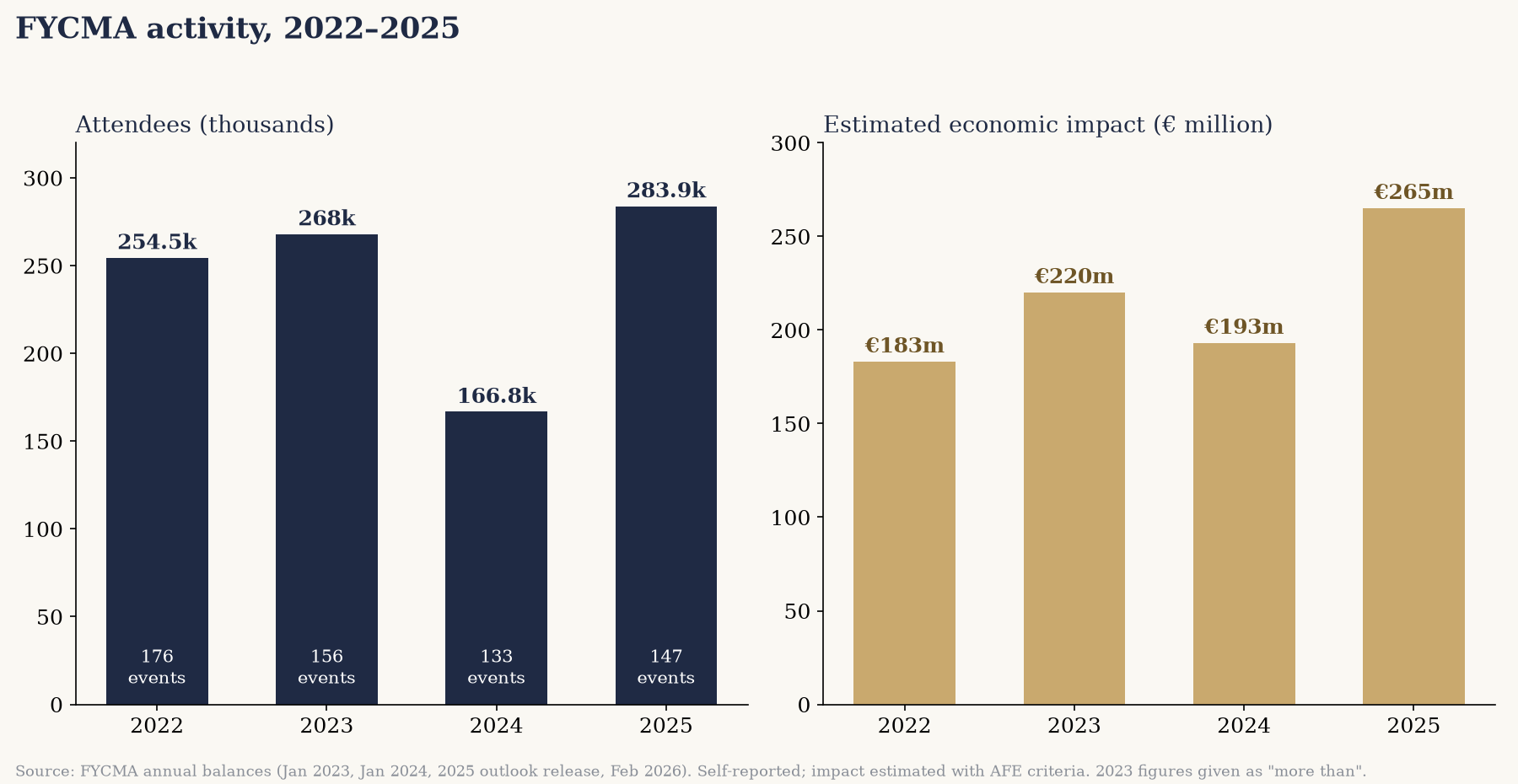
Three cautions apply. First, these are the venue's own numbers. The impact figure is a model estimate built on criteria used by the Asociación de Ferias Españolas, the national trade fair association, and on spending indicators from a municipal study of the meetings industry. It adds direct spending by attendees and organisers, indirect spending with local suppliers and an induced effect on wider consumption. That is standard practice in the sector, but it is not measured spending, and it should not be read as money that would otherwise have been absent from the city.
Second, attendance swings with a handful of large public events. The 2025 breakdown in FYCMA's annual report shows 13 trade fairs with 101,071 visitors and six conventions with 98,806, a category the report says was transformed by the first San Diego Comic-Con Málaga. The 22 congresses, which bring the delegates who stay longest and spend most, drew 25,515. The fall from 2023 to 2024 and the recovery in 2025 say more about the calendar of mass events than about the underlying business.
Third, the revenue series does not reconcile neatly. FYCMA describes 2025's €16.4 million as a 20 per cent increase, while the €12.7 million it reported for 2024 implies a rise closer to 29 per cent. The 2025 figure is labelled as activity revenue only, so the two may be measured on different bases. The annual reports do not set out the difference, and readers comparing years should treat the trend as more reliable than any single percentage.
The trend for 2026 points the same way. Between January and July the venue reported more than 163,000 attendees, 21 per cent more than in the same period of 2025, and estimated impact above €165 million against roughly €134 million a year earlier.
A calendar in two halves
FYCMA works as a landlord and as a fair organiser, and the two businesses look different. The venue's own fairs are mostly professional and sector-specific. H&T, the Salón de Innovación en Hostelería, is the oldest of them; in 2025 it drew 19,799 visitors and 517 exhibitors, and in February 2026 FYCMA said it had filled three pavilions with more than 600 companies and organisations. Transfiere, the European forum for science, technology and innovation, reached its fifteenth year in 2026; the 2025 edition reported 5,247 visitors and 503 exhibitors. Greencities, on urban management and mobility, is smaller, with 2,248 visitors in 2025. Simed recorded 7,589 visitors and 195 exhibitors in 2025, and we covered this year's opening, with more than 4,300 homes on show at Simed, and the regional government's call for developers to build more protected housing, made at the same fair.
The hosted events are where the international reach comes from. DES, the Digital Enterprise Show, held its tenth edition at FYCMA from 9 to 11 June 2026; its organisers reported 17,733 professionals and economic impact of more than €30 million. In 2026 the venue also took EuCNC and the 6G Summit in June and, in September, ECOC, the European Conference on Optical Communications, alongside the Global Photonics Economic Forum. The Sociedad Española de Medicina Estética has held its annual congress at FYCMA for more than a decade, an unusual arrangement in a field where medical societies normally rotate host cities. Talent Land España, a student and early-career technology event that began in Mexico, holds its third Málaga edition from 24 to 26 November; our wire on Talent Land's return has the programme.
The 2025 annual report says that close to 77 per cent of events were aimed at professional audiences and that science and technology events made up more than 55 per cent. Internationally oriented events rose by more than half and approached a quarter of the programme. Those shares reflect a deliberate strategy. The council markets Málaga to technology firms, and the venue's calendar follows the same line.
Comic-Con as a stress test
No event has tested the building as hard as San Diego Comic-Con Málaga, the first edition of the Californian convention held outside the United States. In September 2025 the organisers had planned for about 60,000 people. The regional president, Juanma Moreno, said on the closing day that the real figure had doubled to between 120,000 and 125,000, and Diario Sur reported long queues at the entrances, visitors with reservations shut out of sessions and a reorganisation of the access routes by the security contractor on the final day. The same report put public support at €2.4 million from the Junta de Andalucía and €800,000 from the city council, and Moreno cited an economic impact of €50 million. The Málaga hoteliers' association, AEHCOS, reported city hotel occupancy above 94 per cent during the event.
The second edition, from 1 to 4 October 2026, added a new exhibition pavilion of almost 9,000 square metres. The Junta's tourism minister, Manuel Gavira, told the Andalusian parliament that it recorded almost 73,000 entries to the site and described the result as very positive. The two years' figures are not directly comparable: one is a politician's estimate of people, the other a count of entries. What the episode did establish is that FYCMA can win events of this size, and that in its current form it needs additional exhibition space to stage them.
Where Málaga sits in the international meetings league
The most widely cited independent measure of conference destinations is the annual ranking by ICCA, the International Congress and Convention Association. It counts only association meetings that take place regularly, rotate among at least three countries and draw at least 50 people on site. In the 2025 ranking, published in May 2026, Málaga recorded 19 such meetings, placing it 141st in the world and 76th in Europe. Barcelona was third in the world with 166 and Madrid 13th with 108. Valencia logged 46, Seville 27 and Bilbao 24. Granada had 13; Torremolinos had four and Marbella two.
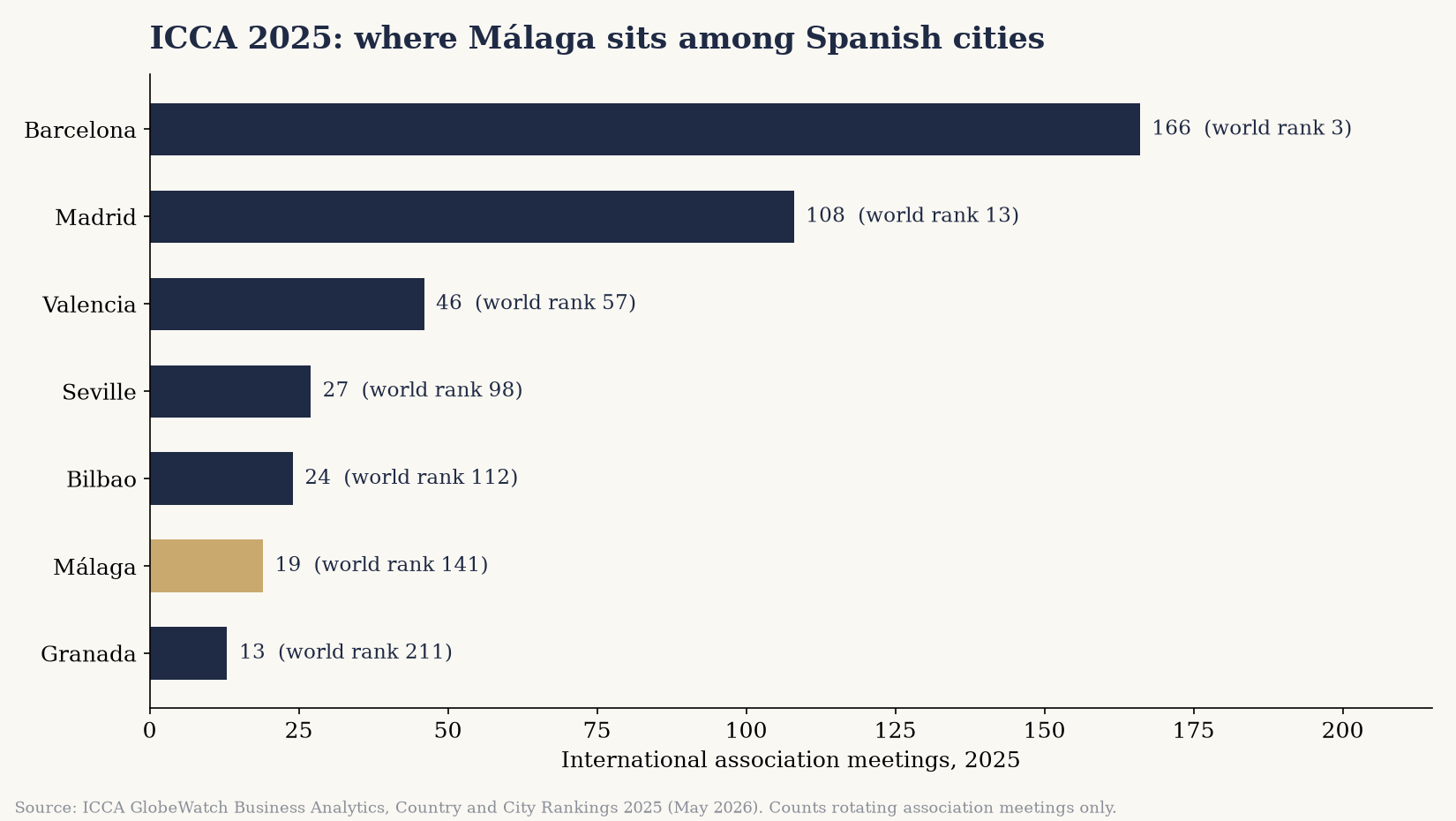
The ranking is narrow. It excludes corporate meetings, trade fairs and one-off events, which together make up most of FYCMA's calendar. Even so, it is the league that the medical and scientific associations behind the most valuable congresses read, and on that measure Málaga sits behind Valencia, Seville and Bilbao. FYCMA is not the only factor, since hotel prices, flight connections and university links all count, but the size and configuration of its auditoriums are part of the explanation.
The limits
The plainest constraint is scale. IFEMA in Madrid lists 240,000 square metres across 13 halls at its main fairground; Fira de Barcelona's Gran Via site lists 240,000 square metres of gross exhibition space and is building a further 60,000-square-metre hall. FYCMA's 19,500 square metres of exhibition space is less than a tenth of either. Operators measure space differently, so the comparison is indicative, but the gap is one of kind as well as degree. Málaga is not competing for the largest European trade shows and is not likely to.
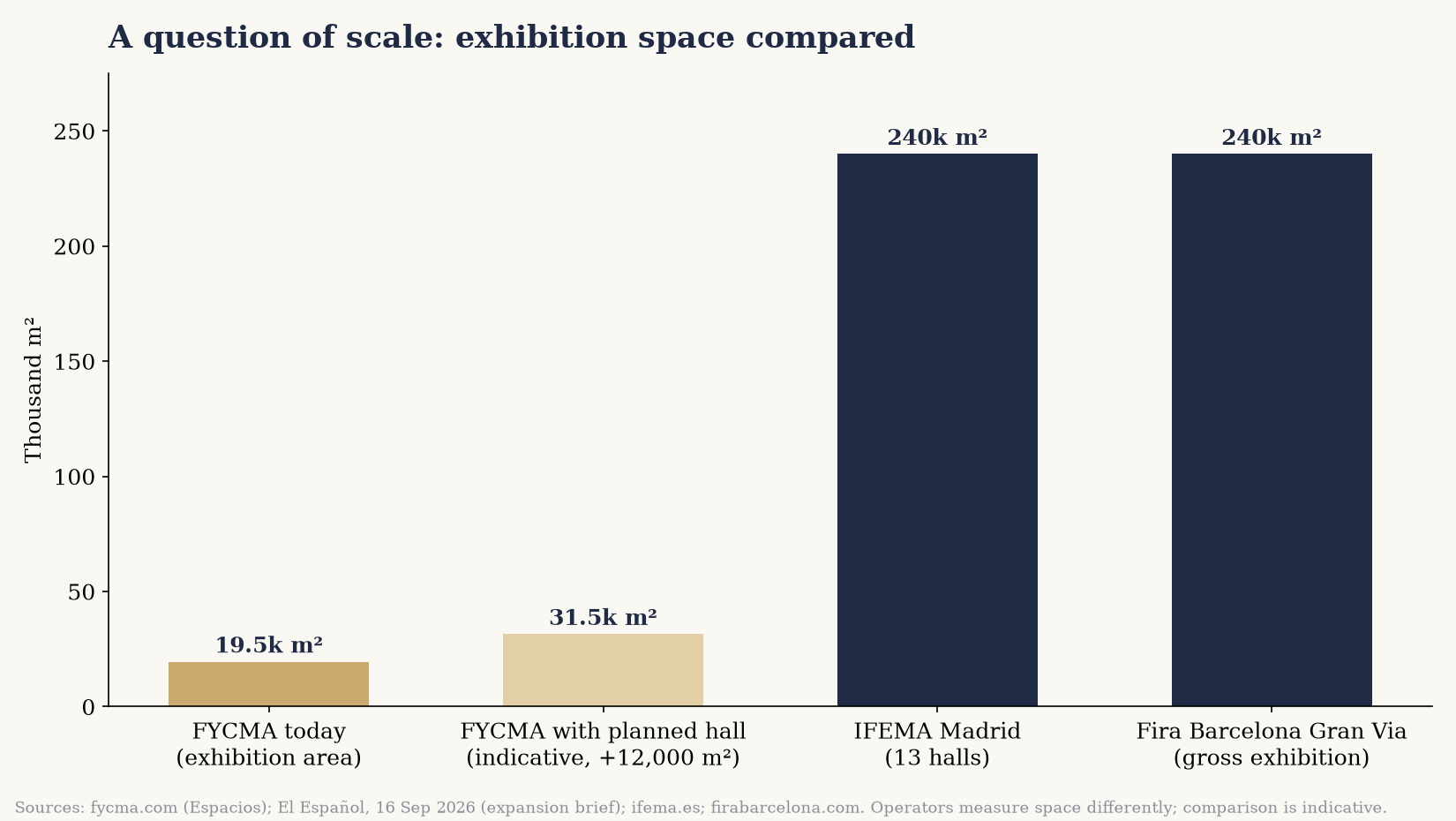
The congress side is tighter still. FYCMA's largest auditorium seats 901, and the council's own brief for the extension records that the 30-metre structural span of the existing halls is too narrow for good sightlines when a pavilion is used as an auditorium. A congress of 2,500 delegates can be held in the building today, but it would have to hold its plenary in a pavilion fitted out as an auditorium.
Beds are a further constraint. The city's tourism indicators for 2025, drawn from the Andalusian tourism register, counted 97 hotels in Málaga at the end of the year, with 13,567 hotel places, and 18,244 places once hostels and guesthouses are included. The city also had 12,790 registered holiday homes with 65,043 places. A congress of several thousand in high season competes with leisure demand for the same rooms, which can push up rates, and the holiday-flat stock is of limited use to associations that need block bookings and invoices. The coast's resort hotels in Torremolinos, Benalmádena and Marbella add capacity, though not within walking distance of the venue.
Transport is a qualified strength. Nine kilometres from an airport with direct flights across Europe is close; Fira de Barcelona's Gran Via site, by comparison, is 12 kilometres by road from El Prat. The C1 train covers the distance. But the absence of a direct airport bus, and an urban site whose main approach is a ring road, means that peak days depend heavily on taxis and private cars. The Comic-Con queues of 2025 showed how quickly the entrances fill when a festival crowd arrives at once.
Finally, FYCMA remains a public company. Its 2025 annual report notes that the improved result "optimises the municipal contribution", which confirms that one exists. That is normal for a European congress centre whose purpose is to bring spending into a city, but it means that the case for expansion rests on the impact estimates discussed above, not on the venue's own accounts.
The extension
The council's answer is to build next door. On 11 August 2026 the city's local government board gave initial approval to the estudio de detalle, the planning document that orders a 49,188-square-metre site made up of the existing building plot and the adjacent car park. It sets a ceiling of 60,000 square metres of buildable floor area, a maximum height of 35 metres and site coverage of up to 90 per cent. On 15 September the board agreed to ask the Junta de Andalucía for €590,000 towards the cost of drafting the project, which El Español put at €4.09 million. The commission is to go to Ángel Asenjo, the original architect.
The technical brief described by El Español centres on a multipurpose hall of at least 12,000 square metres that can be divided in two by acoustic partitions and configured as an exhibition hall, an arena, an auditorium or a concert venue, with retractable seating and a stage of about 18 by 12 metres. It calls for a minimum clear span of 45 metres and a free height of 12 metres. The brief allows for roughly 30,000 square metres above ground, 65,150 square metres of underground parking and 9,403 square metres of landscaping. Earlier council documents described a congress hall for 2,600 people and conference rooms for 1,400 linked to it, and parking for about 2,000 cars; the technical brief puts the parking need at 1,500 spaces.
The timetable is less precise. The brief gives the architect eight months to deliver the basic and execution projects; the council expects to have the document within about a year. Construction depends on completing the planning process, approving the project and tendering the works, and none of the published reports gives a start date or a construction budget. For planners booking congresses for 2029 or 2030, the extension is a prospect, not a capacity they can contract.
If it is built as described, the new hall would add more than 60 per cent to the venue's exhibition space and, more significantly, would give Málaga a congress hall for 2,600 delegates, according to the council's planning documents. That is the format that the larger medical and scientific associations require, and the one the ICCA table rewards. It would still leave FYCMA a fraction of the size of IFEMA or Fira, which is no bad thing for a city of Málaga's size. The more relevant comparison is with Valencia and Seville, which is the gap the extension is meant to address.
What it means for the coast
For property, the link is direct. Simed brings Málaga's developers, lenders and housing authorities together once a year, and the 2026 programme gave most of its time to professional sessions on land supply, public-private housing, industrialised construction and building rehabilitation. The extension site itself is a reminder of how scarce large urban plots have become: the city is building on a car park because there is nowhere else. Congress weeks also add demand for short-stay rentals, which matters in a city with 12,790 registered holiday homes.
For hospitality, FYCMA matters most outside the summer. Much of its professional calendar falls away from July and August: H&T in February, Transfiere in February or March, the medical congresses of May, Simed in November. FYCMA's 2022 annual report, citing national data, said the daily spending of a meetings tourist in Spain in 2021 was three times that of a leisure tourist. H&T itself presents equipment and technology for hotels and restaurants. Venues, restaurants and hotels that want to be on the shortlist when organisers book delegate dinners and side events can apply to our Salons directory.
For the technology sector, the calendar brings companies and graduates into the same building for a few days at a time, through DES, Talent Land and the optical-communications congresses. In May 2027 FYCMA will host WordCamp Europe, the largest European gathering of the WordPress community, from 27 to 29 May; its lead organisers expect between 2,500 and 3,000 attendees. For small web studios on the coast that build on WordPress, such as Wellyington, an Estepona-based web development and digital strategy studio, an event on that scale puts them in the same rooms as the agencies and plugin companies that shape their tools.
For culture, the building now does a second job. Its winter programme is heavy with touring orchestras and ballet companies, and it complements the smaller city-centre stages such as Teatro del Soho CaixaBank on Calle Córdoba. Visitors planning a December trip will find the concert listings below fit easily around the coast's Christmas markets.
On the calendar
FYCMA's published calendar, as of mid-November 2026, lists the following. Dates come from the venue's website and can change; check with each organiser before booking travel.
- 17–18 November: Andalucía TRADE Global 2026, business meetings with the regional agency's representatives in 76 countries.
- 18–19 November: Málaga Sun&Tech by Alhambra Venture, for startups and investors.
- 24–26 November: Talent Land España 2026.
- 28 November: The Lord of the Rings in concert, with orchestra and choir.
- 3 December: Andalucía Management, the annual meeting of the region's senior executives.
- 5 December: FIM Awards 2026.
- 19 December: The Nutcracker by the Tchaikovsky National Ballet, and the Alabama Gospel Choir (which returns on 10 January).
- 20 December: Great Straits, a Dire Straits tribute.
- 8 and 17 January: Swan Lake by the Tchaikovsky National Ballet.
- 10 January: New Year concert by the Strauss Philharmonic Orchestra & Ballet.
- 22–24 January: Retro Málaga 2027, the classic and collectors' vehicle show.
- 8–10 February: H&T, Salón de Innovación en Hostelería.
- 10–12 March: Foro Transfiere.
- 14–18 April: Hyrox Málaga 2027.
- 27–29 May: WordCamp Europe 2027.
- 14–18 June: Intergalva 2027.
A verdict
Twenty-three years after it opened, FYCMA does what a mid-sized municipal congress centre should. Its own fairs are specialised and professional, and the city's technology profile has helped it win international congresses such as ECOC and EuCNC. Its self-reported figures are rising; the methods behind them are the sector's usual ones, with the sector's usual tendency to flatter. The weaknesses are mostly physical. Plenary capacity is too small for the largest association congresses, and the extension would deal with that. It would do nothing for hotel supply in high season, or for the missing direct bus from the airport. Whether Málaga moves up the ICCA table will depend less on the drawings Asenjo's studio delivers next year than on how quickly the city turns them into a contract and a building.
From the journal
Related articles
Costa del Sol at 50: A New Brand and the Long Fight Against Seasonality
Turismo Costa del Sol unveiled its new identity in May and took it to Madrid and Barcelona this week, marking 50 years since the 1976 Patronato. INE data show why the push for year-round visitors matters: August still brings three times January's hotel nights, and most of this year's growth came in January, March and April.
20 NOV 2026
Marbella Is Going After the World's Biggest Spenders: How DUCO Spain & Portugal 2026 Signals a New Era for Luxury Tourism
An operational breakdown of DUCO 2026 in Marbella: connecting 170 luxury travel advisers with regional hospitality to drive year-round, high-yield tourism.
27 OCT 2026
GTA VI and the 30fps Backlash: What a Viral Disappointment Is Worth
Grand Theft Auto VI was not delayed again. What went viral was a 30fps target, a few glitch clips and missing launch features, set against a 99 Metascore and record pre-orders. What the backlash means for Take-Two's shares, Spanish retail and Malaga's games studios.
18 NOV 2026
Live from the coast
Related wire dispatches
Tourism Employs 170,463 in Malaga Province, Up 12%, Though Summer Hiring Dipped
Tourism employed 170,463 people in Málaga province in the first nine months of 2026, 12% more than a year earlier and almost 22% of the working population, according to Turismo Costa del Sol's barometer. Employment fell 3.9% in the June to September quarter, as visitor numbers were flat.
Festival de Málaga Brings Back Its FM Concerts For The 30th Edition, With Barry B, Ojete Calor And Xoel López
The 30th Festival de Málaga, set for 26 February to 7 March 2027, is reviving its FM Festival concerts at the new Sala Circus in the municipal auditorium. Barry B plays on the opening night, Ojete Calor on 27 February and Xoel López on 6 March, with three more acts still to be announced. Tickets went on sale on 17 November.
Teatro Cervantes Sets Its Christmas Season, From Tomatito On 9 December To A Kyiv 'Nutcracker' On 6 January
Málaga's municipal theatres have published their 'Navidad en el Cervantes y Echegaray 2026' season. Tomatito plays on 9 December, Ara Malikian on 21 December and María Peláe on 19 December with a flamenco Christmas show. Ballet Clásico Internacional dances 'Swan Lake' on 27 December, and the Ballet de Kiev closes the run with 'The Nutcracker' on 6 January.