Cloth Cut on the Diagonal and Shirts Thrown Across a Table: 1920s Luxury Fashion and a Formal Evening in Marbella
An examination of 1920s eveningwear construction, materials, and cut, detailing authentic period black-tie standards ahead of Puente Romano's charity gala.
By Anna Kuznetsova · Updated 17 OCT 2026
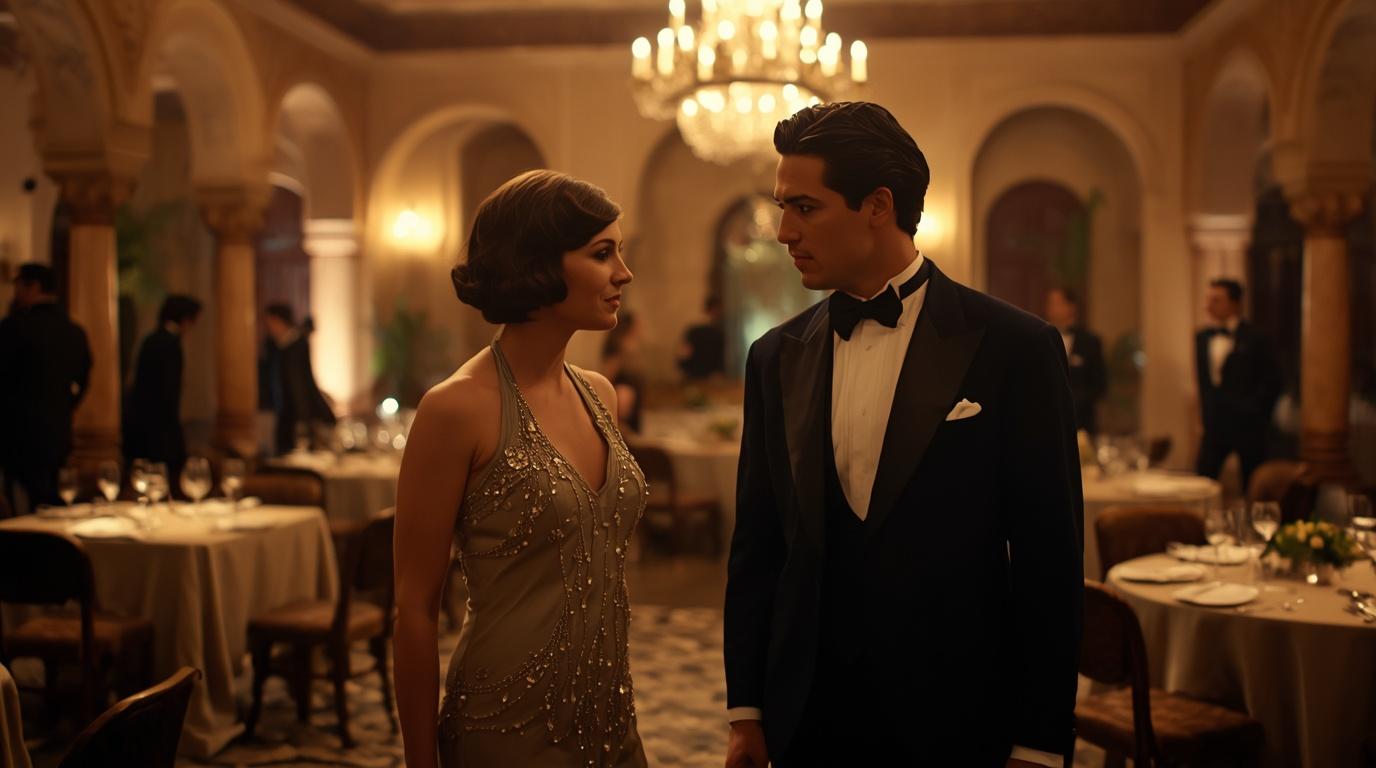
1920s eveningwear
The decade that followed the First World War reordered both the silhouette of clothing and the occasions on which it was worn. In Paris ateliers and in the drawing rooms of American resorts, the same pressures acted at once: the end of wartime restrictions, the availability of new textile techniques, the entry of more women into public nightlife, and the simple fact that money made in the previous decade could now be spent visibly. Evening clothes absorbed most of the change. Day dresses shortened and simplified; evening pieces retained length, weight, and surface interest while abandoning the corseted hourglass that had defined formal dress for half a century.
What emerged by the middle of the 1920s was a narrow, straight line that fell from the shoulder to a hem that hovered between the knee and the mid-calf for dancing, or longer for more static occasions. The waistline dropped to the hip. Fabric no longer had to be supported by internal structure to hold a shape; it could hang, swing, or, when cut correctly, cling and recover. The effect looked freer than what had preceded it. The construction was not simpler. Beading, embroidery, and fringe required hours of handwork. A single evening dress could consume metres of silk and thousands of glass beads. The result was clothing that moved when the wearer moved and caught light at every turn.
Materials and Surfaces
Silk remained the dominant fibre for evening wear, but the range of silks expanded. Chiffon and georgette offered transparency and weightlessness; satin and charmeuse supplied sheen; crepe de chine held embroidery without collapsing. Metallic threads and lamé appeared as accents or as entire panels. Glass beads, sequins, and metal thread were applied in dense geometric patterns or in swirling Art Deco motifs that covered bodices and hems. Fringe, often of silk or metal, was hung in tiers so that it continued to move after the body stopped. Russian émigré workshops in Paris specialised in this beadwork; houses such as Callot Soeurs and Lanvin commissioned them for pieces that still survive in museum collections with their original density of surface intact.
Colour followed the geometry. Black was no longer reserved for mourning. Coco Chanel’s 1926 black dress, published in American Vogue and described there as “Chanel’s Ford,” offered a straight, low-waisted sheath that could be worn with a long strand of pearls or a fabric flower. The dress was not the first simple black garment, but its presentation as a repeatable, almost uniform piece altered the status of the colour. Other designers continued to work in saturated tones: chartreuse, deep purple, ivory, and metallic gold. Jeanne Lanvin’s evening dresses of the later 1920s often used one strong colour across a large area, punctuated by geometric collars or bands of parallel stitching that held shape while remaining decorative.
Designers and the Shift in Cut
Three houses set the technical and commercial terms of the decade. Chanel emphasised jersey, cardigan suits, and the reduction of ornament for day; for evening she retained simplicity of line while allowing accessories to carry the decoration. Madeleine Vionnet approached the same problem from the opposite direction. She worked by draping fabric on a half-scale wooden mannequin, then transferring the result to full scale. By placing the pattern on the bias—at 45 degrees to the straight grain—she produced cloth that stretched and recovered without darts or internal stiffening. Early examples appear in the early 1920s; the fully developed bias-cut evening gowns that skim the body and flare at the hem belong more to the late 1920s and early 1930s, yet the principle was established in the earlier decade. Vionnet eliminated most closures and under-structures. A dress that could be pulled over the head and that moved with the wearer became possible once the fabric itself supplied the elasticity.
Lanvin occupied a middle ground. Her evening dresses of the mid-1920s combined the straight silhouette with dense beadwork and embroidery in Chinese-inspired or purely geometric patterns. A black silk crêpe dress from around 1922 in the National Gallery of Australia collection carries lattice panels of black and white glass beads edged in metallic thread. Another, in chiffon, uses cut-work and beading along the hem. The construction remains relatively simple; the labour is concentrated on the surface. Jean Patou, Callot Soeurs, and the House of Myrbor (which retailed work by Natalia Goncharova) supplied additional variations: longer lines, heavier embroidery, or Russian-inspired motifs executed in silk and velvet appliqué.
Accessories completed the surface. Multiple long strands of pearls or glass beads hung to the hip. Headbands of metal, beads, or feathers sat low on the forehead. Cloche hats, by definition close-fitting, were worn for day and sometimes for early evening. Long cigarette holders, small evening bags of metal mesh or beaded fabric, and T-strap or single-strap shoes with low heels finished the ensemble. The clothes were designed to be seen in motion under artificial light; fringe and beads were not merely decoration but mechanisms that extended the body’s movement into the surrounding space.
Men’s Evening Clothes
Men’s formal dress changed more slowly, yet it registered the same preference for cleaner lines and for colour as a marker of means. White-tie full evening dress—tailcoat, white waistcoat, white bow tie, wing collar, patent shoes—remained correct for the most formal occasions. The dinner jacket, or tuxedo, became acceptable for smaller parties, restaurants, and theatres. In the early 1920s the jacket was still relatively long, with narrow notched or peaked lapels; by the end of the decade lapels had widened. Trousers carried a satin or braid stripe along the outer seam. The shirt was white, usually with a stiff bib front and detachable or attached wing collar, fastened with studs and French cuffs. Cufflinks and studs in gold, onyx, mother-of-pearl, or platinum with geometric Art Deco settings were standard.
What distinguished the wealthiest wardrobes was the range of shirt colours and fabrics available for less formal evening or for day. F. Scott Fitzgerald’s description of Jay Gatsby throwing shirts across a table—“shirts of sheer linen and thick silk and fine flannel which lost their folds as they fell… shirts with stripes and scrolls and plaids in coral and apple-green and lavender and faint orange with monograms of Indian blue”—records a real commercial fact. Coloured and patterned shirts, monogrammed and made of fine cloth, were expensive and therefore legible as status. They were not worn with white tie, but they appeared at country-house weekends, at informal dinners, and in the private rooms of hotels. A three-piece suit in light wool or linen, high-waisted trousers held by braces, and a patterned silk tie completed the daytime or early-evening look for men who could afford the cloth and the cut.
Display and Occasion
The clothes existed for occasions that themselves required display. Private parties in Long Island mansions, hotel ballrooms, and the newer nightclubs of Paris and New York demanded evening dress that could be seen across a crowded room and that could survive dancing. The Charleston and the fox-trot rewarded hems that moved and bodices that did not restrict the arms. At the same time, the reduction of under-structure made the body more visible; the straight silhouette and the low waistline shortened the apparent torso and lengthened the leg. Contemporary observers noted both the freedom and the exposure. Fashion magazines documented the changes season by season; social columns recorded who wore what at which party. The garments were not costume. They were the working clothes of a specific social stratum that had both the money to commission them and the spaces in which to wear them.
Museum collections preserve the evidence in concrete form. A chartreuse silk dance dress by Callot Soeurs, circa 1924, carries Chinese-style embroidery in silk and silver beads. A Lanvin purple satin evening dress of the mid-1930s (already showing the later bias influence) uses a large geometric collar built from triangles and squares, the surface reinforced by parallel rows of stitching. These pieces were made to be worn under electric light, photographed, and remembered. Their survival allows the construction—the density of beads, the placement of seams, the choice of grain—to be examined rather than imagined.
A Formal Evening That Takes the Period as Its Frame
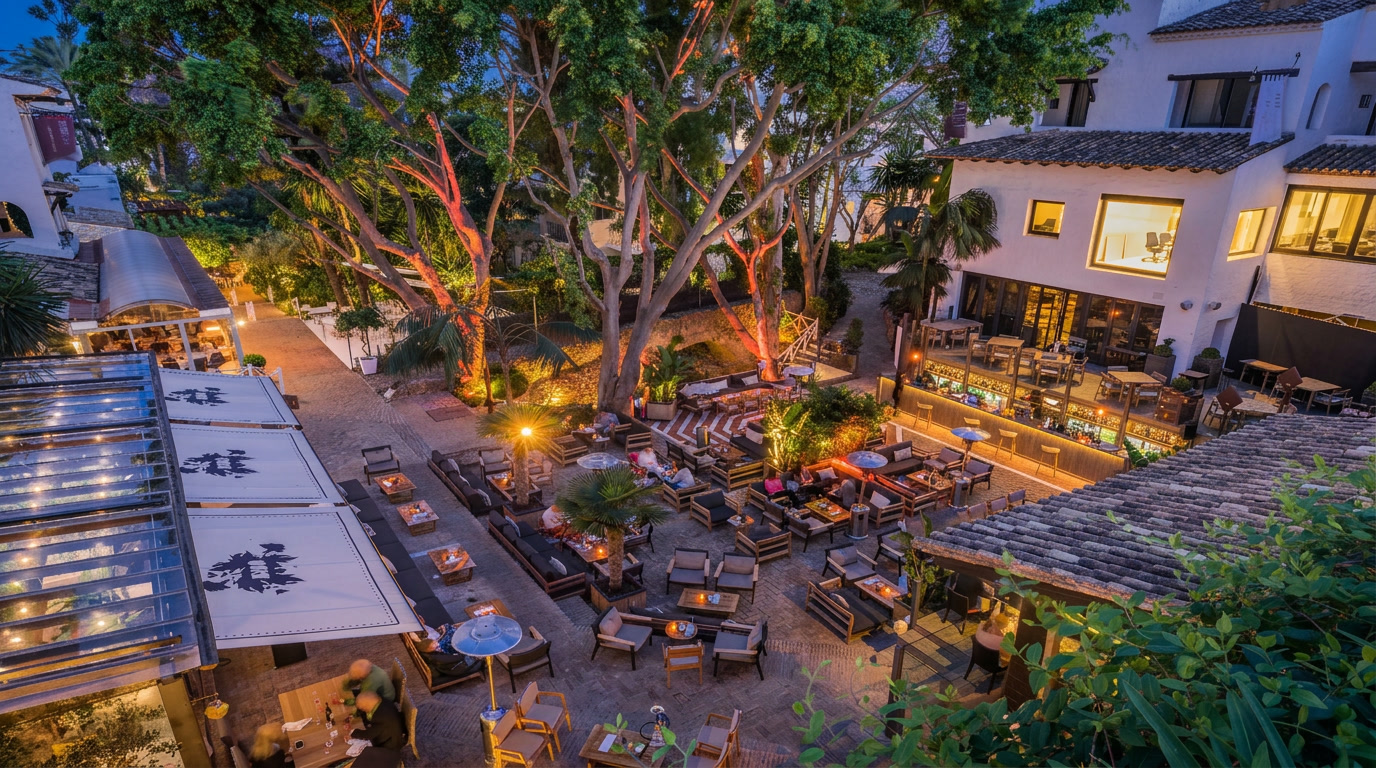
On 31 October 2026 the Salón Andalucía Ballroom at Puente Romano in Marbella will host a black-tie charity dinner. The evening is structured as a Roaring Twenties-inspired event: welcome cocktails and canapés at Claude’s music bar, followed by an autumn chef’s tasting menu paired with regional Spanish vintages inside the ballroom, with live performances that move from orchestral sets and theatrical vignettes to later DJ programming. Proceeds benefit The Children’s Trust. Arrival is requested fifteen minutes before the 20:00 start.
The dress code is explicit: strictly formal evening black tie or bespoke 1920s sartorial pieces. Commercial or plastic costumes are not admitted. The distinction matters. A 1920s-inspired evening in this setting is not an invitation to mass-produced fringe or synthetic sequins. It is an occasion for cloth that behaves as period cloth behaved—silk that moves, beads that catch light, a cut that either falls straight from the shoulder or, if later in the decade’s vocabulary, follows the bias. For men, the correct response is a dinner jacket or full evening dress with a white shirt, studs, cufflinks, and a bow tie; coloured shirts of the sort Fitzgerald described remain possible only if the overall formality of the room is respected. The venue itself supplies a Mediterranean coastal frame—whitewashed architecture, gardens, and the Roman bridge that gives the resort its name—rather than a recreation of a Long Island mansion. The clothes, therefore, need only register the period’s proportions and materials; they do not need to reconstruct an entire interior.
Puente Romano opened in 1979 on the Golden Mile, built around a first-century Roman bridge that once formed part of the Via Augusta. The resort’s low-rise Andalusian village plan, subtropical gardens, and concentration of restaurants have made it a fixed point for formal gatherings on the Costa del Sol. An evening that begins with cocktails in a music bar and continues through paired courses and live music in the ballroom fits the property’s existing pattern of large-scale dining events. The 1920s frame adds a specific requirement for clothing: garments that can be worn for several hours of seated dining and standing conversation, that tolerate artificial light, and that do not rely on disposable materials.
Interpreting the Period Without Excess
The practical requirements of the dress code align with what the decade actually produced. A straight silk or chiffon dress with a dropped waist, a modest amount of beadwork or embroidery concentrated at the hip or hem, and a low or no heel remains readable as 1920s evening wear. Multiple strands of beads or pearls, a simple headband, and an evening bag of metal mesh or fabric complete the surface without overwhelming it. For men, a well-cut dinner jacket, a white or pale shirt with French cuffs, and restrained cufflinks satisfy both black-tie convention and the period’s preferences. Overly theatrical additions—oversized feathers, plastic sequins, or costume jewellery of low quality—contradict both the original materials and the stated admission rules.
The social function of the clothing has also shifted. In the 1920s the garments signalled membership in a narrow circle that could afford couture and the leisure to wear it. At a contemporary charity dinner the same proportions and materials signal attention to the occasion and to the host’s request. The difference is useful. It allows the evening to borrow the visual language of the decade—geometry, sheen, movement—without requiring participants to perform a historical role. The tasting menu, the Spanish wines, and the progression from orchestra to DJ supply the contemporary content; the clothes supply the consistent surface against which that content is seen.
Museum holdings and period photographs remain the most reliable guides. A black silk chiffon dress with beaded borders, a satin gown whose geometric collar is held by parallel stitching, a dinner jacket with satin lapels and a wing-collar shirt: these are concrete objects whose construction can still be examined. They indicate what the decade considered appropriate for rooms lit by electricity and filled with people who expected to dance or to be observed. An evening at Puente Romano on 31 October that observes the same material standards—cloth that moves, surfaces that catch light, cuts that follow the body’s proportions without internal armour—will read as continuous with that standard rather than as an approximation of it. The charity purpose and the specific menu supply the reason for the gathering; the clothing supplies the condition under which the gathering is visible.
The Great Gatsby Halloween Gala
From the journal
Related articles
Dolce & Gabbana in Puerto Banús: Inside Marbella’s Luxury Shopping Scene
Discover how Dolce & Gabbana fits into Puerto Banús, one of Marbella’s most recognisable luxury shopping destinations. From distinctive Italian design and carefully considered boutique interiors to the international clientele that defines the marina, explore the relationship between the fashion house and the Costa del Sol’s high-end retail scene.
16 OCT 2026
Antonio Banderas: Málaga, Marbella and the Long Way Home
From Almodóvar's Madrid to Hollywood, Cannes and an Oscar nomination, and back to the coast where he was born: a profile of Antonio Banderas, his Teatro del Soho, his years at La Gaviota in Marbella and the Starlite Gala he has co-hosted since 2010.
15 NOV 2026
The Rise of Longevity Tourism on the Costa del Sol: How Marbella Is Redefining Luxury Through Wellness and Preventative Health
Marbella is entering a new era of luxury wellness. With Oakmond Marbella scheduled to open in 2029, combining five-star hospitality, preventative healthcare and longevity-focused facilities, the Costa del Sol is positioning itself within a growing international market. Discover how this development could reshape luxury tourism, real estate, healthcare and wellness businesses across southern Spain.
01 NOV 2026
Live from the coast
Related wire dispatches
Marbella Readies 3.8 Million LED Points For Christmas, With Four Giant Angels In Plaza de los Naranjos
Marbella and San Pedro Alcántara will light 3,825,784 LED points this Christmas, the town hall said on 8 November. Four large angels in Plaza de los Naranjos and a light forest on San Pedro's Avenida Marqués del Duero will each stage three musical shows a day. The council had not published a switch-on date when this dispatch was filed on 19 November.
Puente Romano Names Francesco Roccato General Manager, Returning Him to Marbella
Puente Romano Marbella has appointed Francesco Roccato as general manager. The Turin-born hotelier led the opening of Nobu Hotel Marbella between 2016 and 2018 and will oversee a multi-year investment programme covering the resort's suites, restaurants and sports facilities.
Marbella Opens Voces del Sur, A Four-Day Poetry And Flamenco Cycle, Ahead Of The 20th Sierra Blanca Festival
Marbella's Teatro Ciudad hosts Voces del Sur, a new free cycle of poetry and flamenco with Rocío Márquez, Jaime Siles and Daniel Casares, from 18 to 21 November. The 20th Festival Flamenco Sierra Blanca follows at the same theatre on the Saturday night.