Antonio Banderas: Málaga, Marbella and the Long Way Home
From Almodóvar's Madrid to Hollywood, Cannes and an Oscar nomination, and back to the coast where he was born: a profile of Antonio Banderas, his Teatro del Soho, his years at La Gaviota in Marbella and the Starlite Gala he has co-hosted since 2010.
By Wellington Almeida · Updated 15 NOV 2026

Antonio Banderas at the Starlite Gala in Marbella, August 2019. Photo: Rincón Friki, via Wikimedia Commons, CC BY-SA 2.0.
On the evening of Sunday 9 August 2026, in a former quarry at Nagüeles, in Marbella, a tenor and a four-tier cake brought a charity dinner to a close. Plácido Domingo sang "Cumpleaños feliz" to Antonio Banderas as midnight passed and the actor turned 66. It was the seventeenth Starlite Gala, the event he has hosted with the entrepreneur Sandra García-Sanjuán since 2010. He had missed the previous edition in person because of work, joining only by video call. This year he was back on stage, auctioning a shirt he had painted himself that morning. It sold for €11,000.
The scene shows two sides of Banderas's public life that are rarely examined together. One is the international career: more than four decades of film, a Cannes prize, an Academy Award nomination, Broadway. The other is a long and practical attachment to the coast where he was born and to which, since 2017, he has largely returned. This profile follows both, with particular attention to Marbella, where his daughter was born, where he kept a beachfront house for more than twenty years, and where the Starlite Gala has become one of the fixed dates of the summer.
A Málaga childhood
José Antonio Domínguez Bandera was born in Málaga on 10 August 1960. He is the son of José Domínguez Prieto and Ana Bandera Gallego, a schoolteacher. He has a younger brother, Francisco Javier. As a boy he wanted to be a footballer, until a broken foot at fifteen ended that plan. He turned instead to the stage, training in Málaga at the ARA theatre school and at the city's School of Dramatic Art.
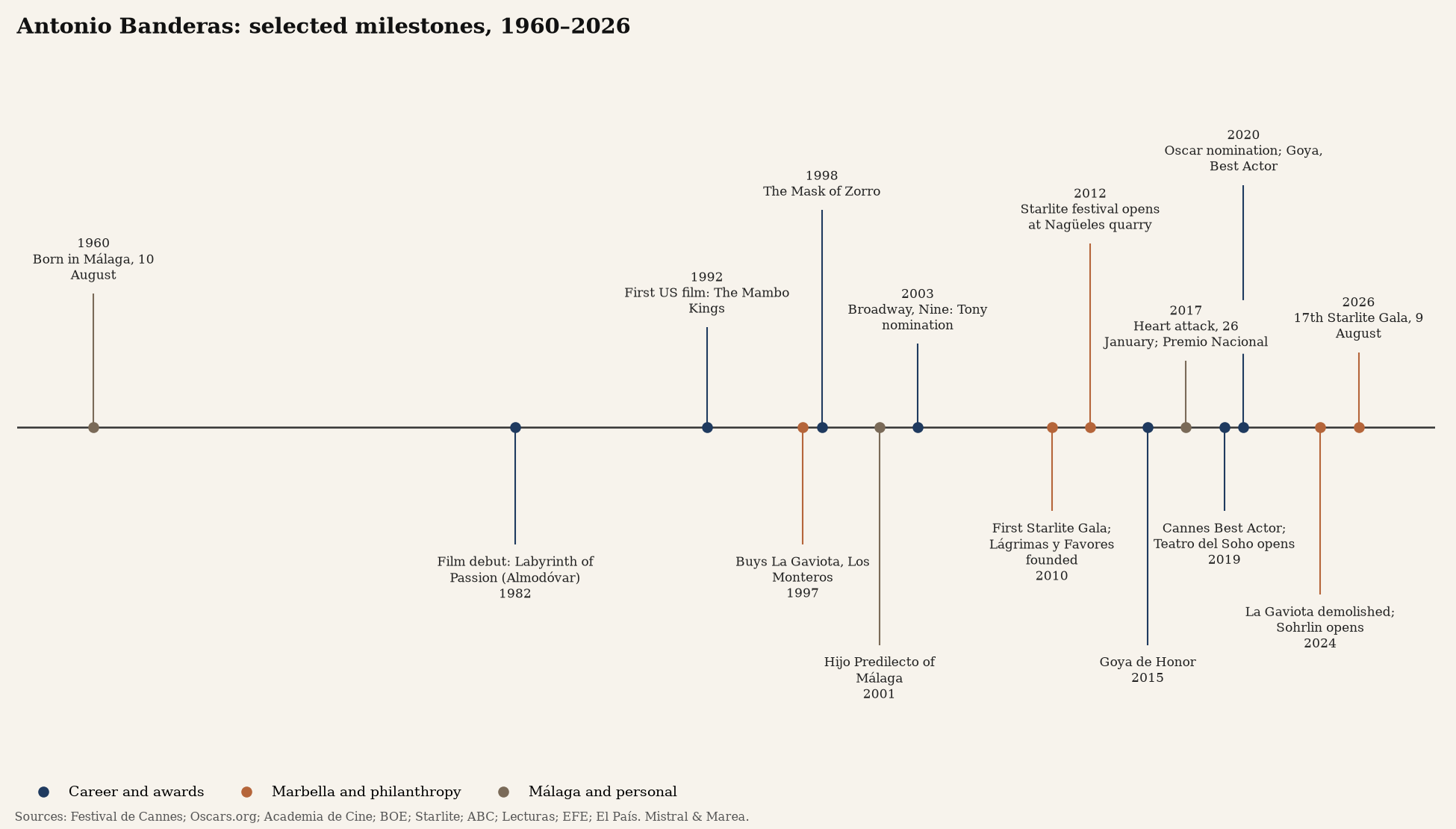
His first performances were local and unglamorous. At a press conference during the Málaga Film Festival in 2017 he recalled working as an actor at the Roman Theatre beneath the Alcazaba in the 1970s: "Venía vestido de romano en un Vespino" (I used to arrive dressed as a Roman, on a moped). At nineteen he took the train to Madrid. When he received the Goya de Honor in 2015, he thanked his parents, who, he said, had watched their son leave Málaga fearing he had made a reckless choice, and told the audience: "Nunca volvería a mi Málaga con las manos vacías" (I would never return to my Málaga empty-handed).
In Madrid he found work with the Centro Dramático Nacional and lived, for a time, in cheap boarding houses. The city was in the middle of La Movida, the cultural opening that followed the dictatorship, and it was on stage there that he came to the attention of Pedro Almodóvar.
The Almodóvar years
Almodóvar gave Banderas his first film role in Labyrinth of Passion (1982). Across the decade they made Matador (1986), Law of Desire (1987), Women on the Verge of a Nervous Breakdown (1988) and Tie Me Up! Tie Me Down! (1989). Matador and Tie Me Up! Tie Me Down! each brought him a Goya nomination. Women on the Verge was nominated for the Oscar for best foreign-language film, and the nomination took Banderas to Los Angeles for the first time.
The director described the partnership in 2015, when he presented Banderas with the Goya de Honor: "Las pantallas españolas de los 80 fueron de Antonio; y en los 90 triunfó fuera de nuestras fronteras" (Spanish screens in the eighties belonged to Antonio; in the nineties he triumphed beyond our borders). Banderas has been equally direct about the cost of working with him. In 2017 he said he owed Almodóvar "muchísimo", but called him a very hard director with whom a shoot becomes "una especie de infierno creativo" (a kind of creative hell).
Hollywood, learned phonetically
His first American film, The Mambo Kings (1992), was made when he still spoke little English; he learned his lines phonetically. In Málaga in 2017 he recalled the period without romance: staying in a New York hotel and not daring to call room service, he bought mortadella sandwiches from a grocer downstairs instead.
The breakthrough was quick. In 1993 he played Tom Hanks's partner in Jonathan Demme's Philadelphia; in 1994 he joined Tom Cruise and Brad Pitt in Interview with the Vampire. Robert Rodriguez cast him as the guitar-case gunman of Desperado (1995), and in 1996 he played Che opposite Madonna in Alan Parker's Evita, earning a Golden Globe nomination. The Mask of Zorro (1998), with Anthony Hopkins and Catherine Zeta-Jones, made him a leading man of the studio system, a status he extended with the Spy Kids films and, from 2004, as the voice of Puss in Boots in the Shrek series. He recorded the character in Spanish as well as English.
He also tested himself outside film. In 2003 he made his Broadway debut as Guido Contini in a revival of Nine, winning the Drama Desk Award and a Tony nomination. He directed two features, Crazy in Alabama (1999) and El camino de los ingleses (2006), the second adapted from Antonio Soler's novel and shot in Málaga. In 2005 he received his star on the Hollywood Walk of Fame.
Looking back in 2015, he described the move to Los Angeles as a risk taken "cuando no había ningún español instalado" (when there was no Spaniard established there), and suggested that its value lay partly in showing that Spanish actors could compete at that level.
Return to Almodóvar, and Pain and Glory
The two men did not work together for two decades after Tie Me Up! Tie Me Down!. They reunited for The Skin I Live In (2011), in which Banderas played a plastic surgeon. He also had a small part in I'm So Excited! (2013). The recognition at home accumulated in these years. The Academia de Cine gave him the Goya de Honor in 2015; at 54 he was, according to RTVE, the youngest recipient in the award's history. In July 2017 a jury awarded him the Premio Nacional de Cinematografía, citing, in the words of the Boletín Oficial del Estado, "una trayectoria extraordinaria a nivel nacional e internacional, que ha abierto el camino a muchos actores y actrices españoles" (an extraordinary career at national and international level, which has opened the way for many Spanish actors). In 2018 he played Pablo Picasso, another son of Málaga, in the National Geographic series Genius, which brought him a second Emmy nomination.
Then came Pain and Glory (2019). Banderas played Salvador Mallo, an ageing film director in physical pain, looking back on his childhood. The character was widely read as a portrait of Almodóvar himself, and Banderas said so on stage. On 25 May 2019 the jury of the 72nd Cannes Film Festival, chaired by Alejandro González Iñárritu, gave him the award for best actor. The festival's published record of his acceptance speech includes the lines: "Il ne fait de mystère pour personne que ce personnage est Pedro Almodovar. Nous avons tourné huit films ensemble. Je l’aime, je le respecte, il est mon mentor." (It is no secret that this character is Pedro Almodóvar. We have made eight films together. I love him, I respect him, he is my mentor.)
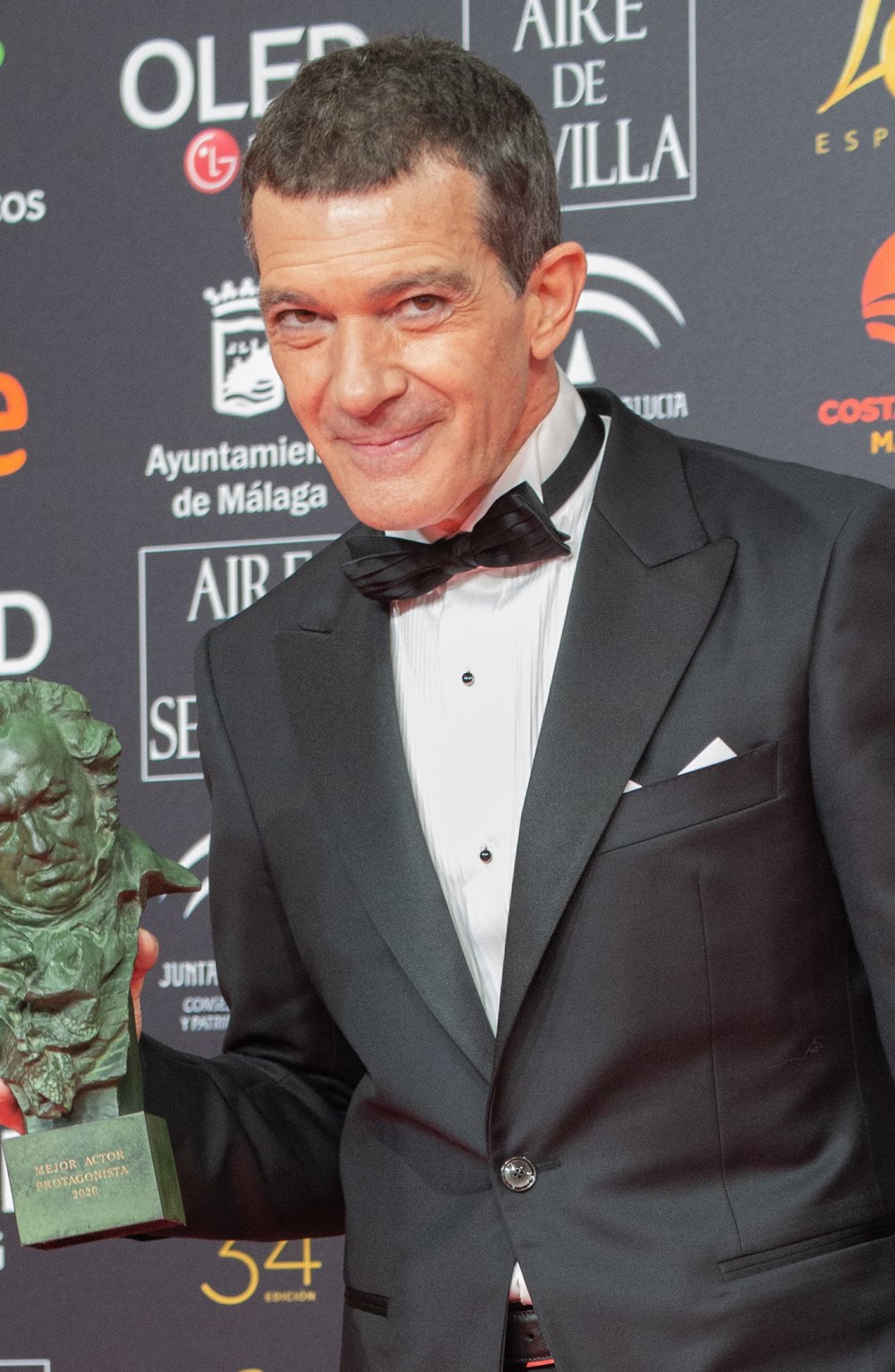
The performance brought his first Academy Award nomination, for best actor at the 92nd Oscars in 2020; the award went to Joaquin Phoenix for Joker. At home the result was different. On 25 January 2020, at a Goya ceremony held in Málaga, he won best leading actor for the same role.
The heart attack, and the decision to come home
The turn in Banderas's later life has a date. At the Málaga Film Festival in March 2017 he confirmed what had been rumoured for weeks: "Sufrí un infarto el 26 de enero, pero tuve mucha suerte, fue benigno y no ha dejado daños" (I had a heart attack on 26 January, but I was very lucky; it was mild and has left no damage). He explained that three stents had been fitted in his coronary arteries. He added that he was reconsidering a great deal after years in which, by his own account, he could not stop working.
He has since described that episode as the reason he moved his working life back to Málaga. Speaking to reporters at the Starlite Gala in August 2026, as reported by Vanity Fair, he said that after the heart attack he realised he "estaba haciendo muchas cosas que no necesitaba" (was doing many things he did not need), and decided to go home. The same report describes Málaga as the place where he walks, keeps his friends and has expanded his businesses. He also ruled out any interest in running for mayor.
Teatro del Soho and the Málaga projects
The clearest product of that return is the Teatro del Soho CaixaBank on Calle Córdoba. The building's history goes back to the Pascualini cinema of 1907; the Cine Alameda opened on the site in 1961. Banderas took a long-term lease, rebuilt the house and opened it on 15 November 2019 with a Spanish-language production of A Chorus Line, which he directed and in which he performed. The theatre describes itself as the only large-format private theatre in Andalucía, run on a non-profit basis without public funding, with CaixaBank as principal sponsor. It lists 840 seats today.
The theatre has produced its own musicals, including Stephen Sondheim's Company in 2021, which later played Barcelona and Madrid. It also has a resident orchestra, founded in spring 2021 as the Sinfónica Pop del Soho, with about fifty musicians under Arturo Díez Boscovich, and renamed Larios Pop del Soho in 2023. This December the orchestra gives the theatre's Christmas concert, with four performances from 25 to 28 December at 19:30. Banderas is artistic director, and this year he sings several numbers himself.
The second project is separate from the theatre, a distinction Banderas has made himself. Sohrlin Andalucía opened in July 2024 in a former industrial building in the west of Málaga, near the sea. It is a joint venture with his friend Domingo Sánchez of Producciones Merlín. According to EFE, it occupies 8,000 square metres, used over the decades by a steelworks, a textile firm and a grain store. Its stated purpose is to train stage technicians, in lighting, sound, wardrobe, make-up, stage management and production, and to serve as a rehearsal and production space. At the launch Banderas said the courses would be "caras" (expensive), and that a sponsor was being sought for a bursary fund covering up to 40 per cent of the cost.
EFE's report also describes him as the owner of several restaurants in the city. In 2020, El País reported that he kept a penthouse in central Málaga beside the Teatro Albéniz and El Pimpi, the restaurant in which he holds a stake.
Marbella: La Gaviota and Los Monteros
Banderas's connection to Marbella predates the theatre by two decades and is, in part, a family one. His daughter with the American actress Melanie Griffith, Stella del Carmen, was born in Marbella on 24 September 1996. The couple had married in London that May, after meeting on the set of Fernando Trueba's Two Much. (Banderas's first marriage, to Ana Leza, had lasted from 1987 to 1996.) In 2001, when Málaga City Council made him Hijo Predilecto and awarded him its gold medal, El País reported that the ceremony was planned to coincide with his holidays in Marbella.
The holidays were spent at La Gaviota, a two-storey beachfront house in the Los Monteros urbanisation, east of the town centre. It had been built in 1995 under a licence issued by the council of Jesús Gil, and its first owner was the radio presenter Encarna Sánchez. After her death in 1996, Banderas bought the house from her heirs; ABC and La Vanguardia date the purchase to 1997. It remained his Marbella base for more than twenty years, through his marriage to Griffith, which ended in an announced separation in 2014 and a divorce in 2015, and afterwards. During the spring 2020 lockdown, El País reported him confined there alone; his partner, Nicole Kimpel, was in Switzerland at the time.
The house also spent most of that time in legal difficulty. According to Lecturas and ABC, neighbours challenged the construction in 1996, arguing that it occupied land reserved for public use. In 2003 the High Court of Justice of Andalucía annulled the licence. A 2013 agreement to cede 1,243 square metres to the town hall, as compensation, was overturned in 2015 by the Supreme Court. In July 2024 Lecturas reported that the house had been demolished. Banderas had said shortly before, at a promotional event: "Marbella es la tierra en la que nació mi hija" (Marbella is the place where my daughter was born).
The episode is a reminder, for any buyer, of how far the town's past planning still reaches. ABC noted that the 2010 town plan initially legalised the house, before a later review suspended that status along with thousands of other homes. Los Monteros remains one of the established beachfront addresses of eastern Marbella. Buyers looking at the area today tend to work with local advisers, such as EQUA Estates, who can check a property's legal history and its standing under the current town plan before an offer is made. Older villas that change hands often need renovation before their new owners move in, and owners living abroad tend to bring in studios that can run such projects for them. Mirela B. Interiors, which works between Mijas and Casares, is one.
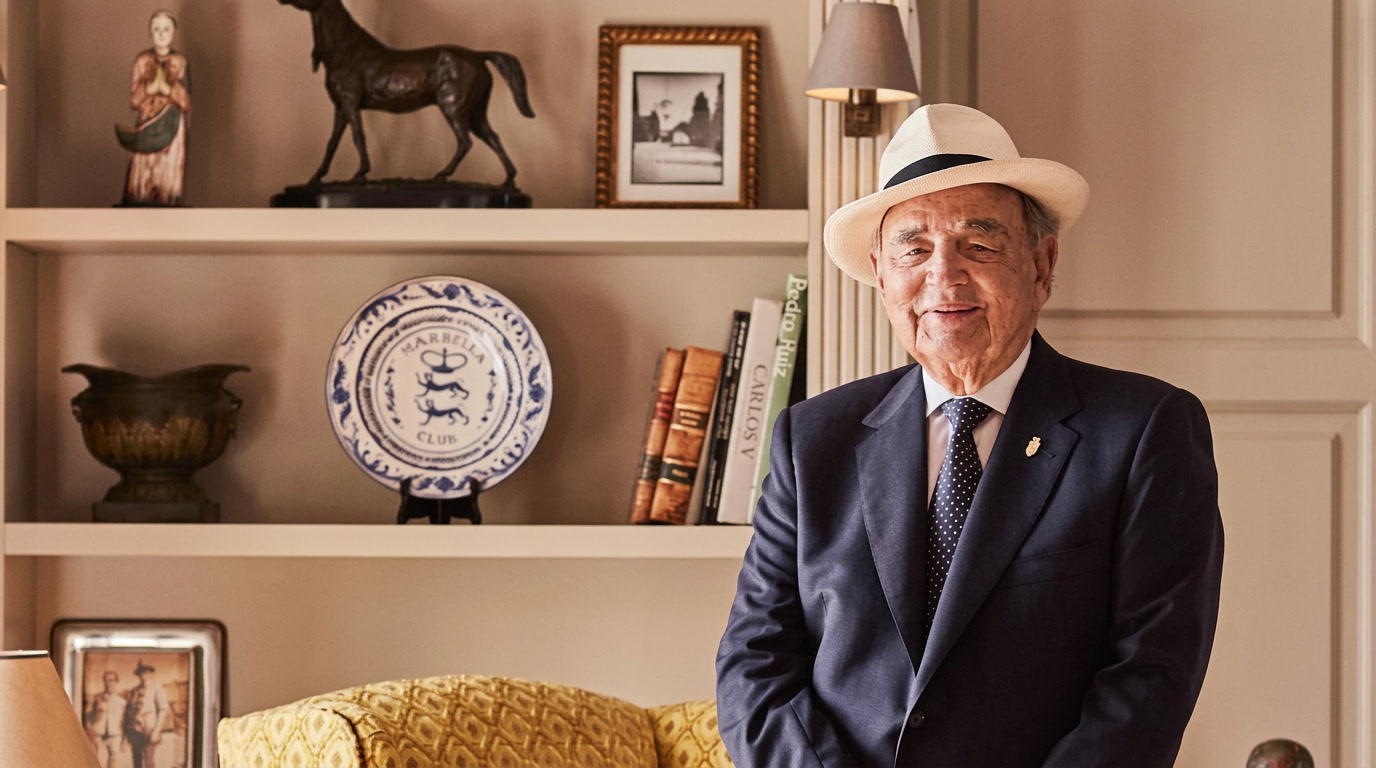
Our obituary of Count Rudi von Schönburg described the personal hospitality at the Marbella Club that made this stretch of coast known far beyond Spain. Banderas belongs to a later generation of Marbella hosts, and his part is concentrated in a single night each August.
Starlite: a gala, then a festival
The Starlite Gala began in 2010. In an interview with Billboard Español published in January 2026, Sandra García-Sanjuán described its origins: "In 2010, [actor] Antonio Banderas and I started a charity gala in Marbella called the Starlite Gala, where we invited various celebrities and gave them an award and a tribute." At the time she ran a company booking artists for concerts and private events. The gala, she said, took so much of her team's time that they added a concert the day before and one the day after, using the same stage, lighting and artists. That became the Starlite festival.
The festival's first season, in 2012, put thirteen concerts into the Cantera de Nagüeles, a former quarry in Marbella converted into an open-air auditorium. Julio Iglesias, Tony Bennett and George Benson were on the bill. By 2022 the season had grown to 61 nights. In 2023 the brand expanded to a winter edition in Madrid. The festival, now called Starlite Occident, is run by Starlite Music Group, of which García-Sanjuán is co-founder and executive president. Banderas's role has remained the gala: Starlite's own history page describes him and García-Sanjuán as its hosts.
The money goes mainly to two foundations. One is Niños en Alegría, co-founded by García-Sanjuán and the Mexican businesswoman Alejandra Alemán, which works with schools in Mexico. The other is Banderas's own Fundación Lágrimas y Favores. In 2013, presenting what was then the fourth gala, Banderas said the 2012 edition had raised €267,861 and that everything raised was distributed. In 2026 Europa Press reported more than €140,000 raised at the seventeenth edition. That included the auction, where a guitar and cajón signed by the evening's performers fetched €17,000 and a painting by the Swiss artist Raymond Stuwe went for €30,000.
The 2026 edition took the theme "Peace & Love" and the dress code "Hippie Retro Glam", which suited Banderas better than most of the guests. Vanity Fair reported his comment from the stage: "Fui hippy cuando el movimiento se extinguió" (I was a hippie when the movement was dying out). He followed it with a Marbella memory from 1967: "Los hippies no venían a Marbella porque era muy cara, se quedaba en Torremolinos." (The hippies didn't come to Marbella because it was very expensive; they stayed in Torremolinos.) He was, he said, seven years old, in the car with his parents and his brother. On the gala's future he was clear: "Llevar 17 años es un gesto de perseverancia y vamos a seguir otros 17 años más para seguir apoyando nuestros sueños solidarios y los de nuestras fundaciones." (Seventeen years is an act of perseverance, and we will carry on for another seventeen to keep supporting our charitable dreams and those of our foundations.)
The criticism most often made of events of this kind is that the publicity outlasts the funding. Starlite's response has been to name the beneficiaries and publish its totals each year. The figures are modest beside the guest list, but the gala has now run for seventeen editions.
Lágrimas y Favores: a brotherhood's charity
The name of Banderas's foundation comes from Holy Week in Málaga. According to ¡Hola!, keeping Holy Week free is one of his conditions for accepting a project. He is a member of the Cofradías Fusionadas, a Málaga brotherhood, and on Palm Sunday serves as mayordomo of the throne of the Virgin of Lágrimas y Favores, which is carried in procession through the city. In 2011 he gave the official proclamation that opens Málaga's Holy Week.
The foundation was set up in 2010. According to its own website, the aim was to give practical form to the year-round social work of the brotherhoods. It funds university scholarships for students from Málaga, including postgraduate study in the United States and Canada, and a chair in Holy Week studies at the University of Málaga. It also supports Cudeca, the Costa del Sol's palliative-care foundation, and the Corinto social supermarket, which supplies food to families in need. The foundation's page states that the only condition for a scholarship is to be a malagueño, by birth or by adoption, and that holders are not required to take part in brotherhood activities.
The Starlite Foundation, for its part, states that 90 to 95 per cent of Lágrimas y Favores's annual funds come from the gala, and that the foundation has distributed more than €2 million since it was set up. These are the organisers' own figures, not independently audited ones, but they explain the weight Banderas attaches to the August date.
Business beyond the stage
Banderas's commercial interests are older than the theatre and have not all succeeded. In 1997 the Barcelona fragrance group Puig signed him to produce scents under his name, beginning with Diavolo. Later lines have included Blue Seduction.
Wine was less straightforward. In 2009 he took a half share in the Anta winery at Villalba de Duero in Burgos, renamed Anta Banderas. The company entered insolvency proceedings in 2012. In 2018 the Rioja group CVNE took control through a capital increase. In March 2019 EFE reported that CVNE was completing the purchase of the winery, "que fue propiedad del actor Antonio Banderas" (formerly owned by the actor Antonio Banderas). It now trades as Bodega Bela.
The Málaga ventures, by contrast, are local and run with partners: the theatre, the restaurants and Sohrlin. Their logic is the one he set out after 2017, to spend his time and money in his home city. They also run alongside a film career that has not slowed. In recent years he has appeared in Official Competition (2021), Uncharted (2022), Indiana Jones and the Dial of Destiny (2023), Babygirl and Paddington in Peru (both 2024). In August 2026 he described Tony, a film about the chef Anthony Bourdain, as one of his current projects.
What the coast gets
It would be easy to treat Banderas's Málaga and Marbella as a backdrop to a Hollywood career. The record suggests the reverse. His honours begin at home: Hijo Predilecto of the city in 2001, of the province in 2005 and of Andalucía in 2013. The investments he has made since 2017, a theatre, a training centre and a charity, all depend on people staying in the province. They need technicians trained in Málaga, audiences who come back each season, and students who return with degrees.
Marbella's part in this is narrower but long-lasting. It gave him a summer house, a birthplace for his daughter and, through Starlite, an annual platform. In return the gala has raised money for Málaga students and for palliative care. The house at Los Monteros has gone, but the gala remains.
For readers who want to follow the work on stage, the Teatro del Soho's page in our Salons lists the house's address and box office, and our Radar carries its season through January. Cultural venues on the coast that would like to appear alongside it can apply to join the Salons directory.
From the journal
Related articles
The Last of the Hosts: Count Rudi and the Making of Marbella
Count Rudi von Schönburg-Glauchau dies at 94, closing nearly seven decades of foundational leadership and personal hospitality at the Marbella Club.
20 OCT 2026
The Rise of Longevity Tourism on the Costa del Sol: How Marbella Is Redefining Luxury Through Wellness and Preventative Health
Marbella is entering a new era of luxury wellness. With Oakmond Marbella scheduled to open in 2029, combining five-star hospitality, preventative healthcare and longevity-focused facilities, the Costa del Sol is positioning itself within a growing international market. Discover how this development could reshape luxury tourism, real estate, healthcare and wellness businesses across southern Spain.
01 NOV 2026
Marbella Is Going After the World's Biggest Spenders: How DUCO Spain & Portugal 2026 Signals a New Era for Luxury Tourism
An operational breakdown of DUCO 2026 in Marbella: connecting 170 luxury travel advisers with regional hospitality to drive year-round, high-yield tourism.
27 OCT 2026
Live from the coast
Related wire dispatches
Marbella Readies 3.8 Million LED Points For Christmas, With Four Giant Angels In Plaza de los Naranjos
Marbella and San Pedro Alcántara will light 3,825,784 LED points this Christmas, the town hall said on 8 November. Four large angels in Plaza de los Naranjos and a light forest on San Pedro's Avenida Marqués del Duero will each stage three musical shows a day. The council had not published a switch-on date when this dispatch was filed on 19 November.
Puente Romano Names Francesco Roccato General Manager, Returning Him to Marbella
Puente Romano Marbella has appointed Francesco Roccato as general manager. The Turin-born hotelier led the opening of Nobu Hotel Marbella between 2016 and 2018 and will oversee a multi-year investment programme covering the resort's suites, restaurants and sports facilities.
Marbella Opens Voces del Sur, A Four-Day Poetry And Flamenco Cycle, Ahead Of The 20th Sierra Blanca Festival
Marbella's Teatro Ciudad hosts Voces del Sur, a new free cycle of poetry and flamenco with Rocío Márquez, Jaime Siles and Daniel Casares, from 18 to 21 November. The 20th Festival Flamenco Sierra Blanca follows at the same theatre on the Saturday night.