Talent Land España: What Málaga Gets From Three Days of Courting Young Tech Talent
Talent Land España returns to FYCMA from 24 to 26 November for its third edition. Where the Mexican-born event came from, what the 2026 programme and tickets offer, who funds it, and what it can and cannot do for Málaga's talent pool, employers, hotels and housing.
By Anna Kuznetsova · Updated 16 NOV 2026
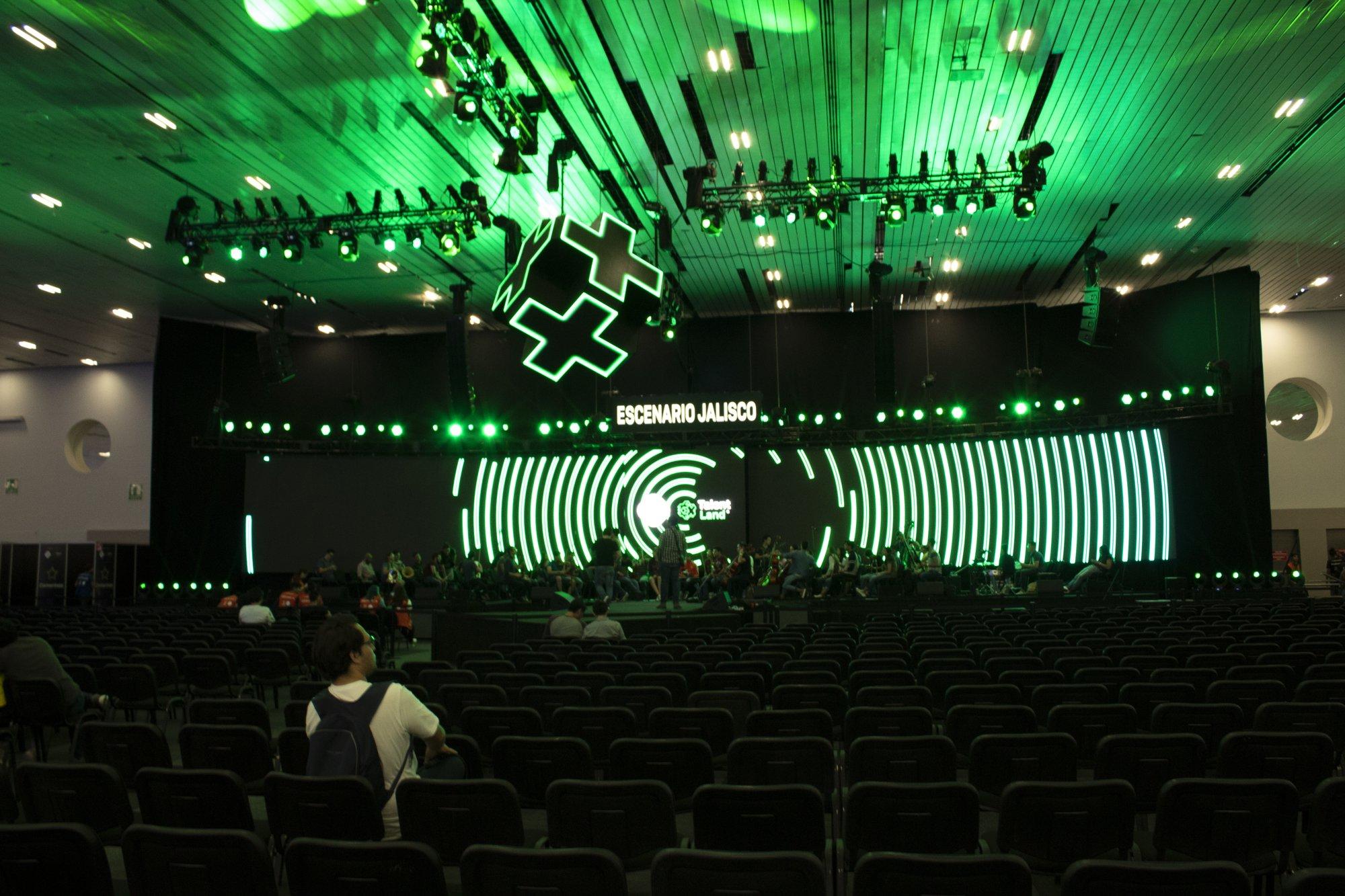
The main stage at Talent Land 2019 in Guadalajara, Mexico, where the event began before arriving in Málaga in 2024. Photo: Rico904, via Wikimedia Commons, CC BY-SA 4.0.
In August 1997, about 250 people carried their computers into a sports hall at the Ceulaj youth centre in Mollina, a town of a few thousand inhabitants in the north of Málaga province, and played and swapped files over a local network for three days. Pablo Antón, one of the friends who organised it, recalled last week that the organisers had installed seven ISDN lines to connect the room to the internet. The gathering became Campus Party, which moved to Valencia in 2000 and was later exported to Latin America. Almost three decades on, Antón is back in Málaga with a different format and a far larger audience. From Tuesday 24 to Thursday 26 November, Talent Land España holds its third edition at FYCMA, the city's trade fair and congress centre, under the slogan "where talent and AI come together to lead the future".
The event sells itself as the largest gathering of talent, technology and innovation in Spain. It is a three-day mix of keynote talks, practical workshops, a hackathon, a startup showcase and a long list of popular science communicators and podcasters. It is also a publicly backed project: the provincial council, the regional government, the city's investment agency and a banking foundation all support it. What follows sets out where Talent Land comes from, what the 2026 programme contains, what it costs to attend, who pays for it and what it can realistically do for Málaga's labour market, its employers and its economy.
From Campus Party to Guadalajara
Talent Land was born in Mexico. In October 2017, the Guadalajara newspaper El Informador reported that Jalisco's state government and former members of the Campus Party team in Mexico were launching a new event of similar scale under the name Jalisco Talent Land. The organiser was Talent Network, a company formed by several of the people who had run Campus Party in Guadalajara; the Campus Party brand itself had been sold in September 2017 to another company. The state government, the municipalities of Guadalajara and Zapopan and federal bodies said they would back the new event instead. The paper described Antón as one of Talent Network's co-founders and as the founder of the Campus Party brand in Spain two decades earlier.
The first edition ran from 2 to 6 April 2018 at Expo Guadalajara. At its close, Antón told the press it had drawn 33,018 people, a figure that included guests, speakers, online community members and media, with an average age of 23. The organisers said more than 200 companies had taken part and that 8,000 job vacancies had been posted in the event's jobs area. Scholarships were part of the model from the start: the University of Guadalajara said it had funded places for 5,000 students. Registration was priced at 3,000 Mexican pesos.
The Mexican event grew for several years and then moved. Its eighth Guadalajara edition, in April 2025, closed with 30,000 attendees, according to the University of Guadalajara's television channel, and the organisers reported 767 speakers and 195 sponsors. Two months later Talent Network announced it was leaving Guadalajara for Mexico City, where the ninth edition was held from 7 to 9 April 2026 at Expo Santa Fe. At the June 2025 announcement, Iván Millán, the director general of Talent Network Mexico, told the trade site DPL News that the aim was for the event to be funded increasingly by the private sector.
The move to Málaga
Spain came next. Talent Land was presented in Málaga on 8 March 2024 at the city's video game museum, with the mayor, Francisco de la Torre, alongside Raúl Martín, chief executive of Talent Network, and Antón, described as the Spanish partner. The city council's statement said the organisers had chosen Málaga as their European venue for four years, from 2024 to 2027, and expected 10,000 young people at the first edition. De la Torre said the event fitted the city's aim "to generate and retain its own talent" as well as attract it from outside.
Asked by El Español last week why he chose Málaga rather than Madrid or Barcelona, Antón, who was born in Switzerland but describes himself as malagueño, said he saw the city as "a technology reference point on the boil". He added that he had first regarded Málaga's technology push as "more a marketing operation", until companies such as Oracle and Google arrived.
The first Spanish edition ran from 3 to 5 July 2024. The organisers reported 19,000 visitors over the three days, more than 180 talks and around 350 speakers, figures relayed by Cadena SER; the video game site Meristation put attendance at more than 10,000. The edition also earned a Guinness World Records title for its Aqua Challenge, a hackathon on water and climate problems that the organisers said drew 1,831 registered participants and 232 projects in its final phase. The regional president, Juanma Moreno, announced the winners, who shared €15,000 in prizes.
The second edition moved to winter, closing on Saturday 6 December 2025. FYCMA's closing statement gave 11,115 attendees, 165 speakers and 110 hours of content. Fundación Unicaja sponsored the first Talent Awards, given to Jordi Wild as podcaster, Brais Moure for technology, Javier Santaolalla for science and Roxana Falasco for business, with a career award for the broadcaster Iker Jiménez. Sponsors named in that statement included YouTube and the Spanish hosting company Raiola Networks, as well as the regional tourism brand and the autonomous city of Melilla.
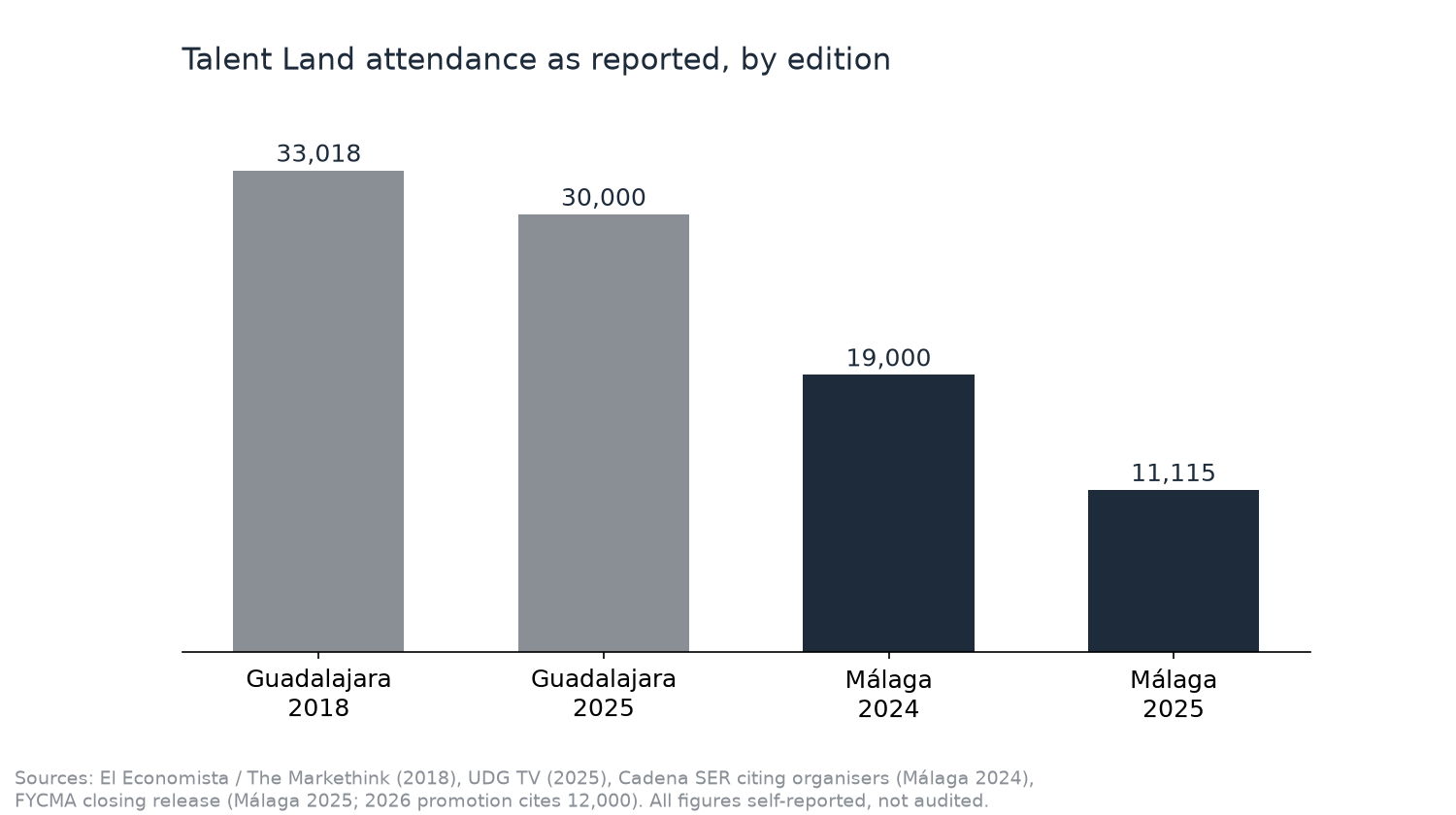
Attendance as reported at the close of each edition. All figures come from the organisers or partner bodies and have not been independently audited. Chart: Mistral & Marea.
The 2025 figures have since been restated. When the 2026 edition was presented on 10 November, the organisers said the previous year had closed with 12,000 registered attendees, 189 speakers and 125 startups, and the event's website now advertises "+12,000 attendees". The two sets of numbers may measure different things, registrations against people through the door, but neither the organisers nor FYCMA has explained the gap. On either count, the Spanish event is still about a third of the size of its Mexican parent.
What the 2026 programme contains
This year's programme is organised into five themed areas, which the organisers call "Lands". Science Land covers artificial intelligence, biotechnology, quantum computing and neuroscience. Cybersecurity & Developer Land covers code, security and cloud-native software. Business & Investor Land deals with fintech, growth, sustainable investment and crypto assets. Creator Land is for design, content and the creator economy, and Gamer Land for video games, esports and virtual reality. Two further tracks run across all five: Talent Woman, on women in science and technology, and AI First, which treats artificial intelligence as the common thread of the edition.
The site has a main stage and two themed stages, plus workshop rooms. The organisers list a Partners Zone for company meetings, a Startup Hub with room for 20 to 24 projects a day, including a pitch competition, and an Activation Zone with three-minute "flash networking" meetings and an open microphone where attendees can present a skill in 15 minutes. An "AI Live Mural" will turn attendees' answers about the future of technology, submitted from their phones, into a collective image generated in real time. The AI First Hackathon, run by the innovation consultancy Diverxia Consulting, is a 16-hour non-stop competition for mixed teams of students, professionals and founders, who must solve business problems with AI tools and present their solutions to a jury.
The main stage is built around well-known names from Spanish-language YouTube and podcasting rather than corporate executives. The headline debate asks whether AI will make programmers redundant, with the software engineer and MoureDev creator Brais Moure, the AI communicator Carlos Santana, known as DotCSV, and the podcaster Uri Sabat, who will record the session live. The neuroscientist Mariano Sigman will discuss the limits of AI with the philosopher Enric Fernández Gel. Carlos Roca, René ZZ and Sabat share a panel billed as "Humans vs AI".
Other sessions move further from technology. A panel titled "Does God exist?" brings together the philosophers David Pastor Vico and Fernández Gel, the science journalist Rocío Vidal, known as La Gata de Schrödinger, and the priest Miguel Segura, who advised on the film The Passion of the Christ. Jordi Wild will take questions from the audience, reversing his usual role as interviewer; Antón told El Español that Wild will be allowed to refuse only three. The physicist Javier Santaolalla and the comedian Luis Piedrahita will stage a show combining science, magic and humour, and the hosts of the podcast Tengo un Plan will interview Santaolalla live. The line-up also includes the Spicy4Tuna podcast group, the pharmacist and nutrition communicator Boticaria García, the physicist Alba Moreno, the chemist Aythami Soto and the YouTuber Mikecrack, whose channel has more than 58 million subscribers. Fundación Unicaja will present the second Talent Awards.
Antón singled out one session: an interview with Miriam González, a communicator with metastatic cancer who, he said, has assembled a team of AI agents to research her own treatment. He presented it as an example of AI "at the service of the human being".
The provincial council will also have a stand presenting its employment and enterprise programmes, including its Plan de Primera Oportunidad for first jobs and its support for the self-employed. María del Carmen Márquez, the provincial deputy for employment, described the event as "a unique shop window" and said the council would be there "beside the young people of Málaga".
Tickets and access
Prices are low by the standards of professional conferences. The official site lists a three-day Standard ticket at €40, a Day Pass at €20 and an Online ticket at €30, which gives access to main-stage content during the event but not to the venue. A Plus ticket at €120 adds a separate lounge area, priority entry and seating at the main stage, a cloakroom, a welcome pack and six months of on-demand main-stage video, against three months for Standard holders. All tickets include a digital certificate of attendance. They are non-refundable but can be transferred to another person, and minors may attend with a responsible adult and signed parental authorisation.
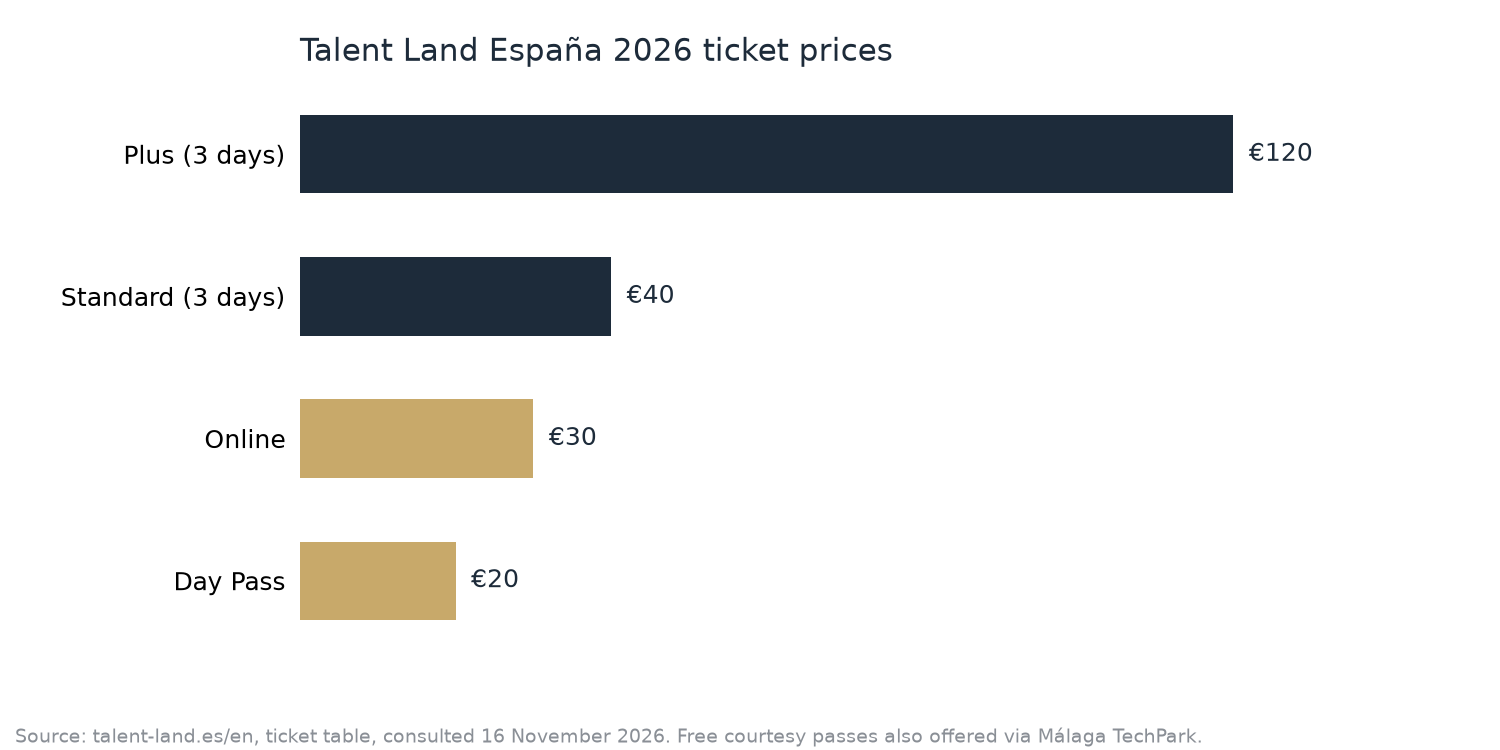
Ticket prices as listed on the official site on 16 November 2026. Chart: Mistral & Marea.
Free places exist, though in limited numbers. Málaga TechPark is offering courtesy passes through a dedicated page on the event's site; each is named, limited to one per person and granted after an application that the organisers promise to answer within 24 hours. For visitors from elsewhere, the organisers have arranged a €5 discount per booking with the rail operator iryo for journeys to Málaga between 19 and 30 November, 12% off at six Soho Boutique properties in the city for stays between 23 and 27 November, a code for the Hotel Zenit and rooms at the Inturjoven youth hostel from €75.
Who pays
The 2026 edition is backed by the Diputación de Málaga; by the Junta de Andalucía, through its ministry for artificial intelligence, digital development and public administration and the Agencia Digital de Andalucía; by Promálaga, the city council's investment agency; and by Fundación Unicaja. The amounts for this year have not been announced with the programme.
Public records give an idea of the scale for 2025. On 27 August 2025, the provincial council approved a direct grant of €150,000 to Rupture Events S.L. to pay for "spaces and services" at Talent Land 2025, according to the national grants database. In December 2025, the Junta's tourism and sport company awarded the same firm a €14,500 contract, before VAT, for sponsorship of that edition. Neither sum is large set against the budgets of the institutions involved, and both buy a visible presence at an event aimed at young residents. But we found no published assessment of what the money returns, in jobs, company formation or visitor spending, and the organisers' attendance figures are the only performance data in the public domain.
The cluster around it
Talent Land is attractive to Málaga's institutions because it addresses a problem they talk about constantly: whether the city can produce and keep enough technical staff for the employers it has attracted. Málaga TechPark, the technology park in Campanillas, reported 29,018 workers and 719 companies and institutions at the end of 2025, with combined turnover of €4,896 million, 17% more than a year earlier. Seventy-three foreign-owned companies from 22 countries employed close to 8,000 people there, and electronics, IT and telecommunications accounted for 52% of the park's jobs.
Several of the city's best-known technology employers sit outside the park. Google's Safety Engineering Center on the Paseo de la Farola, opened in November 2023, had 104 staff in September and was still recruiting for six of 14 posts advertised in July, according to La Opinión de Málaga. EY's Global Delivery Services centre now employs 1,100 people, more than twice its 2022 headcount, as our report on EY's Málaga expansion set out. A semiconductor research centre, with the Belgian institute imec as technology partner, is due to start construction at the TechPark in the first quarter of 2027.
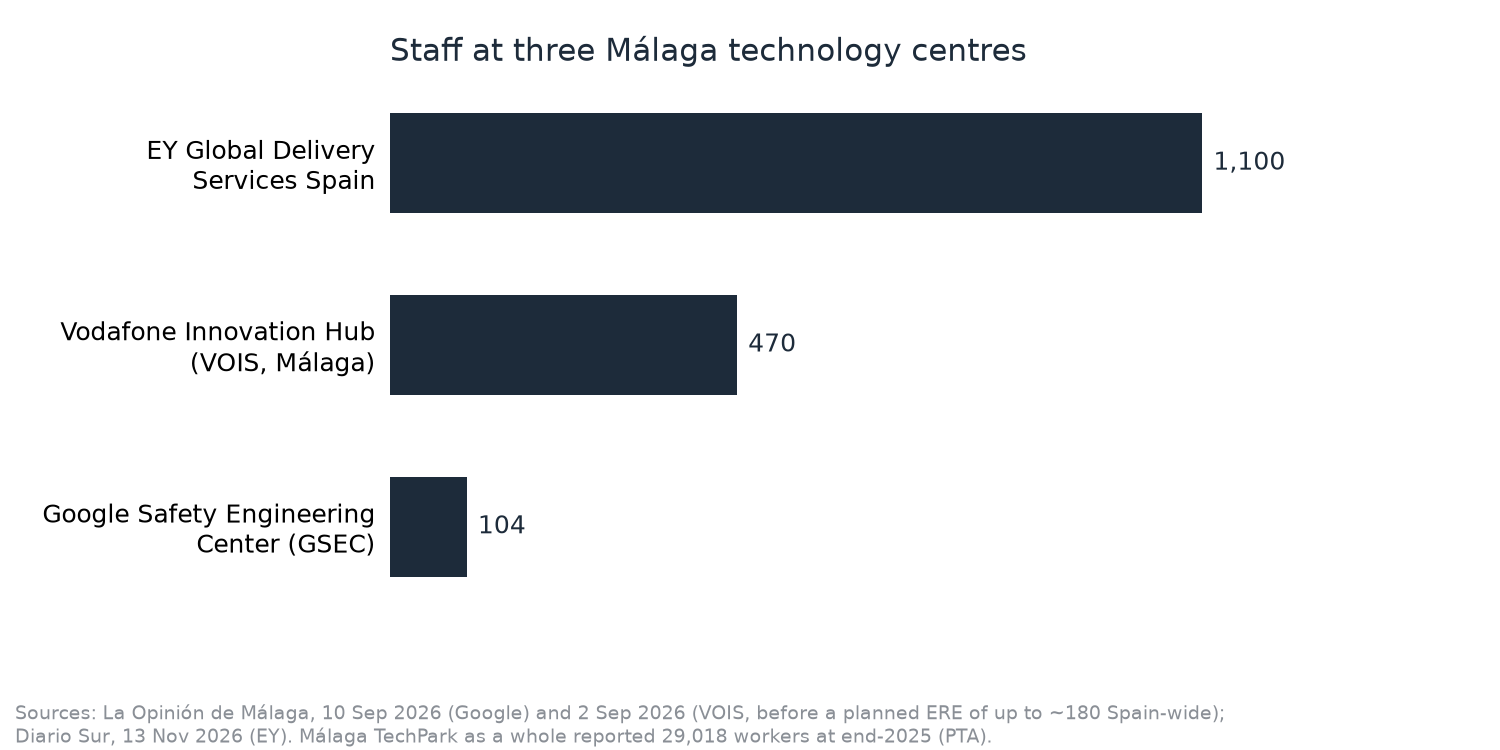
Reported headcount at three Málaga technology centres, autumn 2026. Chart: Mistral & Marea.
Growth is not uniform. In September, Vodafone Intelligent Solutions (VOIS), the Vodafone Group company whose main Spanish base is the Vodafone Innovation Hub in Málaga, announced a collective dismissal procedure affecting up to 20% of its roughly 900 staff in Spain. The Málaga centre had 470 employees at the time. The company called it a "necessary adjustment" to a changing sector; the UGT union said it was hard to justify given the current workload.
Not every developer the event courts will end up at a multinational. A share of the coast's technical work is done by small studios and freelancers serving local businesses, among them Wellington Almeida's web development and digital strategy studio in Estepona, which also built this publication's website. For that part of the market, an event of this kind is more useful for meeting clients and collaborators than for finding an employer.
What it delivers
For young people and talent retention. The event's strongest argument is access. A €40 ticket, or a free one through the TechPark, puts students from Málaga and the rest of Andalucía in a room with practising engineers, founders and recruiters, and with the communicators many of them already follow online. The hackathon and the Startup Hub give a few teams practical experience of presenting to a jury. Antón's own case is that young people with talent "still dreamed of Mountain View, San Francisco, London" and that Málaga has now become an alternative. Whether the event changes anyone's decision to stay is not measured. The Mexican edition published job-vacancy figures in its first year; the Spanish edition has not published comparable data on hires, internships or vacancies.
For employers. The organisers pitch the event to companies as a tool for talent attraction and employer branding. For the larger employers, the attraction is visibility in front of thousands of technically minded young people at a modest cost compared with campus recruitment. The audience profile is broad, however. Content creators, gamers and minors accompanied by adults sit alongside computer-science graduates, and companies looking for experienced engineers in cybersecurity or chip design will find a thinner pool than at a specialist trade event.
For the venue and the city's events calendar. For FYCMA, Talent Land fills three days in late November, a quiet month for tourism. Since 2024 it has joined a run of technology events in the building, from the Digital Enterprise Show to WordCamp Europe, which comes to the city in May 2027. Our analysis of FYCMA and its expansion plans sets out how the municipal company counts such events in its activity figures.
For hotels. The effect on hotel demand is probably modest. Málaga city had 97 hotels with 13,567 bed places in 2025, plus 12,790 registered tourist flats with 65,043 places, according to the city's tourism observatory. An event of around 11,000 to 12,000 attendees, many of them local students, is unlikely to strain that capacity in November, and the organisers have not published data on where attendees come from or how many stay overnight. The discount agreements with hotels and the youth hostel suggest that part of the audience travels, but not how large that part is.
For housing. The longer-term question is what happens if the strategy works. Every engineer the city retains or attracts needs somewhere to live, and Málaga is already among Spain's most expensive cities to rent in. Idealista put the average asking rent in the city at €16.7 per square metre in October, 5.4% more than a year earlier, behind only Madrid, Barcelona, Palma and San Sebastián among provincial capitals. Antón does not dispute the problem. "More supply is needed, there is no other way to solve it," he told El Español, adding that whichever government emerges from the 29 November general election "will have to work very hard on that". He also welcomed digital nomads with "purchasing power", a view that sits uneasily with residents who see rising rents as the price of that success.
The limits
The first limit is the data. Every attendance figure cited for Talent Land, in Mexico and in Spain, comes from the organisers or their partners, and the Spanish figures have shifted. The 2024 edition was reported as 19,000 by the organisers and as more than 10,000 by at least one outlet covering it. The 2025 edition was given as 11,115 at its close and as 12,000 a year later. The speaker count for 2025 has risen from 165 to 189. None of these is necessarily wrong, but none has been audited, and the event's public funding makes clearer reporting a reasonable expectation.
The second is the programme's balance. The main stage leans heavily on popular communicators, which explains much of the event's draw among teenagers and young adults. It also means that the most visible sessions are discussions about technology rather than training in it. The workshops, the hackathon and the developer stage carry the practical content, and their capacity is smaller.
The third is time. Three days a year is a short window for a goal as large as talent retention, which depends far more on salaries, housing and the number of senior roles available in the city. The Mexican experience also shows that the event can move: after eight editions in Guadalajara, Talent Network took it to Mexico City. Málaga's original agreement runs until 2027, which means next year's edition will be the last under the four-year commitment announced in 2024.
What to watch
Three things will show whether the 2026 edition adds up to more than a busy week at FYCMA. The first is the closing statement, and whether it reports attendance on a basis that can be compared with previous years. The second is what happens to the hackathon and Startup Hub projects after the jury has left: whether any reach the TechPark's incubators or find investment. The third is whether the institutions that fund the event renew their commitment beyond 2027, and on what terms.
For now, Talent Land España offers Málaga an inexpensive, crowded and well-promoted showcase for the idea that a technical career can be built in the city. The practical details for this year's edition are in our dispatch on the 2026 programme. Firms building systems, advising employers or supporting staff relocating to the coast can apply to join The Black Book.
From the journal
Related articles
GTA VI and the 30fps Backlash: What a Viral Disappointment Is Worth
Grand Theft Auto VI was not delayed again. What went viral was a 30fps target, a few glitch clips and missing launch features, set against a 99 Metascore and record pre-orders. What the backlash means for Take-Two's shares, Spanish retail and Malaga's games studios.
18 NOV 2026

Sunshine Servers, Hidden Faults: How Critical PHP Flaws Reached the Costa del Sol’s Hotels, Agencies, and Town Halls
The disclosure of the "PHP2Shell" zero-day vulnerabilities (CVE-2026-109618 and CVE-2026-109619) has triggered emergency patches and critical national alerts across Spain. Across the Costa del Sol—where tourism platforms, booking engines, municipal portals, and prime real-estate CRMs rely overwhelmingly on PHP—the runtime-level remote code execution flaws expose a dangerous operational vulnerability: a high-stakes regional economy powered by legacy stacks and unmanaged hosting.
22 OCT 2026
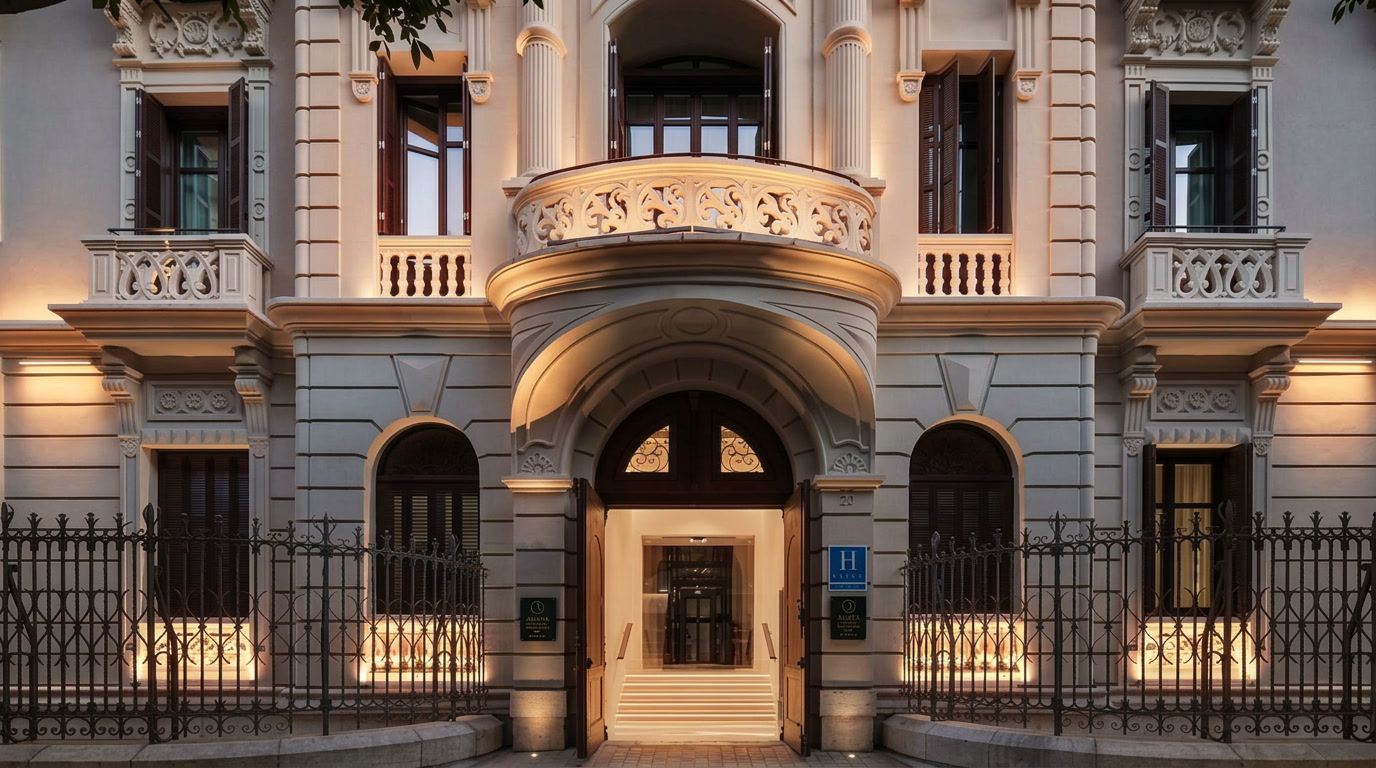
From Ticket Stubs to Cubist Geometry: The Palacio de la Tinta’s Return as Áurea’s Five-Star Anchor in Málaga
A look inside Málaga’s Áurea Palacio de la Tinta: a 1908 railway monument transformed into a 141-room hotel with Cubist-inspired design opposite La Malagueta.
18 OCT 2026
Live from the coast
Related wire dispatches
Sun&Tech by Alhambra Venture Puts 36 Founders Before Investors at FYCMA
The first Málaga Sun&Tech by Alhambra Venture opened at FYCMA on Wednesday, putting 36 founders from across Spain in front of investors, funds and family offices over two days. Mayor Francisco de la Torre said Málaga TechPark has more than 29,000 workers and nearly €4.8 billion in turnover across over 700 companies.
Ten Andalusian Start-Ups to Pitch Investors at Malaga's EEN ScaleUP Forum on 26 November
Ten Andalusian start-ups will present to investors and venture funds at the EEN-Andalucía ScaleUP 2026 forum at ESSCA's Málaga campus on Thursday 26 November. Fifteen of the 31 eligible applicants came from Málaga province, according to organisers Andalucía TRADE and ESSCA.
Talent Land Returns to FYCMA on 24–26 November With an 'AI First' Programme
Talent Land España holds its third Málaga edition at FYCMA from 24 to 26 November under an 'AI First' theme, with science, cybersecurity, investor, creator and gaming tracks, a 16-hour hackathon and a startup hub. Last year's edition registered 12,000 attendees.